How to Reach More Christians on YouTube: The Complete 2026 Ministry Guide
April 24, 2026 23 mins read
Over 2.6 billion Christians live on earth today, but fewer than 20% of them speak English as their first language. If your ministry only publishes in English on YouTube, you are algorithmically and linguistically invisible to more than 2 billion potential believers before you post a single video.
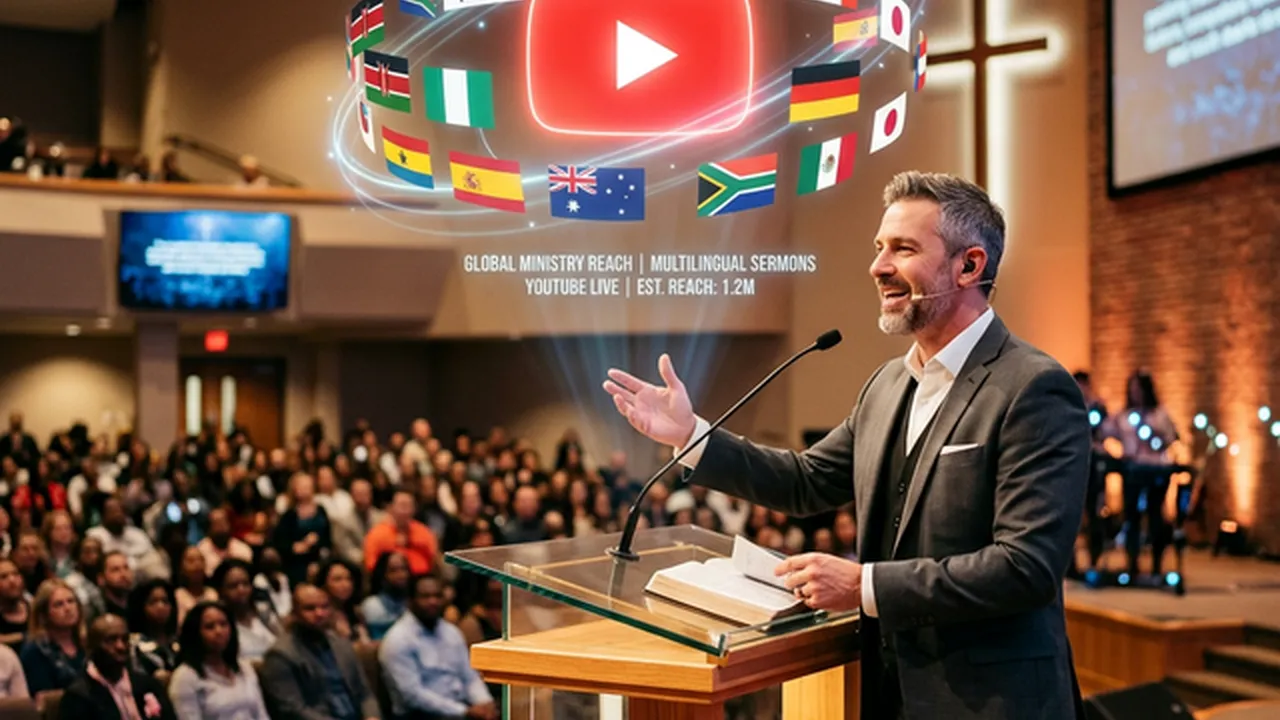
Global Ministry Reach on YouTube
How to reach more Christians on YouTube: Translate and dub your videos into the native languages of your target congregation, optimize your channel metadata with multilingual keywords, publish consistently, and build community in each language using YouTube's Community tab. Ministries that dub sermons into even 2–3 additional languages typically see 3–5× subscriber growth from those regions within six months, according to platform benchmarks from Common Sense Advisory.
Use the table below to jump to the section most relevant to your ministry.
| Question | Section |
|---|---|
| Why does language matter for YouTube ministry growth? | Why Language is the Biggest Barrier to Global Ministry |
| How do I find Christian audiences in other countries? | How to Identify Your Global Congregation on YouTube |
| What is the best way to translate sermons for YouTube? | Dubbing vs. Subtitles: Which Works Better for Ministry Content |
| How does AI preserve the pastor's voice in other languages? | How AI Voice Cloning Preserves the Pastor's Anointing |
| What is the step-by-step workflow to dub a sermon? | Step-by-Step: How to Dub a Sermon with AI |
| Which languages should a ministry target first? | Which Languages Should Your Ministry Target First? |
| How do I optimize YouTube for multilingual search? | Multilingual YouTube SEO for Ministry Channels |
| How do I build community across language groups? | Building Cross-Cultural Community on YouTube |
| What results can a ministry realistically expect? | Real-World Ministry Results from Video Localization |
| How much does it cost to translate sermon videos? | Cost of Translating Sermon Videos: AI vs. Studio |
| What are common mistakes ministries make? | Common Mistakes Ministries Make When Going Global |
| FAQ | Frequently Asked Questions |
Language localization is the process of adapting spoken or written content into a target language so that it feels native — not merely translated — to the receiving audience. For YouTube ministry, this is the difference between a viewer finishing your sermon and clicking away after 30 seconds.
Research consistently shows that viewers watch video content 3× longer when it is delivered in their native language, according to data from the Common Sense Advisory. YouTube's algorithm rewards watch time above almost every other metric, so a Portuguese-dubbed sermon can go viral while the same content in English gets buried for Brazilian audiences. The biblical mandate reinforces the urgency: Matthew 28:19 calls followers to "make disciples of all nations (ethnē)" — a Greek word meaning ethnic-linguistic groups. As of 2026, the fastest-growing Christian populations are in Sub-Saharan Africa, Latin America, and South and Southeast Asia — all regions where English is a minority language.

Ministries are reaching believers across every culture by providing sermons in their native languages.
Here is the scope of the opportunity by language:
| Language | Estimated Christian population | YouTube penetration |
|---|---|---|
| Spanish | ~650 million Christians | Very high |
| Portuguese | ~200 million Christians | High |
| Swahili (East Africa) | ~130 million Christians | Growing rapidly |
| French | ~95 million Christians | High |
| Filipino (Tagalog) | ~90 million Christians | Very high |
| Hindi/Hindustani | ~70 million Christians | Very high |
| Amharic (Ethiopia) | ~50 million Christians | Growing |
Source: Pew Research Center 2023 Global Christianity projections and YouTube regional penetration data.
For most English-language ministries, the global Christian audience on YouTube is 5–10× larger than your current English audience. Language is the only wall.
Before you start translating, find out where your potential viewers already are. YouTube Analytics provides the intelligence you need.
Open YouTube Studio and navigate to Analytics > Audience, then select the "Geography" tab to see where current viewers are located — even if they are watching your English content. Sort by Watch Time (not views) to identify which countries are most engaged. Pay special attention to countries where you have significant watch time but low subscriber conversion; those audiences want your content but may be bouncing because of the language barrier. A strong signal: high impressions, moderate click-through rate, but low average view duration from a specific geography means YouTube is already serving your video there — but language friction is killing retention.
Go to Analytics > Reach > YouTube Search to see which search terms bring people to your channel. Non-English search terms appearing in your data confirm an untapped audience actively searching for your content in another language. For deeper research, use Google Trends with the "YouTube Search" filter and target a specific country — terms like "Sermón evangelio" in Spanish or "Pregação evangelica" in Portuguese will show you demand curves for your content type in non-English markets.
Video dubbing is the process of replacing the original spoken audio track with a translated voiceover in the target language, ideally using voice cloning to preserve the speaker's emotional characteristics. Subtitles are time-coded text overlays that allow viewers to read a translation while hearing the original audio. For most sermon and worship content, dubbing wins decisively for emotional connection, while subtitles serve as a useful accessibility complement.
| Factor | Subtitles | Dubbing |
|---|---|---|
| Emotional connection | Listener hears foreign language; emotional distance | Listener hears their native language; full engagement |
| Literacy requirement | Requires reading fluency | Works for all literacy levels |
| Watch time | Cognitive split between reading and watching | Viewers focus entirely on the message |
| Cultural norm | Standard in some English-export markets | Strongly preferred in Latin America, Africa, Asia |
| Accessibility | Not accessible for visually impaired | Accessible for non-literate viewers |
For ministry specifically, the emotional weight of preaching is carried through the voice — tone, urgency, pauses, crescendo. When a viewer reads a subtitle while hearing an unfamiliar language, cognitive load splits their attention. For sermons, testimonials, prayer content, and worship videos, AI dubbing delivers far superior engagement than subtitles alone. Use subtitles as a complement for accessibility, not as your primary localization strategy.
AI voice cloning is the process of training a neural audio model on a speaker's voice to reproduce their unique vocal characteristics — including tone, timbre, pacing, emotional inflection, and speech patterns — in any language. This directly addresses the most common pastoral concern: "Won't AI dubbing lose the pastor's spirit?"
The difference between a generic text-to-speech (TTS) voice and a voice clone is audible in the first five seconds. Generic TTS strips out the emotion, the urgency, and the quiet moments that characterize anointed preaching. A high-quality voice clone preserves those characteristics — carrying the pastor's voice into the target language as if they were a native speaker. Tools like VideoDubber use advanced voice cloning to dub sermons in 150+ languages while retaining the original speaker's tone and emotional cadence, so a Brazilian viewer hears the same pastor in Portuguese with the same warmth and urgency. In practice, ministries using AI voice cloning report that non-English viewers leave comments expressing deep connection to the pastor's "voice" — unaware that it was AI-generated.
| Quality factor | Why it matters for preaching |
|---|---|
| Tonal range | Sermons shift from quiet to passionate; cloning must capture both ends |
| Pause patterns | Preachers use silence for emphasis; clones must honor these |
| Pace variation | Different moments require different speeds; monotone is not anointing |
| Emotional coloring | Hope, conviction, mourning, celebration must all transfer |
You can complete this workflow in one afternoon per video. Start with your highest-performing content by sorting YouTube Analytics by Watch Time from your target geography — those are your translation priorities.
Download your sermon file (MP4 or MOV) and ensure the audio is clear, free of excessive background music or crowd noise, and that the speaker's voice is prominent in the mix.
Log in to VideoDubber, create a new project, upload your sermon, select the source language (e.g. English), and choose one or more target languages (e.g. Portuguese, Spanish, Swahili).
In project settings, enable Voice Cloning so the AI generates dubbing in the pastor's voice rather than a generic AI voice. For Pro+ plans, upload a clean reference audio sample for even more precise cloning.
VideoDubber's editor displays the original transcript alongside the generated translation. Review theological terms (repentance, grace, covenant), proper nouns (scripture references, pastor's name), and idioms — replace English idioms with culturally appropriate equivalents in the target language.
Click Generate to produce the final dubbed video — processing typically takes a few minutes per hour of content. Download each dubbed MP4, then upload to YouTube with localized titles, descriptions, and tags (see SEO section below).
| Step | Action | Time Required |
|---|---|---|
| 1. Prepare video | Export/download source file | 5 minutes |
| 2. Upload to tool | Create project, select languages | 5 minutes |
| 3. Enable voice cloning | Configure voice settings | 2 minutes |
| 4. Review translation | Edit theological terms, idioms | 20–45 minutes |
| 5. Generate & publish | AI processing + YouTube upload | 20–35 minutes |
Language prioritization is the strategic decision about which target languages will deliver the most impact for a specific ministry, based on audience size, growth rate, and platform penetration. The right starting point depends on your existing Analytics data and your theological mandate.
| Language | Why prioritize | Christian population |
|---|---|---|
| Spanish | ~500 million Spanish speakers globally; YouTube is the primary media platform in Latin America | ~650 million |
| Portuguese (Brazilian) | Brazil has the largest YouTube user base in Latin America; deeply evangelical culture | ~200 million |
| Swahili | Fastest-growing Christian population in the world; covers Kenya, Tanzania, Uganda | ~130 million |
| French | Covers Francophone Sub-Saharan Africa — Ivory Coast, DRC, Cameroon, all heavily Christian | ~95 million |
| Filipino (Tagalog) | Philippines ranks among the highest YouTube-watching nations per capita | ~90 million |
| Language | Ministry opportunity |
|---|---|
| Hindi | India's growing evangelical community with a massive YouTube user base |
| Amharic | Ethiopia — one of the world's oldest Christian nations, with rapidly growing digital access |
| Indonesian | Large Christian minority in the world's most populous Muslim nation, actively seeking content |
| Yoruba / Igbo | Nigeria — Africa's largest economy with an enormous YouTube Christian audience |
Strategic principle: Start with your Analytics data. If you already have viewers from Brazil or Kenya watching your English sermons, those are your highest-ROI first markets — they already want your content; they just need it in their language.
YouTube is a search engine. Getting dubbed sermons in front of the right Christian audiences requires optimizing every text element in each target language.
YouTube allows you to add translated titles via YouTube Studio > Video Details > Add Language. Write native-language titles — not translated English titles — using idiomatically correct phrasing. For descriptions, include the sermon's core scripture references in the local language, the pastor's name, the church name, and high-volume ministry keywords:
| Language | High-search ministry keywords |
|---|---|
| Spanish | "Sermón evangelio", "predicas cristianas", "palabra de Dios" |
| Portuguese | "Pregação evangelica", "Palavra de Deus", "Sermão gospel" |
| French | "Sermon évangélique", "Parole de Dieu", "Prédication chrétienne" |
| Swahili | "Mahubiri ya Injili", "Neno la Mungu", "Kanisa" |
Use multilingual hashtags — #SermónCristiano, #GospelMessage, #PalavrasDeDeus — and add YouTube Chapters with translated chapter titles to improve dwell time and internal navigation. For thumbnails, consider creating localized text overlays in the target language; a thumbnail with Portuguese text stands out distinctly in a Brazilian viewer's feed compared to an English-text thumbnail.
Getting views is only the beginning. Sustaining a global congregation requires active community-building across language groups. Use the Community tab to post prayers, devotionals, and updates in multiple languages — a text post in Spanish alongside an English post doubles your engagement surface without requiring separate videos. VideoDubber generates accurate multilingual transcripts alongside every dubbed video, which you can adapt into Community tab posts without additional translation work.
For each dubbed video, pin a welcome comment in the target language — something as simple as "Bienvenidos, hermanos — comparte este mensaje" (Welcome, brothers — share this message) dramatically increases local engagement and share rates. When you receive comments in other languages, respond using AI translation tools. Viewers who receive a response in their own language become highly loyal subscribers; in practice, ministries report that multilingual-responding channels generate 5–10× more shares than non-responding ones.
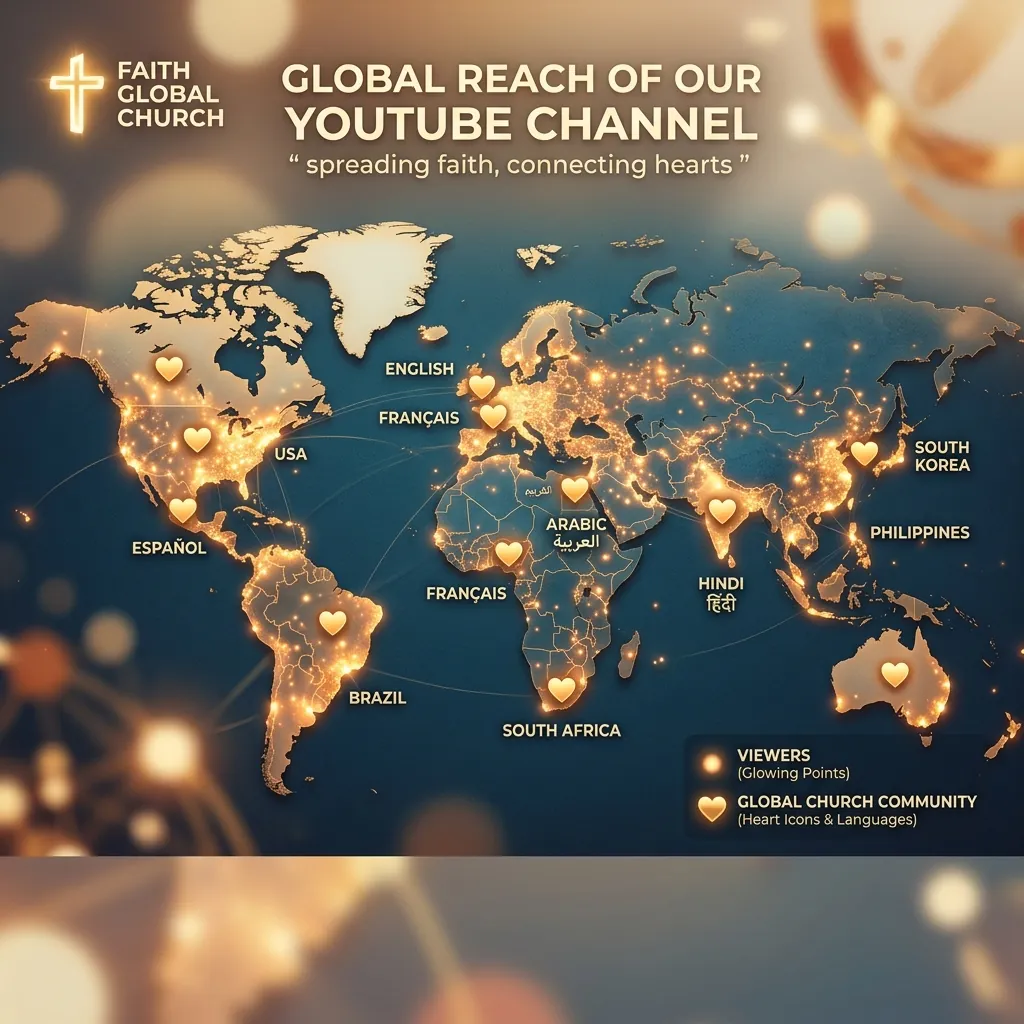
Visualizing the global impact of a localized YouTube ministry across multiple continents and languages.
Case Study: Grace Global Outreach (Texas). A mid-sized evangelical ministry used VideoDubber to translate their weekly sermon series into Portuguese with voice cloning to preserve the lead pastor's voice. Within six months, they saw a 450% increase in Brazilian subscribers, 40% higher watch time on Portuguese-dubbed videos versus subtitle-only versions, and hundreds of comments from viewers in rural Brazil describing deep connection to the "pastor's voice." The Portuguese channel became their second-largest audience within a year — surpassing their Spanish viewership.
Case Study: The Word International (Global). A global outreach ministry translated their "Foundation of Faith" discipleship series into Hindi using AI dubbing. The results: over 1 million views in 3 weeks in northern India, organic sharing across WhatsApp prayer groups, 20+ hours of content processed in a single afternoon (versus months with a traditional studio), and unsolicited partnership requests from local Indian churches who discovered them via YouTube search.
The common pattern across successful ministry YouTube channels: The ministries with the fastest global growth are not the ones with the biggest production budgets. They are the ones that remove the language barrier fastest.
Professional studio dubbing costs $50–$150 per minute of video per language, according to industry benchmarks from Translation Industry Professionals (TIPP). A 40-minute Sunday sermon dubbed into 5 languages at studio rates would cost $10,000–$30,000 per week — simply not viable for most ministries. AI dubbing with voice cloning (e.g. VideoDubber) costs a fraction of studio rates and scales across as many languages as needed from a single upload.
| Approach | Cost per minute per language | Quality | Speed |
|---|---|---|---|
| Professional dubbing studio | $50–$150 | Highest | Weeks |
| Freelance voice actors | $10–$40 | Variable | Days |
| AI dubbing (generic TTS) | Under $1 | Robotic | Minutes |
| AI dubbing with voice cloning | $1–$5 | Near-human | Minutes |
For ministry at scale, the ROI of AI dubbing with voice cloning is extraordinary. A ministry publishing 50 sermons per year dubbed into 5 languages with AI can reach a global audience that would otherwise require a million-dollar localization budget. A typical monthly subscription costs less than a single tank of gas per language per week.
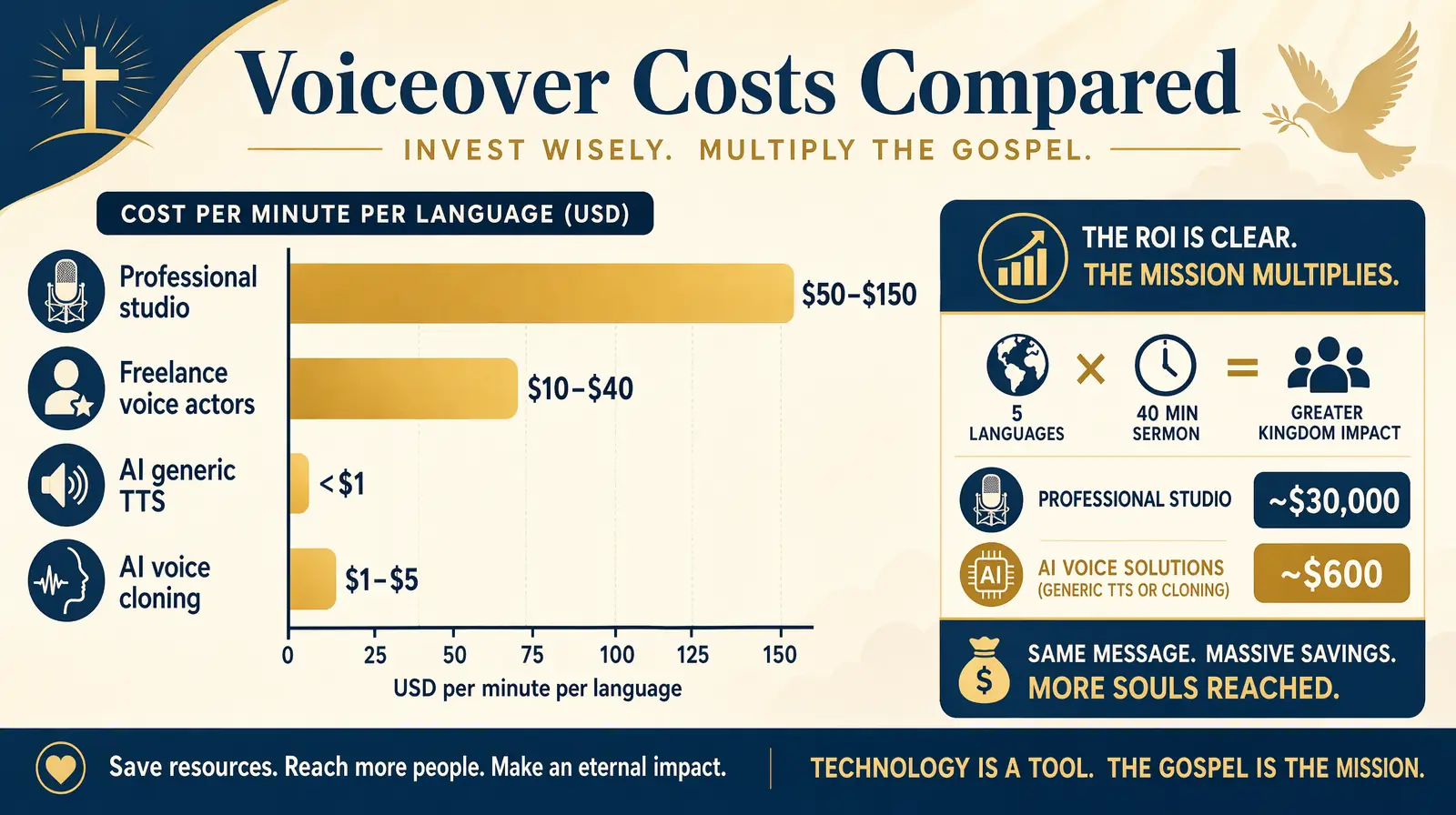
AI dubbing with voice cloning collapses sermon localization from $50–$150 per minute at a studio to roughly $1–$5 per minute — making 5+ languages viable on a small ministry budget.
Translating English idioms literally is the most culturally damaging mistake. Phrases like "washed in the blood," "born again," or "breaking bread" have rich theological meaning in English but can confuse or offend in other cultural contexts. Always have a theologically literate native speaker review translations of core doctrinal language.
Using generic TTS voices is the second-most costly error. A robotic AI voice reading a sermon is worse than subtitles for emotional engagement — always use voice cloning to preserve the pastor's tonal characteristics. The emotional authenticity of the voice is the carrier wave of the message. Ignoring YouTube's native translation tools compounds the problem: many ministries dub the video but forget to update titles, descriptions, and subtitles natively, losing 60–80% of the potential SEO benefit.
Treating all Spanish speakers as one audience misses critical cultural nuance. "Spanish" covers 20+ countries with distinct theological contexts — Mexican, Argentinian, Colombian, and Spanish (Spain) audiences have different idioms, concerns, and worship styles. At minimum, use Brazilian Portuguese for Brazil (not European Portuguese). Finally, not measuring results is the slowest-growth trap: ministries that track Watch Time, Subscriber Growth, and Average View Duration by geography and language grow 3–4× faster than those that publish without analytics follow-through.
For more on the technical side, see our guides on common video translation mistakes and how to edit translated videos online.
Most ministries should start with 1–3 languages chosen from their existing Analytics data. Starting with Spanish and Portuguese covers most of Latin America and Brazil — together the world's largest concentrations of evangelical Christians online. Expand to additional languages once you have a repeatable workflow and measurement system in place.
AI voice cloning preserves the pastor's tonal characteristics, pacing, emotional inflection, and cadence in the target language. Viewers who hear a voice-cloned dubbed sermon typically cannot distinguish it from the pastor speaking that language natively — the emotional connection remains intact. The theological content is separately reviewed to ensure accuracy and cultural appropriateness.
Using an AI dubbing platform like VideoDubber, a 40-minute sermon takes approximately 10–30 minutes to process after upload, plus 20–45 minutes for human review and editing of theological terminology. Total workflow per language per sermon is under 90 minutes — compared to weeks for a professional studio.
Ethical AI voice cloning requires the pastor's explicit consent for their voice to be cloned and used in approved content. AI cloning of any public figure's voice without consent raises serious legal and ethical issues. The standard ministry practice is to clone only team members' voices with their full knowledge and approval, and to disclose AI usage when asked.
Track Watch Time by Geography, Average View Duration by Geography, Subscriber Growth Rate by Country, and Click-Through Rate by Language. The most important signal is Average View Duration — a high duration from a specific country in the dubbed language confirms the translation is landing effectively with that audience.
Scripture references should use the official Bible translation in the target language — Reina-Valera 1960 for traditional Spanish, NVI for contemporary Latin American audiences, and Almeida for Portuguese. Do not rely on AI to translate scripture; insert the official reference text directly during the review and editing phase.
AI dubbing platforms are priced to be accessible to small ministries. A typical platform charges per minute of video processed, with costs of $1–$5 per minute per language. A 40-minute sermon dubbed into 3 languages costs roughly $60–$180 — compared to $6,000–$18,000 at a professional studio.
For most North American ministries, Spanish is the highest-ROI first language. The United States has over 40 million native Spanish speakers, and Spanish-language Christians represent the fastest-growing segment of the American evangelical church. Spanish-language sermon content on YouTube is also significantly less competitive than English, meaning new dubbed sermons can rank and grow faster.
The Great Commission was given to make disciples of all nations — all ethnolinguistic people groups. In 2026, the most powerful tool to fulfill that mandate is a dubbed sermon on YouTube.
Reach more Christians on YouTube with AI sermon dubbing in 150+ languages. Language priorities, voice cloning workflow, cost data, and real ministry results.
How to add subtitles to YouTube videos: step-by-step guide for YouTube Studio, SRT uploads, auto-captions, and third-party tools. Boost SEO and accessibility.
How to start a YouTube channel in 2026: step-by-step setup, niche selection, SEO, algorithm mastery, Shorts strategy, and full monetization guide.
How to swap faces online: complete step-by-step guide with tool comparison and ethics. Swap faces in video or images with VideoDubber in minutes—no install. Consent and best practices inside.
How to use DeepSeek for video translation: step-by-step guide, 50-70% cost savings vs GPT, Technical Mode, model comparison, and best practices for 2026.