
Is CapCut Banned? Complete Global Status, Data Risks, and Best Alternatives (2026)
April 24, 2026 31 mins read
CapCut's legal situation has become one of the most-watched regulatory stories in the creator economy. The app went from being the world's fastest-growing video editor to facing a brief ban in the United States, a €530 million EU fine, an active class-action lawsuit, and permanent removal in India — all within an 18-month period. For the 500 million creators and businesses that depend on CapCut daily, understanding exactly where the app stands — and what risks remain — is no longer optional.
CapCut is a free video editing application developed by ByteDance, the same Chinese parent company that owns TikTok. As of 2026, CapCut has over 500 million monthly active users globally and is reinstated in the United States after a brief ban on January 18–20, 2025. However, its future in the US and across Europe remains legally uncertain, with unresolved PAFACA divestiture requirements and an active GDPR compliance deadline in the EU that could force operational changes or suspension within the year.
This guide covers every jurisdiction's current status, the specific privacy and legal issues driving the global scrutiny, what the identified risks mean for creators and businesses, and the strongest alternatives available in 2026 — including tools that eliminate data sovereignty concerns entirely.
CapCut — 500 million monthly users globally; legal scrutiny in the US, EU, and India as of 2026
| Question | Section |
|---|---|
| Is CapCut banned in the US right now? | CapCut's US Status: Timeline and Current Standing |
| Which countries have banned or restricted CapCut? | Global Ban Status by Country (2026) |
| Why is CapCut under investigation? | Why CapCut Faces Global Scrutiny |
| What data does CapCut actually collect? | What Data Does CapCut Collect? |
| What did the EU fine ByteDance for? | The €530 Million EU Fine Explained |
| What does the June 2025 Terms of Service change mean? | The June 2025 Terms of Service Changes |
| What are the best CapCut alternatives? | Best CapCut Alternatives in 2026 |
| What should creators do right now? | Action Plan for Creators and Businesses |
| Common questions about CapCut's status | Frequently Asked Questions |
CapCut's US status has moved through three distinct phases since 2024, and understanding the full timeline is essential for creators making platform decisions. The app was available without restriction through most of 2024, then subject to an abrupt two-day ban in January 2025, then reinstated under an executive order that deferred — but did not resolve — the underlying legal question. As of April 2026, CapCut remains accessible in US app stores, but the structural compliance requirements that triggered the original ban have not been satisfied.
| Date | Event |
|---|---|
| June 2023 | Class-action lawsuit filed in US District Court alleging illegal collection of biometric data, photos, videos, and location without consent |
| January 18, 2025 | CapCut banned in the United States under PAFACA (Protecting Americans from Foreign Adversary Controlled Applications Act) |
| January 20, 2025 | CapCut reinstated after executive order postponing PAFACA enforcement for 75 days |
| March 2025 | US District Court ruling that CapCut violated California privacy standards |
| May 2025 | EU issues €530M fine against ByteDance for GDPR violations; CapCut ordered to comply within 6 months |
| June 2025 | CapCut updates Terms of Service, granting perpetual irrevocable license to all user content |
| Late 2025 | ByteDance announces plans for "CapCut US" — a localized version with US-based data management |
| 2026 (current) | CapCut available in US but operating under ongoing legal review; future uncertain |
CapCut is currently available in the United States following reinstatement after the January 2025 executive order. However, ByteDance has not yet completed the structural separation that would fully satisfy PAFACA requirements. The app's long-term availability depends on either a ByteDance divestiture of CapCut's US operations or a further legislative resolution — neither of which has been finalized as of April 2026. The "CapCut US" localization initiative announced in late 2025 represents ByteDance's attempt to preempt a permanent ban, but the proposal has not yet received regulatory sign-off from CFIUS or Congress.
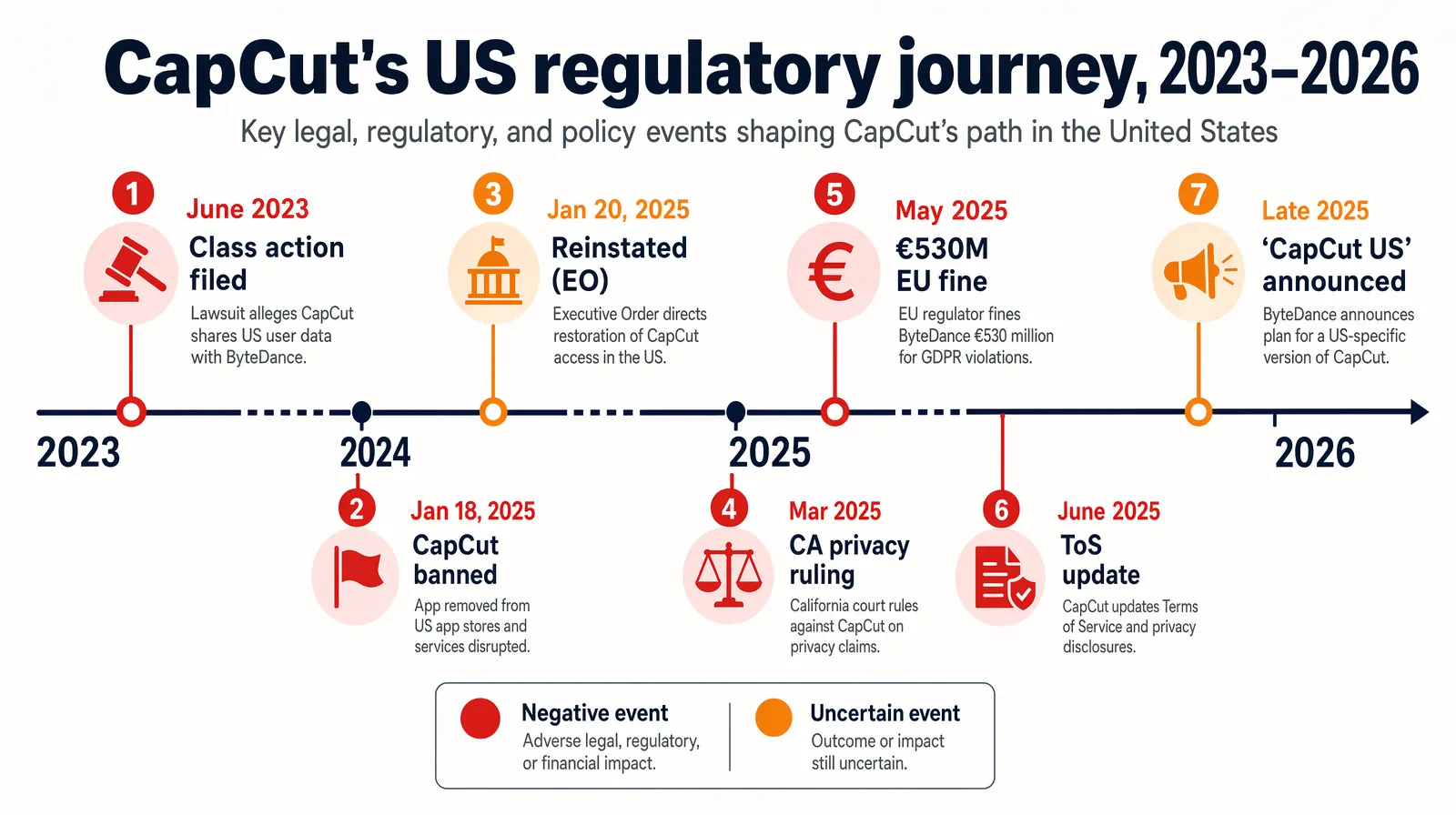
CapCut's US legal journey spans three years and six major events — a class-action lawsuit, a 48-hour ban, an executive order, and ongoing PAFACA review.
The executive order that reinstated CapCut on January 20, 2025, was a procedural delay, not a legal clearance. Under PAFACA, an application owned by a "foreign adversary controlled" company remains subject to ban unless the company completes a qualified divestiture — meaning ByteDance must structurally separate CapCut's US operations, data, and decision-making from Chinese parent company oversight. ByteDance has contested both the underlying law and the divestiture requirement in federal court, and those legal proceedings are ongoing. In practice, CapCut's continued US availability in 2026 reflects a political and regulatory standoff rather than a resolved legal status.
According to cybersecurity researcher Dr. Emily Chen of MIT: "The combination of mass data collection and opaque algorithmic architecture creates regulatory risks that are unlikely to be resolved without structural corporate changes." This assessment aligns with the view of most PAFACA proponents in Congress, who argue that cosmetic localization efforts are insufficient substitutes for genuine operational separation.
| Country | Status | Details |
|---|---|---|
| 🇺🇸 United States | ⚠️ Available (under review) | Banned Jan 18, reinstated Jan 20, 2025; future uncertain under PAFACA |
| 🇮🇳 India | ❌ Permanently Banned | Banned June 2020 alongside 58 other Chinese apps; no path to reinstatement |
| 🇨🇳 China | 🚫 Not Available | CapCut not available in Chinese app stores; separate domestic version exists |
| 🇪🇺 EU (27 states) | ⚠️ Heavily Scrutinized | €530M fine May 2025; GDPR compliance order with 6-month deadline |
| 🇬🇧 United Kingdom | 🔓 Available | No ban; Parliament reviewing ByteDance data and influence risks |
| 🇨🇦 Canada | 🔍 Under Review | Privacy commissioners reviewing ByteDance data handling |
| 🇦🇺 Australia | ⚠️ Restricted (Gov Devices) | Government employees barred from ByteDance apps on work devices |
| 🇩🇪 Germany | ⚠️ Under GDPR Review | Local privacy authorities monitoring data collection practices |
| 🇫🇷 France | ⚠️ GDPR Scrutiny | Data commissioners evaluating user consent transparency |
| 🇮🇹 Italy | ⚠️ Privacy Warning | Users advised to review terms carefully; app still available |
| 🇯🇵 Japan | 🔓 Available | Political voices urging caution; no official restriction |
| 🇧🇷 Brazil | 🔓 Available | Widely used; no formal concerns raised |
| 🇰🇷 South Korea | 🔓 Available | Minor public privacy debates; no restrictions |
| 🇸🇬 Singapore | 🔓 Available | Government encourages digital literacy; no ban |
| 🇲🇾 Malaysia | 🔓 Available | High adoption among influencers and students |
| 🇲🇽 Mexico | 🔓 Available | High adoption among Gen Z creators |
| 🇿🇦 South Africa | 🔓 Available | Growing in popularity; no restrictions |
| 🇮🇩 Indonesia | 🔓 Available | Among top video editors in the country |
| 🇮🇷 Iran | ❌ Restricted | Access blocked due to foreign tech controls |
| 🇰🇵 North Korea | ❌ Inaccessible | Internet heavily restricted; no foreign apps accessible |
The global picture reveals a clear bifurcation: Western democracies with strong data-protection frameworks (the US, EU, UK, Canada, Australia) are actively scrutinizing or restricting CapCut, while markets in Southeast Asia, Latin America, and Africa continue unrestricted adoption. This divide reflects differing regulatory capacity rather than differing risk — the underlying data collection practices are identical in every market where CapCut operates.
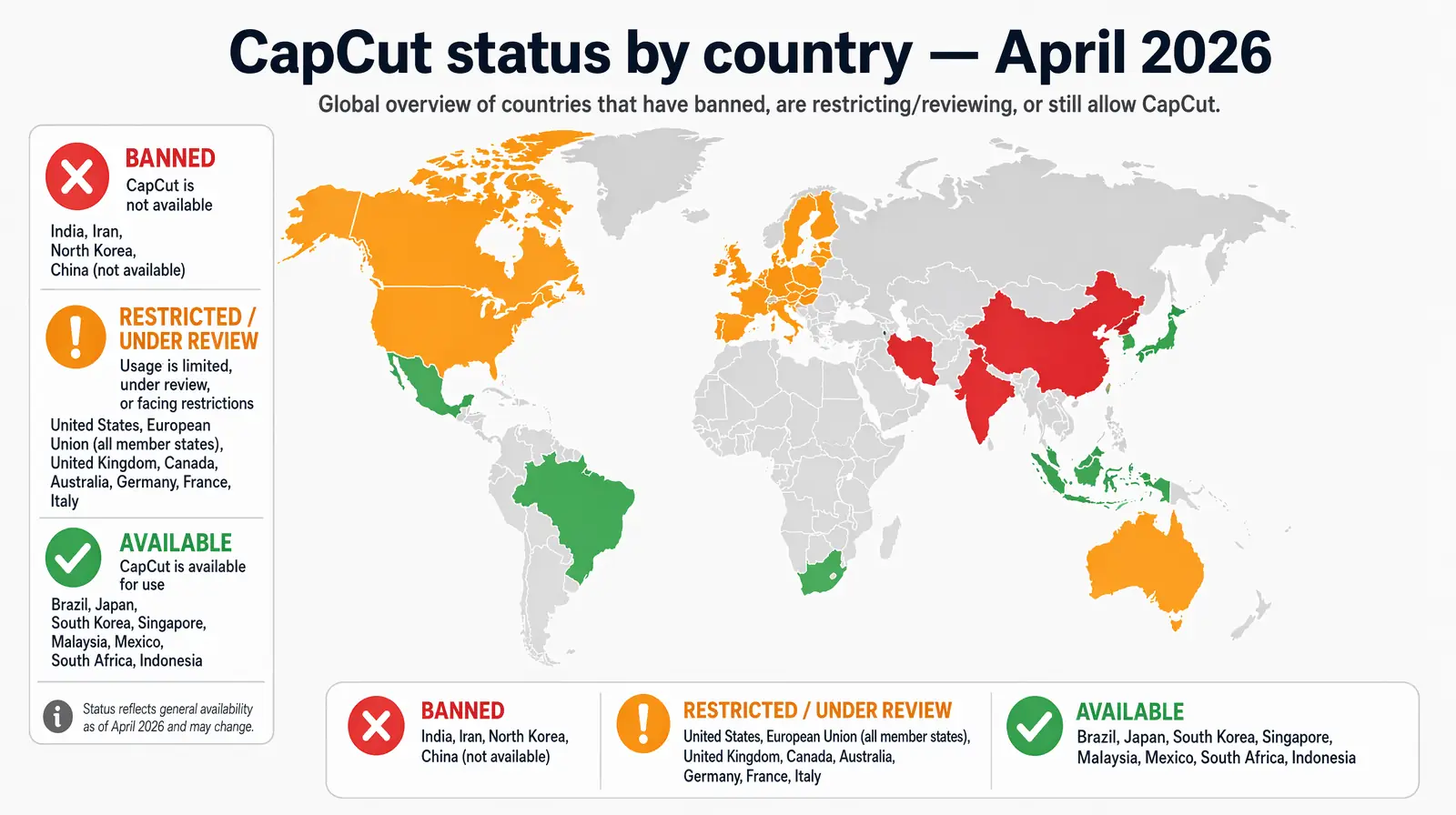
CapCut's 2026 global status splits cleanly along data-sovereignty lines — red for banned markets, yellow for active review, green for unrestricted adoption.
CapCut is a subsidiary of ByteDance, a Chinese technology company founded in 2012 and headquartered in Beijing. The scrutiny it faces is not primarily about the editing tool itself — it is about ByteDance's data handling practices and the legal obligations that Chinese companies have under China's National Intelligence Law (Article 7), which can require companies to cooperate with Chinese state security agencies upon request, without the ability to disclose that cooperation to foreign users or governments. This legal architecture is the foundational concern driving regulatory action across every affected jurisdiction.
Three distinct categories of concern have driven the regulatory actions against CapCut, each reflecting a different layer of risk — from where data physically resides, to how it can be commercially exploited, to how a foreign government can compel a company to hand it over:
The central legal concern is where user data is stored and who has legal access to it. Regulatory investigations across multiple jurisdictions have established that European user data was stored on Chinese servers despite prior assurances from ByteDance that data was stored locally or in Singapore. The Irish Data Protection Commission's investigation — which resulted in the €530M fine — found that ByteDance "failed to verify, guarantee, or demonstrate that the data protection standards equivalent to those guaranteed within the EU are applied to personal data transferred to China." For US lawmakers, the concern is parallel: under China's National Intelligence Law, ByteDance can be compelled to provide Chinese government agencies access to user data, and 500+ million CapCut users' data — including biometric information collected by facial recognition features — potentially falls within this scope.
CapCut's June 2025 Terms of Service update granted the company a perpetual, irrevocable license to use all user content, including content that was never published or shared publicly (unpublished drafts), users' names, images, and likenesses for sponsored content, and rights that survive account deletion. Per the updated ToS, CapCut can use, modify, reproduce, distribute, and create derivative works from any content created in the app — even content the user never shared — without compensation and without further permission. For commercial creators and brand teams, this is a material intellectual property risk that goes beyond the data sovereignty concern.
The US PAFACA legislation classifies ByteDance as a "foreign adversary controlled application," placing it in the same regulatory category as companies operating under the direct influence of adversary foreign governments. This is the legal basis for the January 2025 ban, which was temporarily suspended by executive order but not permanently resolved. PAFACA was enacted with broad bipartisan support, reflecting a congressional consensus that the national security risk posed by Chinese government access to mass behavioral and biometric data on American citizens is distinct from ordinary commercial privacy concerns.
Ming Zhao, Senior Analyst at Bernstein, noted in 2026: "This isn't just about one app — it's about the entire China-linked tech ecosystem and how Western regulators draw the line between commercial activity and national security risk." The CapCut precedent is being closely watched by regulators assessing other ByteDance products and Chinese-owned platforms that collect sensitive user data at scale.
CapCut data collection is significantly broader than most users realize when they first install the app. According to court documents from the June 2023 class-action lawsuit filed in US District Court and the EU GDPR investigation by the Irish Data Protection Commission, CapCut collects the following categories of user data — many of which users are not explicitly prompted to consent to during onboarding:
| Data Category | What Is Collected | Risk Level |
|---|---|---|
| Photos and videos | All media accessed by the app, including unpublished drafts | High |
| Biometric data | Facial geometry, voice patterns from Face Swap and voice features | Very High |
| Location data | GPS coordinates and location history | High |
| Device information | Installed apps, running processes, device identifiers | Medium |
| Clipboard contents | Text copied to device clipboard while app is open | Medium |
| Browsing history | Web activity tracked via in-app browser | High |
| Keystroke patterns | Input patterns for behavioral profiling | High |
The biometric data collection is the most legally significant concern. Facial geometry data collected by features like Face Swap is considered a biometric identifier under US state privacy laws including Illinois BIPA (Biometric Information Privacy Act) and California CCPA, as well as EU GDPR. Collecting and transferring this data to Chinese servers without explicit, informed consent is the core of the ongoing class-action lawsuit — and the primary reason the June 2023 case has survived multiple motions to dismiss. The class action, which covers tens of millions of US users, alleges that CapCut's data collection practices constitute illegal surveillance under both federal and state law.
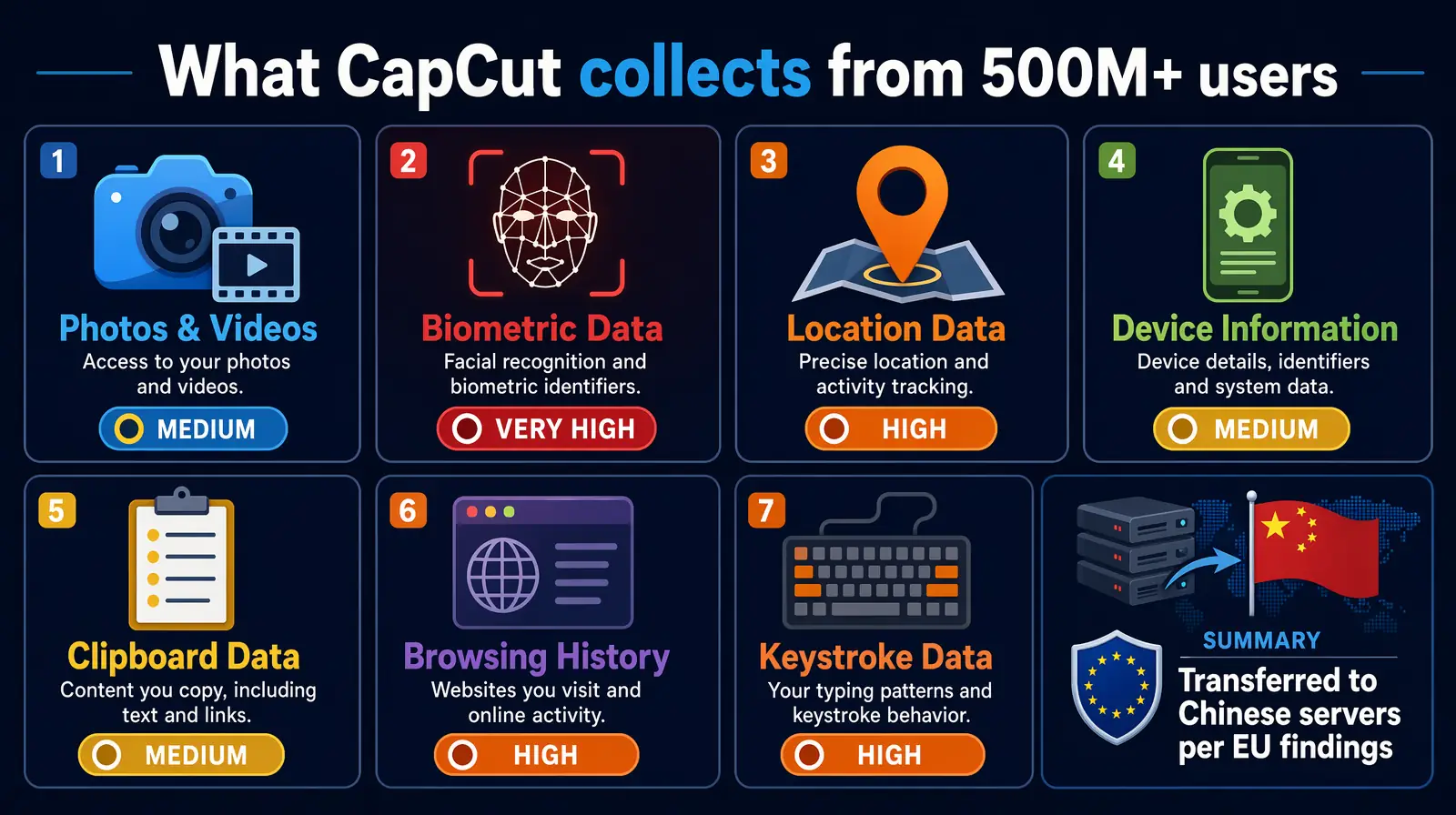
CapCut collects seven broad categories of user data — biometric and behavioral data are the highest-risk items under US and EU privacy law.
In May 2025, the Irish Data Protection Commission (acting as the EU's lead data protection authority for ByteDance under GDPR's one-stop-shop mechanism) issued a €530 million ($600 million) fine — one of the largest GDPR penalties ever recorded, second only to Meta's €1.2 billion fine in 2023. The investigation, which began in 2021 following whistleblower disclosures about ByteDance's data infrastructure, examined both TikTok and CapCut, which share a common backend data architecture under ByteDance's corporate umbrella.
The Irish DPC's investigation, which was among the most technically detailed GDPR enforcement actions to date, found that ByteDance committed four distinct violations:
ByteDance was given a 6-month compliance deadline to either stop transferring EU user data to China or demonstrate equivalent data protection through an approved transfer mechanism. Failure to comply could result in suspension of EU data processing — effectively forcing CapCut to cease operating across all 27 EU member states. As of April 2026, ByteDance has disputed portions of the fine in the Irish High Court while simultaneously working toward a technical compliance solution. The outcome of both the litigation and the compliance effort will determine whether CapCut remains available in Europe beyond mid-2026.
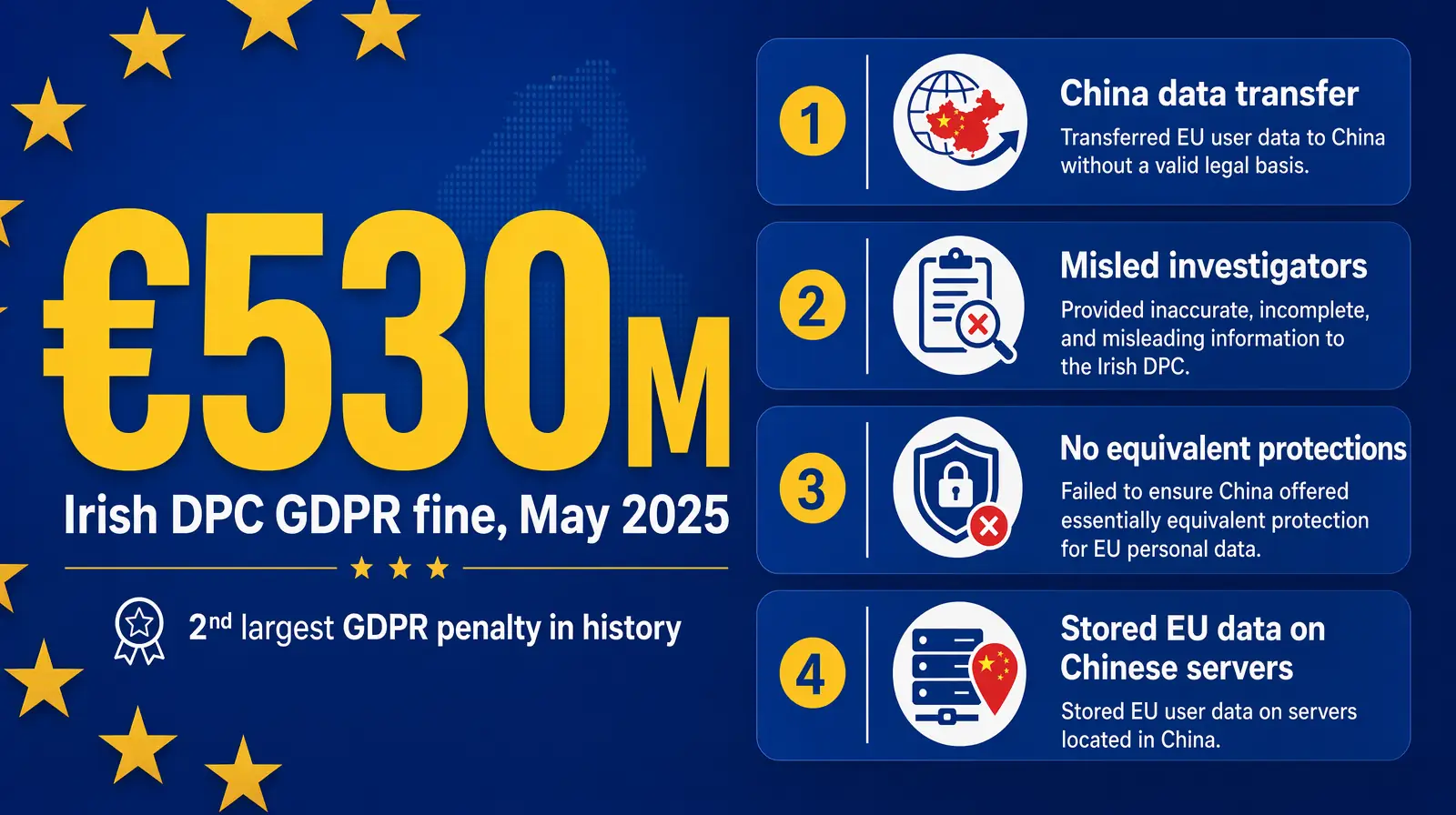
The €530M Irish DPC fine hinges on four distinct GDPR violations — with unauthorized China data transfers and misleading investigators driving the penalty highest.
The June 2025 ToS update is arguably the most directly impactful change for creators who use CapCut for commercial content. Unlike the data sovereignty issues — which primarily affect where your data is stored and who can access it — the ToS change affects your intellectual property rights directly and immediately. Any creator or brand team using CapCut for commercial, branded, or sponsored content should treat the June 2025 changes as a material contract modification, not a routine update.
| Before June 2025 | After June 2025 |
|---|---|
| Limited license to user content for service operation | Perpetual, irrevocable, worldwide license to all content |
| Covered published content only | Covers all content including unpublished drafts |
| No explicit likeness rights | Explicit rights to use name, image, likeness for sponsored content |
| Rights revocable upon account deletion | Rights survive account deletion |
| No commercial exploitation clause | Can use content for commercial purposes without compensation |
For individual creators, any video you create in CapCut — including content you start but never publish, and content created before you close your account — can be used by ByteDance for commercial purposes including sponsored advertising, AI model training, and distribution across third-party platforms. Your name, image, and likeness can appear in ByteDance-sponsored content without your consent or financial compensation. Critically, these rights cannot be revoked by deleting your account — the ToS explicitly states the license "survives account deletion."
For businesses and brand teams, the implications are even more significant. Any brand asset, commercial video, product demonstration, or confidential creative work produced in CapCut is now subject to CapCut's perpetual commercial license. This creates real intellectual property and trade secret risk for companies that use CapCut for branded content production. Legal teams at major agencies began issuing CapCut usage restrictions following the June 2025 ToS update, and several Fortune 500 companies have prohibited the use of CapCut for commercial content creation entirely.
| Feature | VideoDubber.ai | CapCut | Premiere Rush | DaVinci Resolve 20 | Canva Video | YouCut | OpenShot |
|---|---|---|---|---|---|---|---|
| AI Dubbing (150+ langs) | ✅ Voice Clone | ❌ | ❌ | ❌ | ❌ | ❌ | ❌ |
| Auto-Captions | ✅ | ✅ | ✅ | ✅ (AI) | ✅ | ❌ | ❌ |
| AI Effects | Limited | 50+ | 12 | 8 | 25 | 15 | Limited |
| Cloud Backup | ✅ | ❓ | ✅ (Encrypted) | ✅ | ✅ | ❌ | ❌ |
| Data stored in China | ❌ | ✅ (Confirmed) | ❌ | ❌ | ❌ | ❌ | ❌ |
| ToS perpetual license | No | Yes (June 2025) | No | No | No | No | No |
| Royalty-Free Music | ❌ | 1,000+ | 500+ | 300+ | 3,000+ | 200+ | ❌ |
| Watermark | ❌ | ❌ | ❌ (Paid) | ❌ | ✅ (Free tier) | ❌ | ❌ |
| Platform | Web | Mobile | Mobile | Desktop | Web/Mobile | Mobile | Desktop |
| Price | Paid plans | Free | $9.99/mo | Free/$295 | $12.99/mo | Free/$3.99 | Free |
Best for multilingual content and international reach: VideoDubber.ai — AI dubbing in 150+ languages with voice cloning and lip-sync. For creators who want to replace CapCut's ease of use while simultaneously building global audience reach, VideoDubber adds a capability CapCut never offered: turning one master video into 10 or more language versions automatically, without re-recording. Tools like VideoDubber use AI voice cloning and lip-sync to convert a single video into dubbed versions across 150+ languages, enabling creators to scale internationally at a fraction of traditional localization cost.
Best free mobile editor without data concerns: YouCut — no watermark even on the free tier, no known data transfer concerns, and a straightforward editing workflow that closely mirrors CapCut's mobile UX. For creators who primarily use CapCut for quick mobile edits and social media clips, YouCut is the most frictionless migration path.
Best professional desktop editor: DaVinci Resolve 20 — industry-standard color grading, AI-powered audio cleanup (DaVinci Resolve's FairlightAI), automatic scene detection, and a free tier that rivals most paid professional tools. No data sovereignty concerns, no perpetual content license, and no Chinese ownership. For creators who use CapCut for polished long-form content, DaVinci Resolve 20 is the professional upgrade.
Best for business and brand teams: Canva Video — integrates with the broader Canva design suite, offers strong template libraries, easy multi-user collaboration, and enterprise-grade data protection under its Terms of Service. No China data transfer issues. For marketing teams that create branded video alongside other design assets, Canva's unified workflow is more efficient than a standalone video editor.
Best open-source option: OpenShot — cross-platform (Windows, macOS, Linux), unlimited tracks, completely free and open-source, with no privacy concerns by design. For educators, non-profits, and developers operating under strict data governance requirements or tight budgets, OpenShot eliminates both cost and compliance risk without sacrificing core editing capability.
For creators building international audiences, simply replacing CapCut with another editing app is a lateral move that addresses the compliance problem but doesn't improve your content strategy. VideoDubber offers a genuine capability upgrade: it takes videos created in any editor and translates them into 150+ languages with AI voice cloning and natural lip-sync. Creators who migrate from CapCut to a combination of Canva Video or YouCut for editing and VideoDubber for multilingual translation gain both data safety and a competitive international reach advantage that CapCut — even at its best — could never provide.
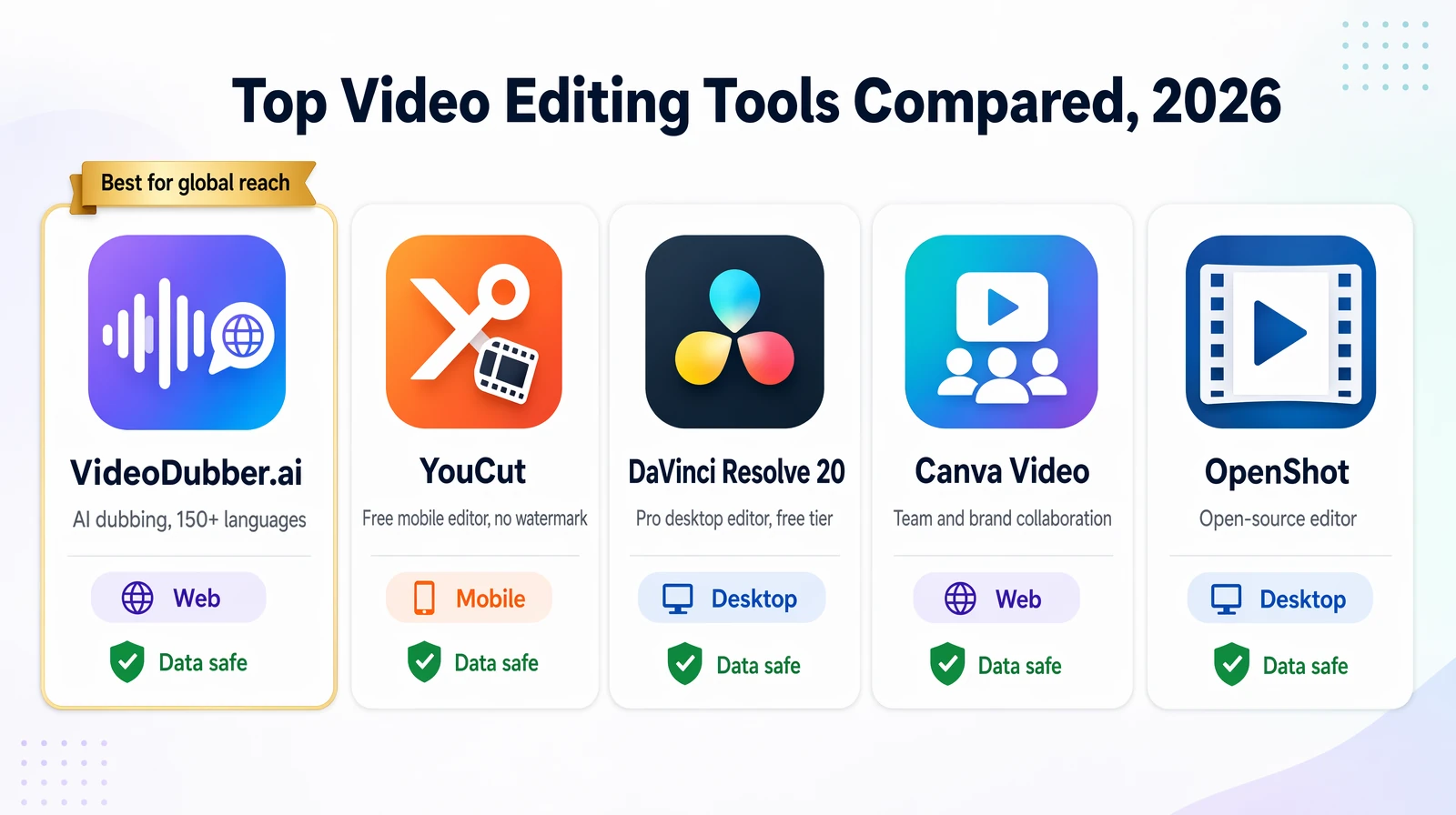
Five strongest CapCut alternatives mapped by platform, data safety, and standout capability — VideoDubber adds multilingual reach none of the others offer.
For classroom and institutional settings, switch to WeVideo or Canva for Education — both platforms offer free education tiers with strong data protection policies, compliance with FERPA and COPPA requirements for student data, and no data sovereignty concerns. CapCut's collection of biometric data (facial recognition features) is particularly problematic in educational contexts involving minors, where COPPA and state privacy laws impose stricter consent and data minimization requirements.
CapCut is currently available in the United States as of April 2026, but its legal status remains unresolved. The app was briefly banned on January 18, 2025, under the PAFACA legislation, then reinstated two days later following an executive order that delayed enforcement. The underlying PAFACA divestiture requirement — which would require ByteDance to structurally separate CapCut's US operations — has not been completed. CapCut's continued US availability in 2026 reflects a political standoff, not a regulatory clearance.
India permanently banned CapCut in June 2020, alongside 58 other Chinese-owned applications, citing national security and data sovereignty concerns following border tensions between India and China. The ban was issued under Section 69A of the Information Technology Act, which gives the Indian government broad authority to block apps that threaten national security or public order. Unlike the US situation, there is no legislative pathway for reinstatement in India, and ByteDance has not pursued legal challenges to the ban in Indian courts.
According to court documents and EU investigation findings, CapCut collects biometric data (facial geometry and voice patterns via Face Swap and voice features), GPS location history, browsing history via its in-app browser, clipboard contents, device identifiers including installed app lists, and all media files accessed by the app — including unpublished drafts. The biometric data collection and confirmed transfer to Chinese servers is the most legally significant concern, as it directly violates US state biometric privacy laws (Illinois BIPA, California CCPA) and EU GDPR's special-category data protections.
Under CapCut's June 2025 Terms of Service, ByteDance holds a perpetual, irrevocable, worldwide license to use all content created in the app — including unpublished drafts and content from accounts that have been deleted. The updated ToS explicitly grants rights to use your name, image, and likeness in sponsored content without additional consent or compensation. These rights apply to content created after accepting the updated terms. Creators who accepted the June 2025 ToS update by continuing to use the app have contractually granted these rights regardless of whether they read the notification.
In May 2025, the Irish Data Protection Commission fined ByteDance (CapCut's parent company) €530 million — one of the largest GDPR penalties in history — for transferring European user data to China without adequate protection, providing misleading information to investigators during the inquiry, and storing European data on Chinese servers contrary to prior representations. ByteDance was ordered to bring EU data operations into full GDPR compliance within 6 months or face suspension of EU data processing, which would effectively force CapCut to cease operations across all 27 EU member states. The fine is currently under appeal in the Irish High Court.
For creators prioritizing international audience reach, VideoDubber.ai is the strongest strategic choice because it provides AI dubbing in 150+ languages with voice cloning and natural lip-sync — a capability CapCut has never offered at any price tier. For day-to-day editing, pairing a privacy-safe mobile editor (YouCut or Canva Video) with VideoDubber for localization produces a more powerful international content workflow than CapCut alone, while eliminating data sovereignty concerns entirely. In practice, creators who make this migration typically report that the international reach gains from multilingual publishing outweigh the transition cost within the first month.
Using a VPN to access a banned app or sideloading an unofficial APK is not a recommended strategy. In the US, VPN circumvention of a PAFACA-mandated ban may violate the Computer Fraud and Abuse Act (CFAA) and CapCut's own Terms of Service (Section 14.3 — Circumvention), potentially resulting in account suspension and loss of all cloud-stored projects. In countries where CapCut is permanently banned (India, Iran), sideloading may violate local telecommunications law and expose users to civil or criminal liability. Beyond the legal risks, sideloaded APKs of banned apps are frequent vectors for malware and modified surveillance software — a significantly elevated risk for an app already under scrutiny for data collection.
China's National Intelligence Law (Article 7, enacted 2017) requires Chinese companies and their subsidiaries to "support, assist, and cooperate" with Chinese state intelligence agencies upon request, and prohibits them from disclosing that such cooperation has occurred. ByteDance, as a Chinese-domiciled company, is legally subject to this law regardless of where its subsidiaries operate. This means that in theory, Chinese intelligence agencies could request access to CapCut's collected user data — including biometric data, location history, and behavioral profiles of hundreds of millions of users — and ByteDance would be legally obligated to comply without notifying affected users.
The core risk picture in 2026 is clear: CapCut's legal exposure is structural, not superficial. Compliance patches and server migrations cannot resolve the fundamental tension between ByteDance's obligations under Chinese law and users' rights under US and EU privacy frameworks.
For creators ready to turn a compliance-driven migration into a genuine content strategy upgrade, VideoDubber transforms any video into a multilingual asset across 150+ languages — with AI voice cloning and natural lip-sync that CapCut has never matched.

I am a Ph.D. in AI, striving to make video translation seamless and user-friendly. In my free time, I enjoy reading biographies and exploring new technologies. Let’s connect if you’re in the San Francisco area!
How to record with OBS Studio in 2026: step-by-step setup, scenes, audio filters, bitrate settings, best plugins, and pro tips for crisp recordings.
How to start a YouTube channel in 2026: step-by-step setup, niche selection, SEO, algorithm mastery, Shorts strategy, and full monetization guide.
How to stream on Twitch in 2026: step-by-step OBS setup, gear recommendations, internet requirements, audience growth strategies, and monetization explained.
How much does TikTok pay in 2026? Creator Rewards pays $0.40–$1.00/1K views. All 6 income streams, RPM by region, brand deal rates, and real earnings scenarios.
How to add subtitles to YouTube videos: step-by-step guide for YouTube Studio, SRT uploads, auto-captions, and third-party tools. Boost SEO and accessibility.