Instagram Travel Vlog Repurposing Guide: Reach Global Audiences with Localized Reels in 2026
April 24, 2026 19 mins read
Travel creators spend thousands on flights, gear, and editing — and then publish content that only 16% of the world can understand. The 2 billion Instagram users who speak Spanish, Portuguese, French, Japanese, and Hindi are watching someone else's content instead.
Instagram travel vlog repurposing is the practice of extracting high-impact clips from long-form YouTube travel content, adapting them to vertical short-form format, and dubbing them into multiple languages for region-specific Instagram Reels that trigger local discovery algorithms and build international audiences simultaneously.
Travel creators who implement this strategy see an average of 3–5× growth in follower count within 6 months, driven by local algorithmic distribution that English-only Reels never access. The investment: $15–$40/month for AI dubbing and a few extra hours of editing.
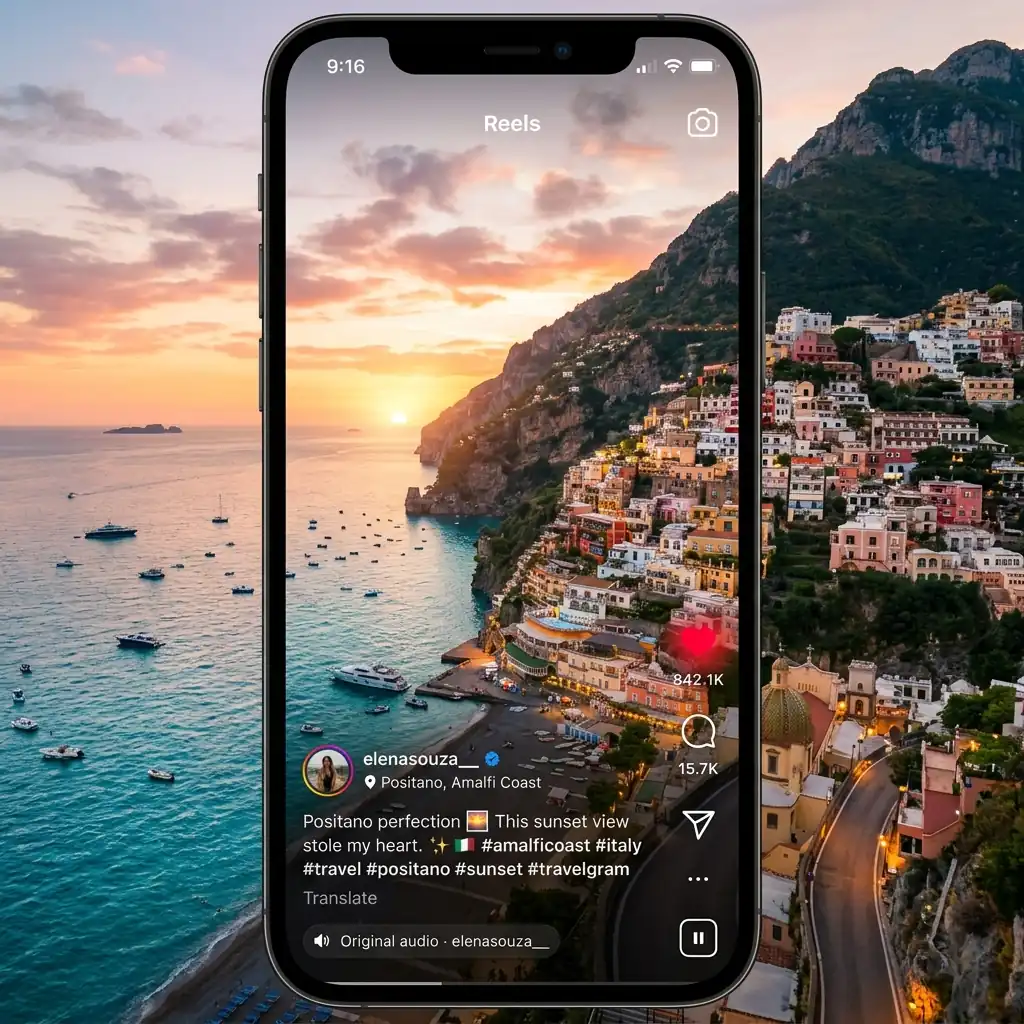
Instagram Reels Travel Interface showing localized content discovery
| Question | Section |
|---|---|
| Why do travel Reels go viral differently in different regions? | Why Instagram is the World's Premier Travel Discovery Engine |
| How do I select the best clips from a YouTube travel vlog? | Phase 1: The Travel Content Audit |
| How do I adapt landscape YouTube footage to vertical Reels? | Phase 2: The Vertical Adaptation Workflow |
| How do I dub travel Reels into Spanish, French, and Portuguese? | Phase 3: AI Dubbing for Travel Content |
| What regional hashtag and caption strategies work best? | Phase 4: Mastering Instagram Localization |
| Which languages should I prioritize for travel content? | Top Travel Markets for Instagram Reels Localization |
| How do I monetize a global travel Instagram presence? | Phase 5: Monetizing Your Global Travel Brand |
| What's the best hook structure for a travel Reel? | The Anatomy of a Viral Travel Reel |
| What mistakes should I avoid? | Common Mistakes Travel Creators Make |
| How long does it take to build a multilingual Instagram following? | Frequently Asked Questions |
Instagram Reels localization is the process of adapting a travel video for a specific language market — including dubbed audio, translated captions, localized text overlays, and region-targeted hashtags — to trigger Instagram's regional discovery and recommendation algorithms.
Instagram's algorithm prioritizes same-language content in Explore and Reels feeds. An English Reel receives minimal organic exposure in Portuguese-speaking Brazil regardless of production quality. Travel content is inherently global — the barrier to distribution isn't the visual content, it's the language delivery.
68% of Instagram users discover new travel destinations through Reels, according to Meta's 2025 Creator Economy Report. Among users aged 18–34, the figure rises to 76%.
Travel Reels localized into the viewer's native language receive significantly higher save rates — the strongest engagement signal in Instagram's algorithm. A Brazilian viewer who saves a Portuguese-dubbed Reel triggers further algorithmic distribution to thousands of similar users who have never seen your account.
Not every scene from a travel vlog makes a successful Reel. The best repurposed clips share three characteristics:
1. Visual self-sufficiency. The viewer understands what they are looking at within 2 seconds without needing surrounding vlog narrative. Drone shots, street food scenes, and sunrise timelapses qualify. Talking-head logistics segments typically do not.
2. Emotional or informational hook. The clip creates awe, wanderlust, or surprise — or delivers concrete value like "The cheapest accommodation in Tokyo costs less than $15 per night."
3. Under 60 seconds of usable footage. Highest completion rates occur under 60 seconds; the optimal range for cross-market travel content is 30–45 seconds.
| Content Type | Why It Works | Best Markets |
|---|---|---|
| Cinematic destination reveals | Universally aspirational; no narration required | All markets |
| "Hidden gem" local tips | High save rate driven by trip-planning intent | Spain, France, Brazil, Germany |
| Budget travel hacks | Practical value crosses language barriers easily | India, Brazil, Indonesia, Mexico |
| Food experiences | Sensory appeal combined with cultural curiosity | Japan, France, Italy, Mexico |
| Transport and logistics tips | High search intent among travel-planning audiences | Germany, Japan, South Korea |
| Local cultural experiences | Authenticity and novelty drive strong engagement | All markets |
Use YouTube Studio's audience retention graph to identify moments where viewers rewatched or retention spiked above baseline. These "retention peaks" are your highest-value repurposing candidates. Creators who prioritize retention-peak segments see 40–60% higher Reel engagement in their first month of localized posting.
Travel video vertical adaptation is the process of reframing horizontal (16:9) footage into portrait (9:16) for mobile-first platforms, selecting the compositional center and adjusting pacing for short-form attention.
Step 1 — Choose the composition center. The visual center — mountain peak, waterfall, or historic building — anchors the vertical frame. For talking-head footage, the face occupies the upper 60% with space above for captions.
Step 2 — Apply dynamic reframing. DaVinci Resolve and Adobe Premiere offer auto-reframe tools that track the primary subject using AI object detection, preventing awkward cropping on drone footage and camera-movement scenes.
Step 3 — Adjust pacing for mobile viewers. YouTube vlogs feature 5–8 second establishing shots; on Reels, 2–3 seconds per cut is the retention-optimized pace.
Step 4 — Add caption text in the target language. 70–80% of Reels viewers read captions even when audio is on (Meta). Captions must be translated and culturally localized — English captions on a dubbed Portuguese Reel create a jarring disconnect.
On Instagram Reels, the viewer experience is primarily visual and auditory. Subtitles force a reading task that competes with visual storytelling, suppressing save and share behaviors. Dubbed Reels achieve 35–50% higher completion rates compared to subtitled-only equivalents in non-English markets, directly amplifying algorithmic distribution.
AI voice cloning for travel creators generates dubbed audio that preserves the original creator's voice characteristics — tone, enthusiasm, pacing — so international viewers experience the same emotional connection as the primary language audience.
Step 1 — Export your adapted vertical clip at 1080×1920 resolution with a clean audio track.
Step 2 — Upload to VideoDubber. Access VideoDubber.ai and upload. The platform handles transcription, translation, and voice synthesis in one pipeline.
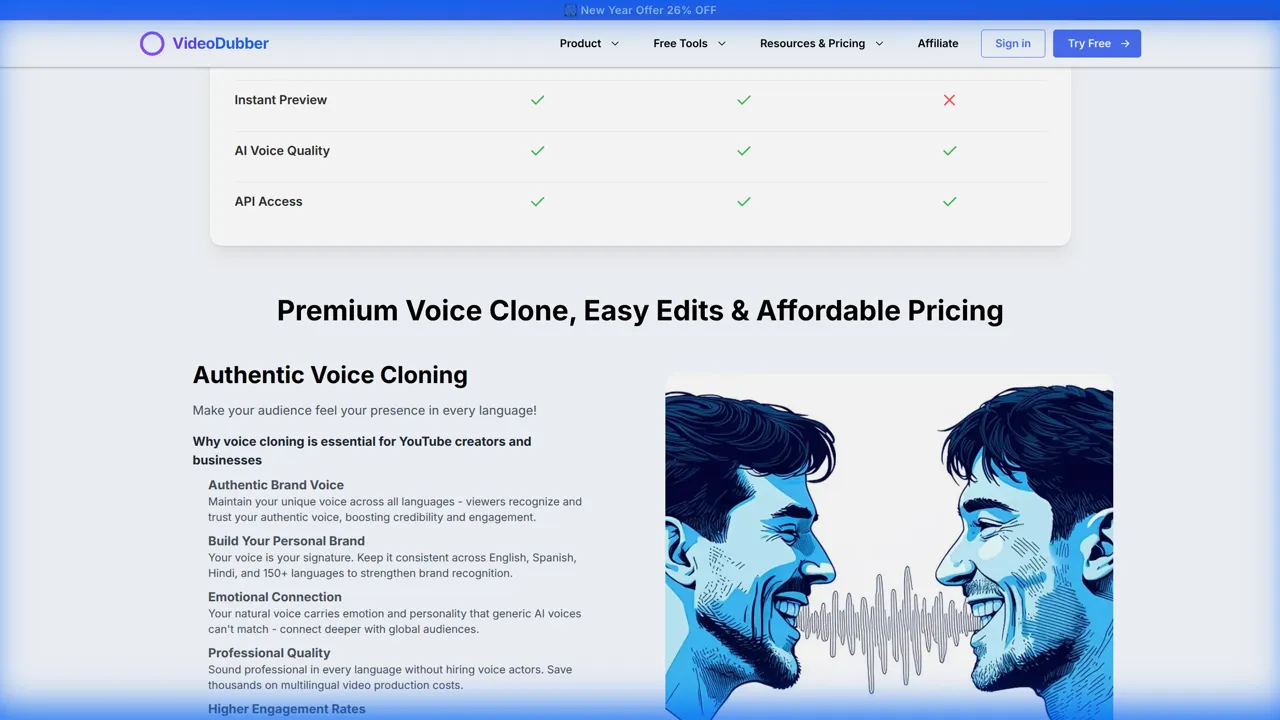
VideoDubber Voice Cloning Interface for travel content localization
Step 3 — Select target languages. Highest-ROI initial set: Spanish (Mexico + Spain), Brazilian Portuguese, and French. VideoDubber processes all three in parallel.
Step 4 — Enable voice cloning. Your enthusiasm describing a hidden beach, your awe at a Japanese temple — voice cloning preserves that authenticity across every language.
Step 5 — Review travel-specific terminology. Keep destination names in original form — "pastel de nata" and "onsen" retain their character untranslated.
Step 6 — Export all language versions. You now have four complete Reels from a single editing session, each engineered for algorithmic distribution in its respective market.
| Videos per Month | Languages per Video | Total Dubbed Minutes | Estimated Cost (VideoDubber Pro) |
|---|---|---|---|
| 4 × 60-second Reels | 3 | 12 minutes | ~$4/month |
| 8 × 45-second Reels | 3 | 18 minutes | ~$6/month |
| 20 × 60-second Reels | 5 | 100 minutes | $29–$39/month |
For a creator posting daily across three language accounts, dubbing costs $15–$40 per month. VideoDubber delivers AI voice cloning and translation across 150+ languages.
Using English hashtags on dubbed content sends conflicting signals to Instagram's classification system. Each language version needs a fully localized hashtag stack:
| Target Market | Primary Hashtags | Travel-Specific Tags | Engagement-Boosting Tags |
|---|---|---|---|
| Brazil | #paravocê #viralbrasil | #viagembrasil #turismo #destinos | #dicasdeviagem #exploreobrasil |
| Mexico + Spain | #parati #viralespañol | #viajes #turismo #destinos | #tipsdeviaje #viajar |
| France | #pourtoi #france | #voyage #tourisme #voyager | #conseilsvoyage #explorerfrance |
| Germany | #fürdich #deutschland | #reisen #tourismus #urlaub | #reisetipps #entdecken |
| Japan | #おすすめ #旅行 | #日本旅行 #観光スポット | #旅vlog #tabi |
| India (English + Hindi) | #trending #india | #travel #incredibleindia | #wanderlust #travelgram |
Structure every dubbed travel Reel with a four-part hierarchy:
Visual Hook (Frame 1–60): Begin with your most visually striking shot — a landscape reveal, unexpected cultural moment, or dramatic before/after.
Audio Hook (0–3 seconds): Open with a question or surprising claim in the dubbed language. Example in Portuguese: "Esse lugar secreto em Portugal ainda não conhecem" ("This secret place in Portugal they still don't know about").
Value Delivery (3–40 seconds): Short, punchy sentences that function as standalone claims for caption-only viewers.
CTA (Final 5 seconds): A localized call to action — "Salva para sua próxima viagem" ("Save for your next trip") — dramatically increases save rates.
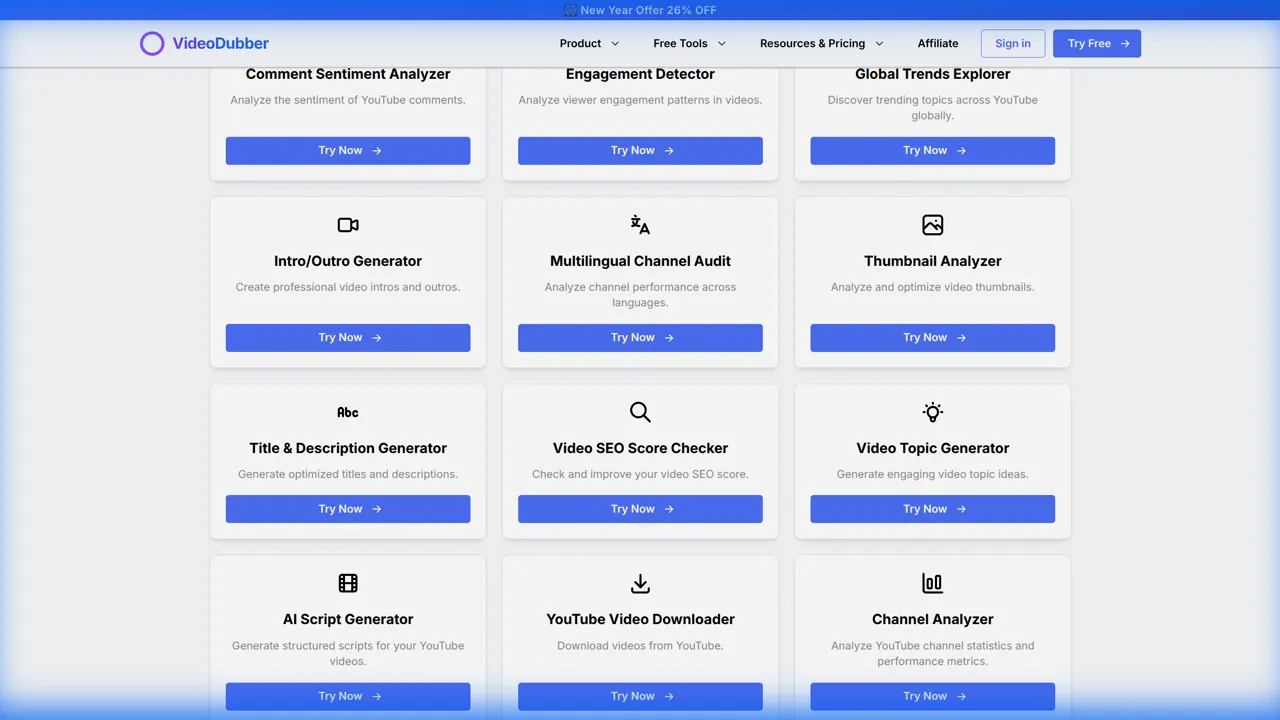
VideoDubber Dashboard showing multilingual travel content workflow tools
Use the natural writing style of each target market — Brazilian Portuguese is warmer than European Portuguese; Mexican Spanish differs from Castilian. VideoDubber accounts for regional variants, but a native-speaker review pass for top-performing content improves authenticity.
| Language | Instagram Monthly Active Users | Travel Content Engagement | Recommended Priority |
|---|---|---|---|
| Spanish (LATAM + Spain) | 300M+ | Very High | Tier 1 — start here |
| Portuguese (Brazil) | 110M+ | Extremely High | Tier 1 — start here |
| French | 80M+ | High | Tier 2 |
| Hindi | 200M+ | High (rapidly growing) | Tier 2 |
| Japanese | 50M+ | Very High | Tier 2 |
| German | 40M+ | Moderate-High | Tier 3 |
| Indonesian | 90M+ | High | Tier 3 |
For travel creators, Spanish and Brazilian Portuguese are the highest-ROI first expansion languages. Large audience size, high travel engagement, and minimal competition for dubbed content from Western creators create an immediate opportunity.
Brazilian Instagram users have the highest average Reel save rate globally for travel content — nearly 2.3× the global average (Meta 2025). French and German represent natural Tier 2 expansions with high travel spending per capita and Instagram-active demographics, per Statista's 2025 European Travel Report.
Each new language account unlocks revenue streams inaccessible to English-only creators:
1. Regional Tourism Board Partnerships. Tourism boards in Spain, France, Portugal, Japan, and Brazil seek creators with engaged audiences in their target markets. A creator with 50K Portuguese-speaking followers is more attractive to Turismo de Portugal than a 500K English-only creator.
2. High-Conversion Localized Travel Guides. Routing a Portuguese-language Reel to a Portuguese-language sales page converts at 2–4× higher rates than cross-language funnels (HubSpot).
3. Localized Affiliate Marketing. Booking.com, GetYourGuide, and Klook offer regional affiliate programs. Portuguese-language affiliate links convert at 30–50% higher CTR than English links.
4. Instagram Subscriptions and Reels Bonuses. Five active language accounts effectively multiply bonus-eligible view count five times.
5. Sponsored Content for Regional Brands. Regional airlines, hotel chains, and tour operators in Spanish, Portuguese, and French markets represent untapped sponsorship opportunities.
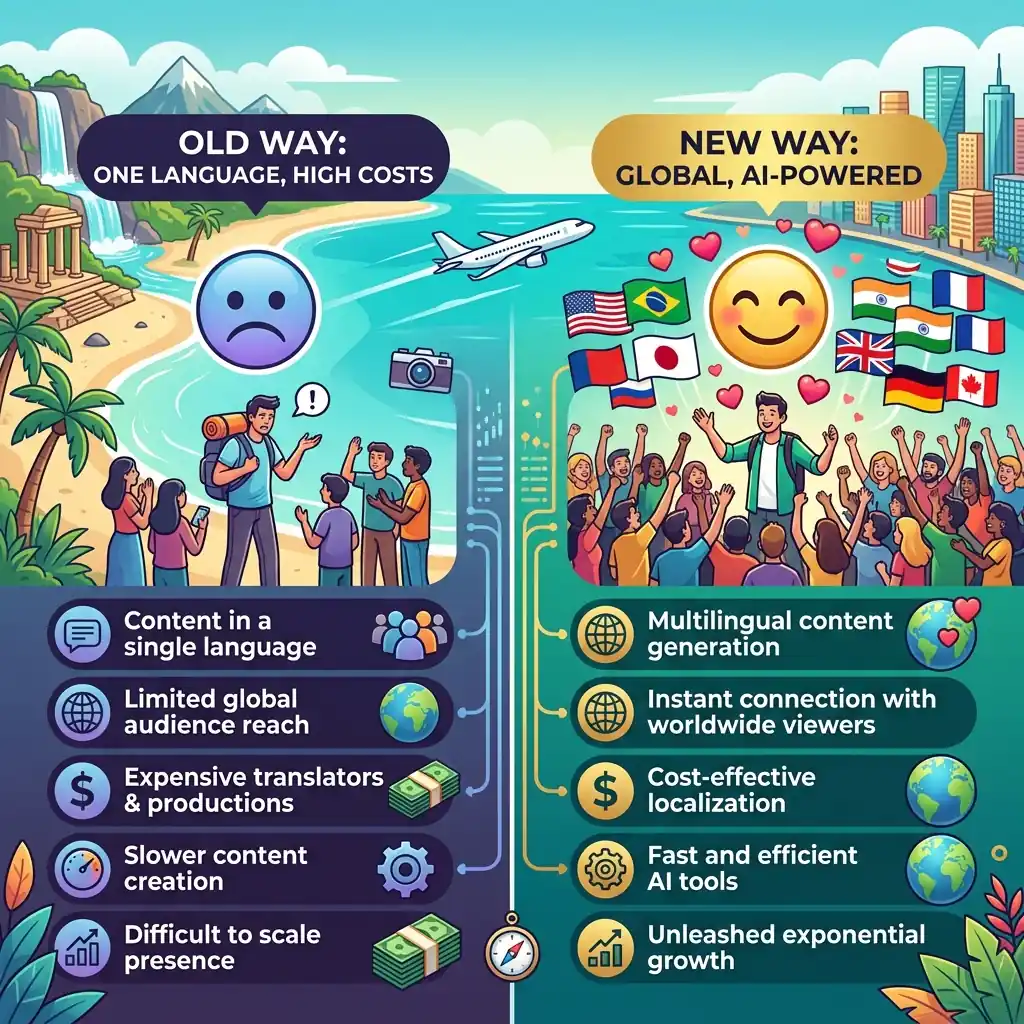
Monetizing Your Global Travel Brand — revenue stream comparison
A travel creator specializing in "Hidden Gems in Europe" plateaued at 8,000 followers. After dubbing vlog highlights into French and Spanish using VideoDubber (~$45/month, 2–3 extra hours/week), their following grew 300% to 32,000 within 4 months. A Portuguese-language Reel about Lisbon went viral in Brazil — 2.1M views, 140,000 profile visits in one week. A Brazilian airline subsequently sponsored an Azores trip, and monthly affiliate revenue increased 4× through Portuguese-language booking links.
| Element | Best Practice | Common Mistake |
|---|---|---|
| Opening frame | Striking visual with no text overlay in first 0.5 seconds | Text-heavy intro before visual is shown |
| Opening audio (dubbed) | Question or surprising claim in first sentence | Generic intro ("Hey everyone, today we're...") |
| Visual pacing | New cut every 2–3 seconds | Slow lingering shots that lose attention |
| Caption density | 1–2 short sentences per screen | Long paragraphs that require sustained reading |
| Destination name display | On-screen text in both native and target language | English-only location labels |
| CTA type | "Save for your trip" / "Where should I go next?" | No CTA or generic "follow me" |
| Hashtag quantity | 5–10 localized tags per language version | 30+ generic tags including irrelevant ones |
One account per major language market: English (primary), Spanish, Portuguese/Brazilian, and French. Each builds its own algorithmic profile. Posting all languages on one account is possible but less effective — Instagram cannot cleanly distribute mixed-language content to the right audiences.
You can repurpose existing YouTube footage exclusively. Filming occasional 9:16 vertical clips improves quality in tight spaces, but the most efficient approach is primarily repurposed YouTube content supplemented with native vertical clips for key moments.
4–7 posts per week per account during the first 3 months ("algorithm trust building" phase). After establishing engagement, 3–5 posts per week maintains momentum. Consistency matters more than frequency.
Yes — the same visual footage is used across all accounts. Only dubbed audio, captions, text overlays, and hashtags differ. Tools like VideoDubber produce multiple dubbed language outputs from a single visual master.
Budget travel, hidden gems, food tourism, and cultural immersion outperform luxury travel in international markets. Audiences in Latin America, Southeast Asia, and Southern Europe respond strongly to practical travel information. Luxury content performs better in English-speaking markets and Japan.
Expect 6–12 weeks before sustained algorithmic distribution begins. The first 20–30 posts establish your content profile. Accounts achieving 3–5 saves per Reel within 24 hours are on track, with meaningful growth typically appearing between weeks 6 and 10.
Yes. Separate Spanish and Portuguese accounts reset your algorithmic ceiling in each new market. The audience potential in Spanish-speaking Instagram alone exceeds the total English-language travel audience, and separate accounts provide diversification against algorithm changes.
Using AI platforms like VideoDubber, dubbing 20–30 short Reels across three languages costs $15–$40/month (including voice cloning, translation, and audio replacement). Traditional studio dubbing would cost $500–$2,000/month for the same volume.
For related strategies, see our guide on TikTok content repurposing and how to choose the best video translation tools for your workflow. For creators building a global brand from scratch, our AI dubbing for content creators guide covers the full creator-specific workflow.
Instagram travel vlog repurposing: dub YouTube vlogs into localized Reels, grow 3–5× faster in Spanish, Portuguese & French markets with AI voice cloning.
Bilibili content repurposing: dub YouTube videos into Mandarin with AI voice cloning. Step-by-step guide to reach 340M+ Chinese viewers in 2026.
Twitch repurposing guide: dub stream highlights into Spanish, Portuguese & Japanese with AI voice cloning, grow multilingual channels, and multiply income in 2026.
Learn the exact blueprint for YouTube Content Repurposing and Globalization using AI-driven tools like VideoDubber to create multiple channels and dominate international markets.
TikTok content repurposing: dub videos into 150+ languages with AI voice cloning, build regional accounts, and monetize globally. Step-by-step 2026 guide.