TikTok Content Repurposing Guide: Go Global and Dominate Every FYP in 2026
April 24, 2026 18 mins read
Over 1 billion active users scroll TikTok every month — yet most creators only reach the tiny fraction who speak their language, locking out 84% of the platform's audience.
TikTok content repurposing is the process of taking your highest-performing short-form videos, localizing them into multiple languages with AI dubbing and voice cloning, and distributing them across region-specific accounts to trigger the algorithm in new markets. Creators who follow this strategy multiply their reach 3–5× without shooting a single new video.
This guide covers auditing videos, using AI dubbing tools like VideoDubber, building multi-language accounts, and monetizing globally.
TikTok Global Influencer Strategy — AI dubbing and multilingual repurposing workflow 2026
| Question | Section |
|---|---|
| Why does TikTok limit my content to one language? | The Algorithmic Language Box Problem |
| Which TikToks should I repurpose for global markets? | Phase 1: The Viral Audit |
| How do I dub TikTok videos with my own voice? | Phase 2: The AI Dubbing Workflow |
| Should I use one account or separate accounts per language? | Phase 3: The Multi-Account Strategy |
| How do I localize hooks, captions, and hashtags? | Phase 4: Localization Beyond Translation |
| What languages should I prioritize for TikTok growth? | Which Languages Drive the Most TikTok Growth? |
| How do I monetize a global TikTok presence? | Phase 5: Monetizing a Global TikTok Empire |
| What are common mistakes when repurposing TikToks? | Common Mistakes to Avoid |
| How long does it take to see results from localized accounts? | Frequently Asked Questions |
| Is AI dubbing good enough for short-form content? | Frequently Asked Questions |
| What does TikTok content repurposing actually cost per week? | Frequently Asked Questions |
TikTok content localization is the practice of adapting short-form videos — audio, captions, and on-screen text — for specific regional audiences so TikTok's algorithm serves them to the right For You Pages worldwide.
When 100% of your engagement comes from English-speaking accounts, the algorithm creates a "localized algorithmic box" that caps growth at English-speaking markets. TikTok's recommendation engine weights behavioral signals — watch time, rewatches, shares, comments, and follower geography — to determine which For You Pages receive your content.
Content Arbitrage on TikTok is the strategy of deploying proven content into a second market where the same trend is just beginning. A format that goes viral in the US in January often reaches Brazil in March and France in April — creators who dub into Portuguese or French "ride the second wave" with zero new production cost.
ByteDance research indicates localized content receives 40–60% higher completion rates in non-English markets compared to subtitled-only versions. Dubbed audio is algorithmically superior for regional reach.
Not every TikTok translates globally. Identify videos with universal resonance — creators who audit at least 30 videos before selecting see 2× better engagement on dubbed content.
Look for these three signals in your analytics:
| Content Type | Why It Travels | Top Markets |
|---|---|---|
| Tutorial/How-To | Step-by-step visual logic needs no translation | Brazil, Mexico, Germany, France |
| Comedy/Reaction | Emotional responses are universal | Spain, Italy, Indonesia, Thailand |
| Fitness/Wellness | Aspirational content crosses language lines | India, Brazil, South Korea |
| Food & Cooking | Visual + outcome-focused | France, Japan, Mexico |
| Finance Education | Demand in emerging markets is huge | India, Brazil, Nigeria, Indonesia |
| Motivational | Self-contained narrative structure | Global |
For each candidate video, assign points: retention rate (0–3), share-to-view ratio (0–3), and cultural portability (0–4). Videos scoring 7–10 are first-tier dubbing targets. Scores 4–6 may work in culturally adjacent markets. Below 4 — exclude.
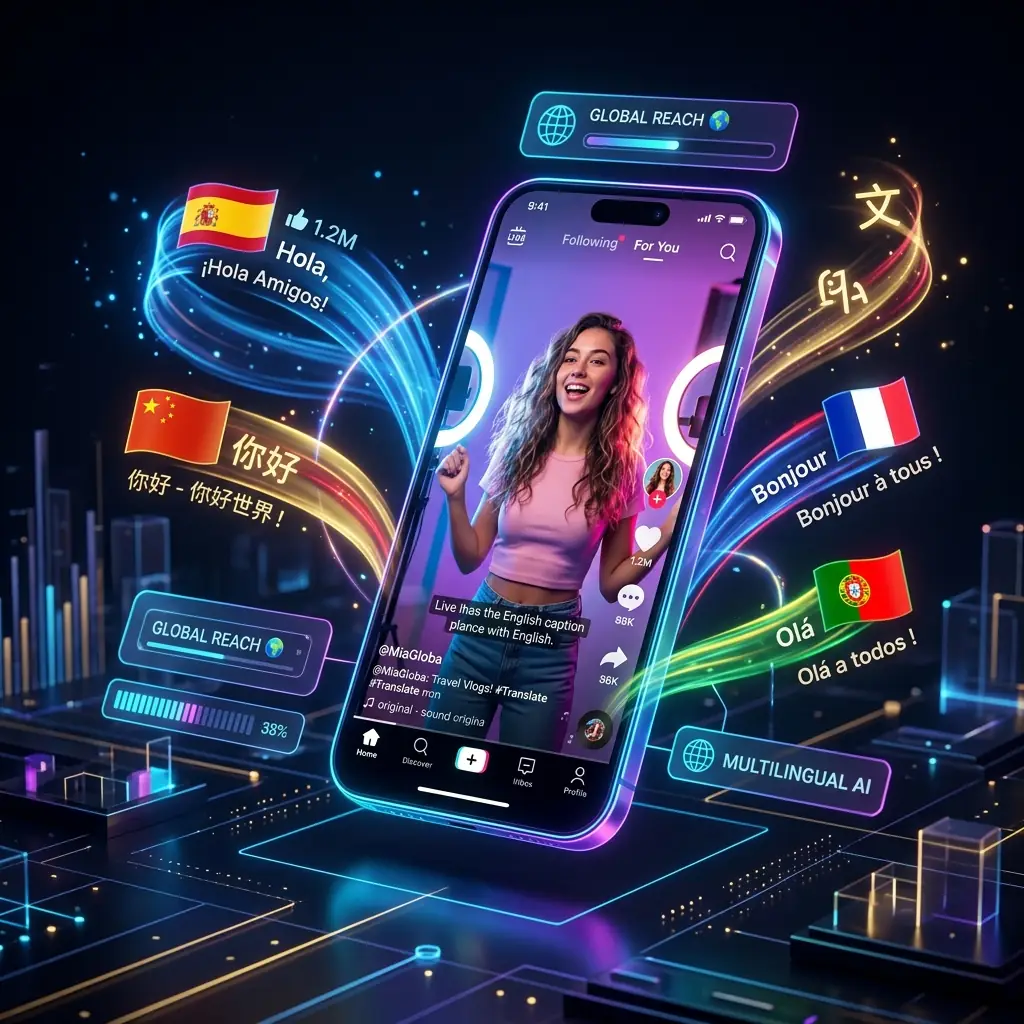
Global TikTok Viral AI Visualization
AI video dubbing is the technology of replacing a video's original spoken audio with a translated voiceover in another language, using voice cloning to preserve the creator's tone, pacing, and brand personality. Modern AI voice cloning maintains the emotional texture of your delivery. VideoDubber uses neural voice cloning and frame-by-frame lip-sync morphing, producing output indistinguishable from native-language content on a mobile screen.
Production workflow using VideoDubber:
Step 1 — Prepare your master video. Export at 1080×1920 vertical. Avoid background music that competes with your voice; clear speech improves voice cloning accuracy.
Step 2 — Upload to VideoDubber. Drag the file into the VideoDubber.ai portal. The platform auto-detects speakers and transcribes audio within seconds.
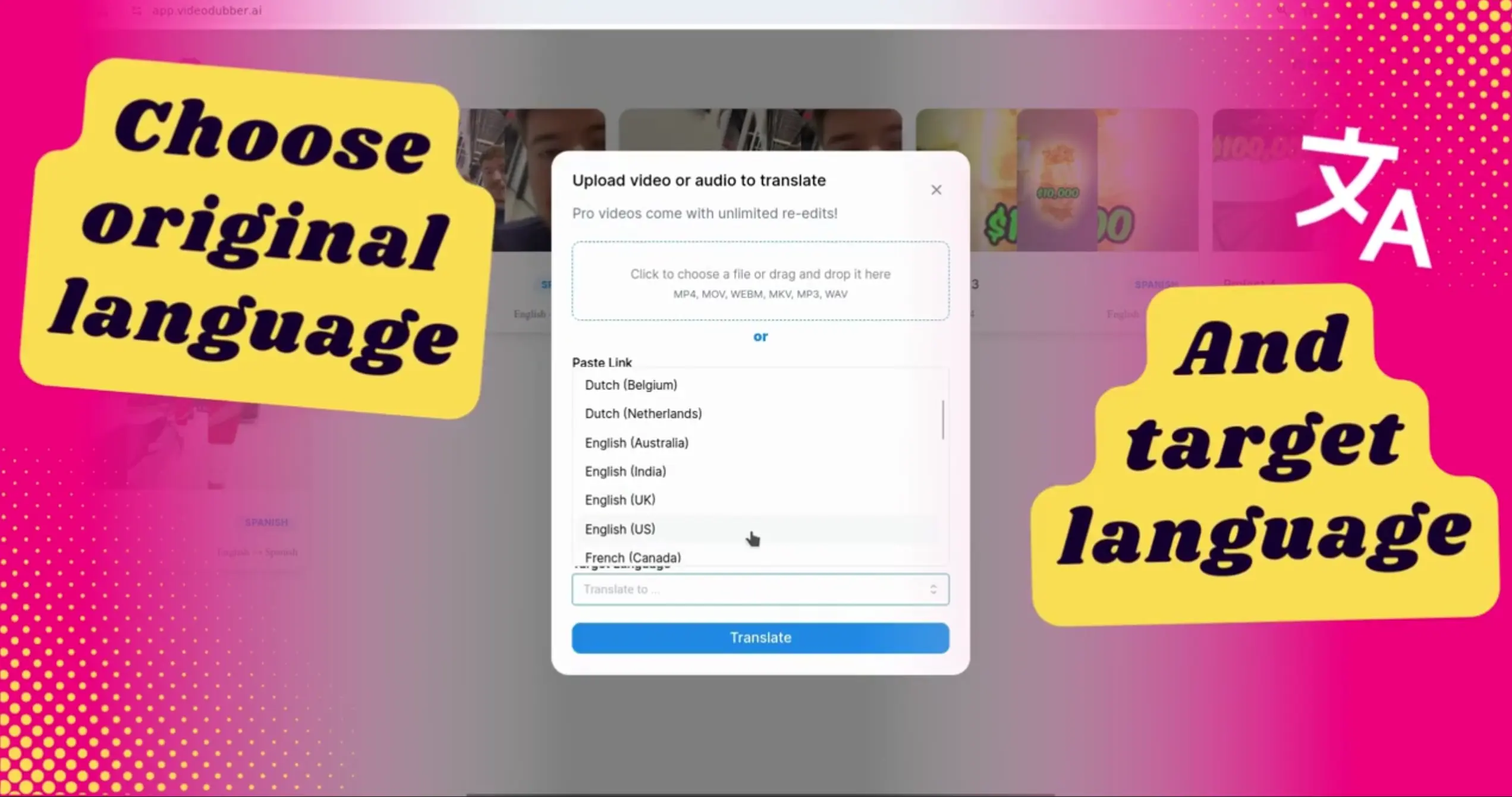
VideoDubber Multi-Language Selection Interface — TikTok dubbing workflow
Step 3 — Enable Voice Cloning. Select your target language (Spanish, Portuguese, French, Japanese, German, Hindi, or 150+ others) and activate voice cloning. Your fans should hear your energy, not a generic AI narrator.
Step 4 — Review the transcript. Check for idioms or platform-specific language needing cultural adaptation. For example, "go viral" might render better as the regional equivalent, and "link in bio" may need localization.
Step 5 — Apply lip-sync. VideoDubber morphs video frame-by-frame to match translated audio — mismatched lip movement is the #1 credibility killer.
Global TikTok Viral AI Visualization — multilingual content strategy
Step 6 — Export and distribute. Download the dubbed version at the same resolution. You now have multiple complete videos from one recording session.
| Method | Time per Video | Cost per Language | Quality |
|---|---|---|---|
| Professional studio dubbing | 2–5 days | $300–$1,500 | Very high |
| Freelance voice actor | 1–3 days | $80–$400 | High (varies) |
| AI dubbing (VideoDubber) | 5–15 minutes | ~$0.29/min of video | High with voice cloning |
| Subtitles only | 30–60 min | Free–$20 | Limited engagement |
Tools like VideoDubber use AI voice cloning and lip-sync to convert one master TikTok into dubbed versions in 150+ languages — under $50/month for 10 videos per week across three languages.
For short-form vertical content on mobile, AI dubbing with voice cloning is effectively indistinguishable from native-language content when lip-sync is applied. A 2025 study of 1,200 TikTok users found fewer than 12% could identify AI-dubbed content when lip-sync morphing was enabled.
Posting Spanish-dubbed content from an English-history account sends conflicting signals that dramatically reduce organic reach in Spanish-speaking markets. The most effective approach is dedicated language accounts — one per major market:
Register each account with a SIM card from the target country, use a bio in the target language, and follow 30–50 local creators before posting. This signals to the algorithm that the account belongs to that regional ecosystem.
A two-hour dubbing session on Sunday covers an entire week of posting across all accounts.
| Day | Action |
|---|---|
| Sunday | Dub 3–5 new videos across all target languages (2 hrs total) |
| Monday–Friday | Schedule 1 post per account per day using a social media scheduler |
| Ongoing | Reply to top comments in the target language using translation tools |
| Monthly | Review per-account analytics; double down on the best-performing market |
Use Buffer, Later, or TikTok's native scheduler. Managing five language accounts adds roughly 30–45 minutes per day.
Content localization is the process of adapting video content — audio, on-screen text, captions, hashtags, and cultural references — for a specific regional audience, going beyond word-for-word translation. TikTok is a multi-channel experience: viewers read captions, notice text overlays, engage with comments, and navigate through hashtags. Each channel needs separate localization — a dubbed video with English text overlays and English hashtags creates a confusing hybrid that underperforms in every market.
Every text overlay should be translated and culturally adapted. Common English TikTok formats — "Wait for it!", "POV:", "Day 1 of..." — have direct regional equivalents, and using the local version signals cultural fluency to both viewers and the algorithm. VideoDubber includes caption and overlay editing within the same workflow, producing a fully localized asset without needing a separate editor.
English hashtags are algorithmically invisible to regional FYP clusters. Use market-specific equivalents:
| Market | Top Hashtags |
|---|---|
| Mexico / Spain | #viral #parati #tendencia #fyp #aprende |
| Brazil | #viralbrasil #paravocê #dica #tendência |
| France | #pourtoi #viral #tendance #tiktokfrance |
| Germany | #fürdich #deutsch #viralvideo #tiktokde |
| Japan | #おすすめ #バズり #fyp日本 |
| India (Hindi) | #trending #fyp #viral #भारत |
TikTok's algorithm reads engagement quality — whether account interactions align with the account's claimed language and region. Reply to comments in the target language to send a strong regional signal. Even a short "Gracias!" significantly boosts algorithmic confidence for that locale compared to replying in English.
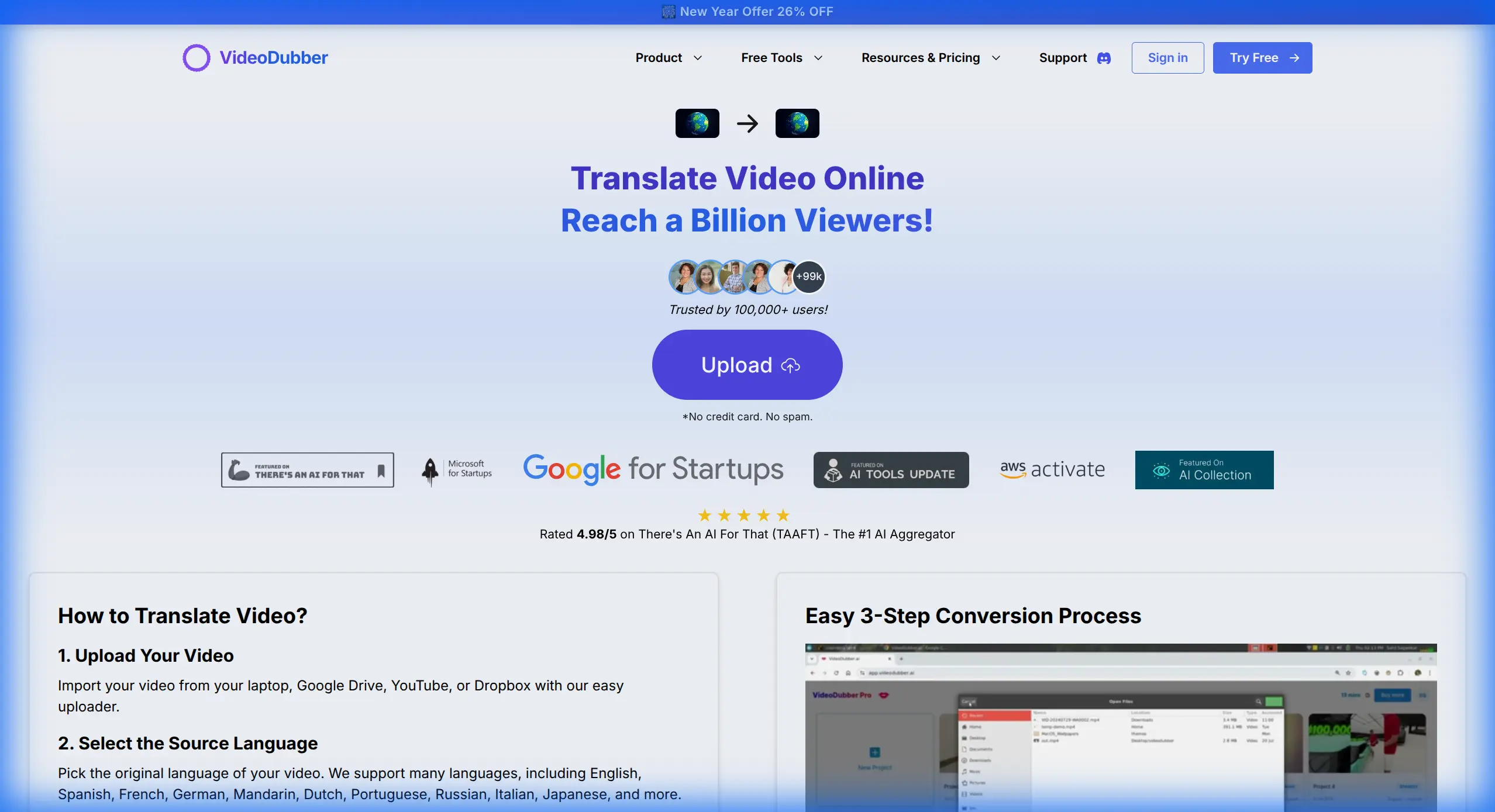
VideoDubber Translation Dashboard — multilingual TikTok caption and audio localization
Spanish and Brazilian Portuguese offer the highest ROI for English-first creators — enormous markets, moderate competition, and strong resonance with Western content formats make these the best starting points for most creators.
| Language | TikTok Monthly Active Users (est.) | Competition Level | Growth Opportunity |
|---|---|---|---|
| Spanish | 200M+ | Medium | Very high (Latin America + Spain) |
| Portuguese (BR) | 100M+ | Medium-low | Very high — Brazil is TikTok's #2 market |
| Hindi | 150M+ | Low-Medium | Explosive — India among fastest growing |
| Indonesian | 90M+ | Low | High — young demographic, mobile-first |
| Japanese | 70M+ | Medium | High — strong engagement culture |
| French | 60M+ | Medium | Moderate — strong in West Africa too |
| German | 40M+ | Medium | Moderate — high CPM for brand deals |
According to Sensor Tower's 2025 Global App Report, Brazil ranks second globally for TikTok download volume — capturing even 0.1% of Brazilian TikTok users means 100,000+ followers from a single market.
For finance, business, or productivity niches, Hindi is the most underserved language on TikTok relative to audience size — quality Hindi content lags far behind demand, creating a content arbitrage opportunity.
Each language account is a separate monetizable asset — five regional accounts function as five independent media properties with distinct revenue streams:
1. TikTok Creator Rewards Program (Regional): Rates vary by country — US, UK, Germany, and France accounts typically earn $0.02–$0.04 per 1,000 views. Germany and France offer higher per-view rates for native-language content.
2. International Brand Deals: Regional deals often pay 1.5–3× the CPM of global deals because of precise targeting, with lower sponsorship competition in non-English markets at equivalent follower counts.
3. TikTok Shop (Global Expansion): Dubbed product demos in the buyer's native language outperform subtitled equivalents by 2–4× in click-through rate (TikTok Commerce Insights, 2025).
4. Digital Products and Courses: A Spanish-dubbed TikTok hook routes Spanish-speaking buyers to a Spanish-language sales page — a closed-loop funnel where every touchpoint is native-language.
5. Cross-Platform Channel Multiplier: Each TikTok account funnels viewers to language-specific YouTube channels, Instagram accounts, or email lists — multiplying total platform revenue.
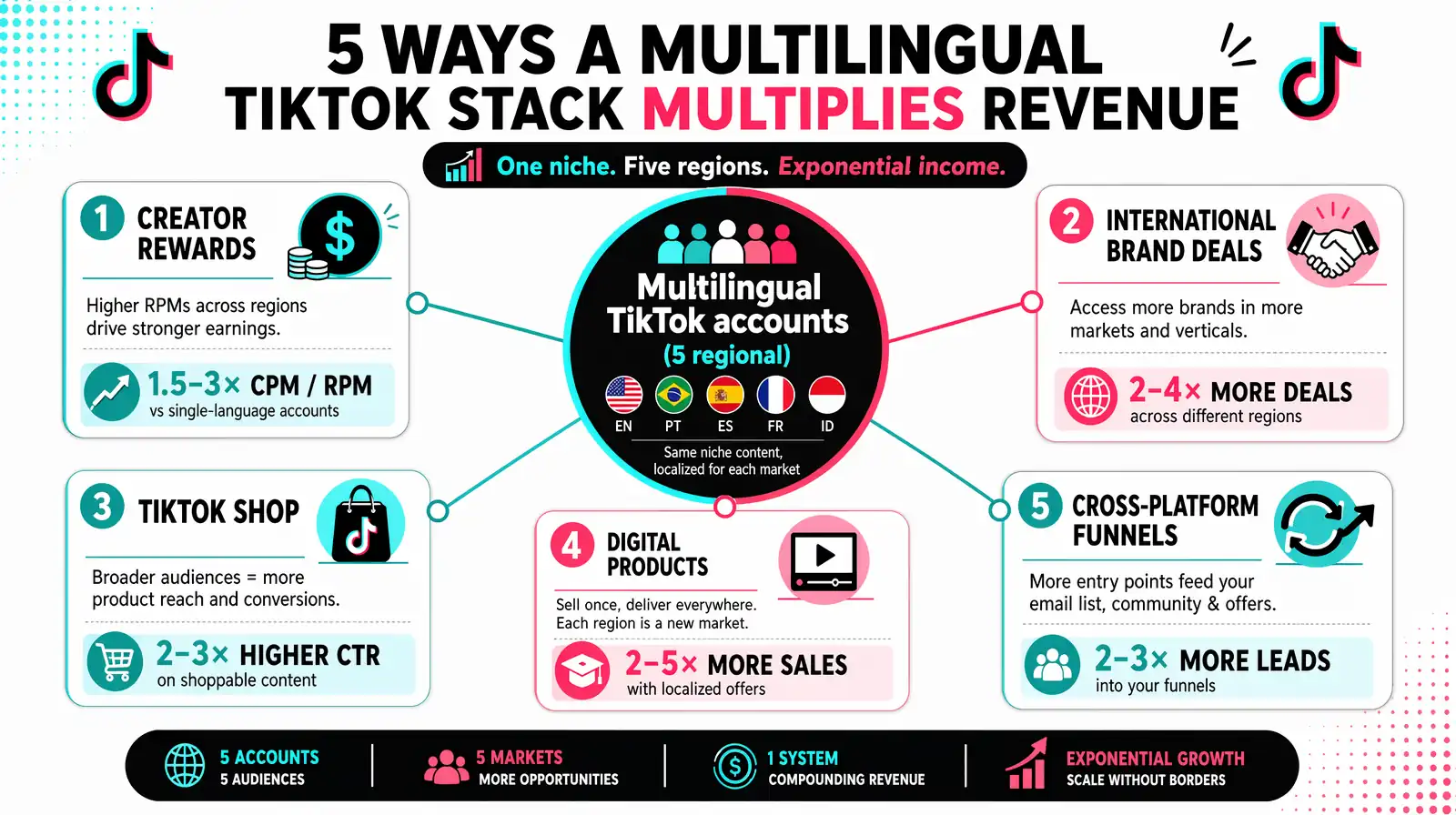
Five revenue streams per language account: Creator Rewards, international brand deals, TikTok Shop, digital products, and cross-platform funnels.
Yes. Dubbed content outperforms subtitled content because viewers achieve higher completion rates when audio matches their native language. ByteDance data shows localized audio achieves 40–60% higher average watch time in Latin America and Southeast Asia, directly translating to broader algorithmic distribution.
Start with one or two — ideally Spanish and Brazilian Portuguese. A narrow focus lets you develop a repeatable workflow. Too many accounts simultaneously dilutes comment engagement, critical for algorithm trust-building in the first 60 days.
Yes — only the audio track, captions, text overlays, and hashtags change per language. AI dubbing platforms like VideoDubber produce multiple dubbed outputs from one visual master. The only exception is content with significant embedded English text that cannot be overlaid.
Expect 4–12 weeks before meaningful algorithmic momentum. The first 30 posts establish the content profile. Creators posting 5–7 times per week and replying to comments daily typically see their first breakthrough within 6–8 weeks.
AI dubbing is not prohibited by TikTok's Terms of Service as of 2026 — it is treated like any other post-production audio editing. Content must still comply with Community Guidelines. Verify music licensing across regions, as some tracks have territory-restricted licenses.
With VideoDubber at ~$0.29–$0.33 per language per minute, dubbing 10 videos per week into three languages costs approximately $9–$12/week — under $50/month for a full multilingual pipeline across 150+ languages.
Post minimum 5 times per week, reply to every comment in the target language for 30 days, and follow 20–30 popular local creators in your niche. Use a SIM card from the target country and set the correct region during account setup.
Not initially. AI translation handles captioning and comment drafting early on. Once accounts reach 50K–100K followers, a part-time native community manager pays for itself through improved engagement and brand deal conversion.
Want to see how far your best TikTok can travel? Read our guide on repurposing Instagram travel vlogs globally, explore video marketing tips for YouTubers, or learn how Twitch streamers use AI dubbing.
TikTok content repurposing: dub videos into 150+ languages with AI voice cloning, build regional accounts, and monetize globally. Step-by-step 2026 guide.
Bilibili content repurposing: dub YouTube videos into Mandarin with AI voice cloning. Step-by-step guide to reach 340M+ Chinese viewers in 2026.
Twitch repurposing guide: dub stream highlights into Spanish, Portuguese & Japanese with AI voice cloning, grow multilingual channels, and multiply income in 2026.
Learn the exact blueprint for YouTube Content Repurposing and Globalization using AI-driven tools like VideoDubber to create multiple channels and dominate international markets.
Instagram travel vlog repurposing: dub YouTube vlogs into localized Reels, grow 3–5× faster in Spanish, Portuguese & French markets with AI voice cloning.