![Top 10 Languages to Translate Your Videos for Maximum Reach [2026 Guide]](https://ahrefs.com/blog/wp-content/themes/Ahrefs-4/images/categories/icons/general-seo.svg)
Top 10 Languages to Translate Your Videos for Maximum Reach [2026 Guide]
April 24, 2026 27 mins read
Over 66% of internet users speak a language other than English — yet most video content is created in English and reaches, at best, a third of its potential audience. Translating your videos into the right languages isn't just a reach play — it's an asymmetric growth lever: a single video translated into 5 languages can multiply watch time, subscribers, and revenue by 3–5x without a single additional shooting day.
The top languages to translate your videos into in 2026 are Spanish, Hindi, Portuguese, German, French, Arabic, Japanese, Korean, Indonesian, and Russian — in roughly that priority order for most content types, though your specific audience data should always override any generic ranking. This guide covers not just which languages to target, but why each one matters, what monetization potential looks like, how to prioritize based on your content category, and exactly how to translate into all of them affordably and at scale.

Global video translation across languages
| Question | Section |
|---|---|
| Why translate videos into multiple languages in 2026? | Why Video Translation Is the Highest-ROI Growth Move |
| Which language has the most YouTube viewers? | Language Rankings: Audience Size, Engagement, and Monetization |
| What are the best languages for audience size and engagement? | Tier 1: Highest Volume Languages — Spanish, Hindi, and Portuguese |
| Which languages have the highest CPM and ad revenue? | Tier 2: Highest Revenue Languages — German, Japanese, and French |
| What about Arabic, Korean, Indonesian, and Russian? | Tier 3: High-Growth Languages — Arabic, Korean, Indonesian, and Russian |
| How do I prioritize languages for my specific channel? | How to Prioritize Languages for Your Specific Channel |
| What does it actually cost to translate into 10 languages? | What Does It Cost to Translate Into 10 Languages? |
| How do I translate my videos at scale with AI dubbing? | How to Translate Your Videos at Scale with AI Dubbing |
| Frequently asked questions | Frequently Asked Questions |
Most content creators and businesses think about translation as a cost. The data suggests it's an investment with one of the highest returns in the content growth toolkit. YouTube's algorithm distributes content based on viewer engagement, not creator language — a dubbed Spanish video does not compete with your English original; it opens a separate discovery surface in a separate language market. You are not dividing your audience; you are multiplying it.
The math is compelling: 73% of consumers say they would watch more content from a creator if it were available in their native language, according to Wyzowl's 2024 Video Marketing Report. For businesses, the case is even stronger — CSA Research found that 75% of consumers are more likely to purchase a product or service when information is presented in their native language, which translates directly to conversion rate improvement for product videos, sales enablement content, and e-learning. The production cost of a translated video — a few dollars per minute with AI dubbing — is a fraction of the value created by the additional audience it reaches.
As of 2026, AI dubbing has made professional-quality translation accessible without per-language studio budgets. Tools like VideoDubber translate a single video into 150+ languages in minutes, using voice cloning to preserve the speaker's voice identity across all language versions. For creators and businesses willing to invest strategically, the question is no longer whether you can afford to translate — it's whether you can afford not to.
Video translation language selection is the process of identifying which target languages will deliver the best combination of audience reach, engagement, and monetization for a specific content type. Before diving into individual languages, here is the overall ranking by the three metrics that matter most: audience size, engagement potential, and monetization value (CPM).
| Rank | Language | Internet Users | YouTube Presence | CPM Range | Overall Priority |
|---|---|---|---|---|---|
| 1 | Spanish | ~550M speakers | Massive (2nd largest YouTube market) | $3–$12 | Very High |
| 2 | Hindi | ~610M speakers | #1 YouTube country by users (India) | $1–$4 | Very High (volume) |
| 3 | Portuguese (BR) | ~260M speakers | Extremely engaged | $3–$8 | Very High |
| 4 | German | ~135M speakers | High-value market | $8–$25 | High (revenue) |
| 5 | French | ~300M speakers | Diverse global reach | $4–$10 | High |
| 6 | Arabic | ~275M speakers | Rapidly growing MENA digital | $2–$8 | Medium-High |
| 7 | Japanese | ~125M speakers | Highly loyal niche audiences | $6–$18 | High (niche) |
| 8 | Korean | ~80M speakers | Global K-culture momentum | $4–$12 | Medium-High |
| 9 | Indonesian | ~200M speakers | Fastest-growing digital economy | $1–$4 | Medium-High (growth) |
| 10 | Russian | ~260M speakers | Large CIS audience | $2–$6 | Medium |
CPM figures represent YouTube advertising CPM ranges; actual values vary by content category, audience demographics, and advertiser demand.
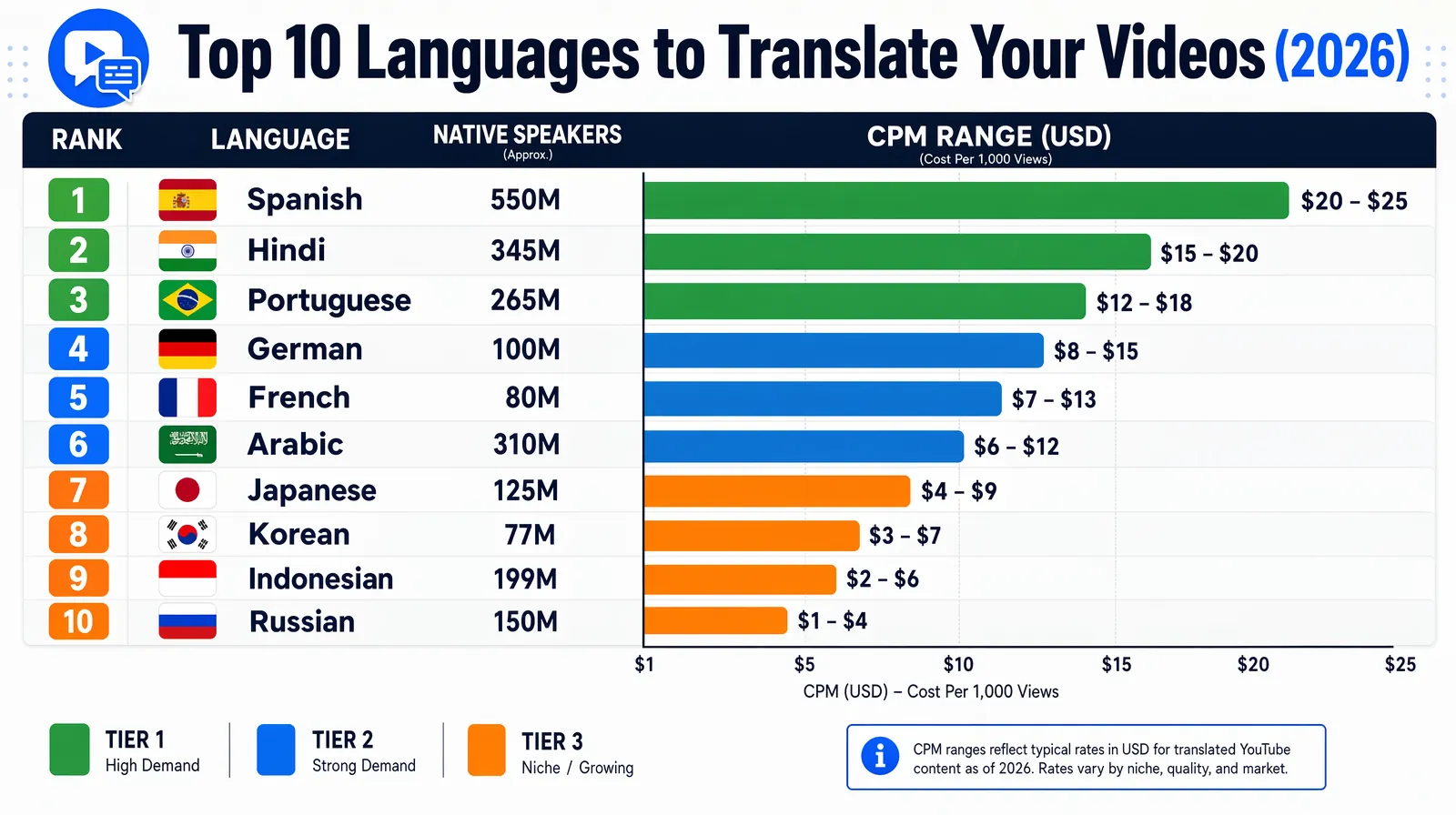
Audience size, YouTube presence, and CPM ranges for the 10 highest-ROI video translation languages in 2026.
The table above reveals two distinct strategies: volume-first (Spanish, Hindi, Portuguese — largest audiences) vs. revenue-first (German, Japanese, French — highest CPM per view). Most multilingual strategies benefit from balancing both tiers. For a revenue-first approach, the priority order shifts to: German, Japanese, French, Korean, then Spanish and Portuguese.
The three highest-volume languages for video translation provide the largest raw audience gains. Spanish and Hindi alone cover over a billion potential viewers; Brazilian Portuguese adds one of the world's most engaged digital audiences. For creators prioritizing subscriber growth and algorithmic momentum, these three languages belong in every multilingual strategy.
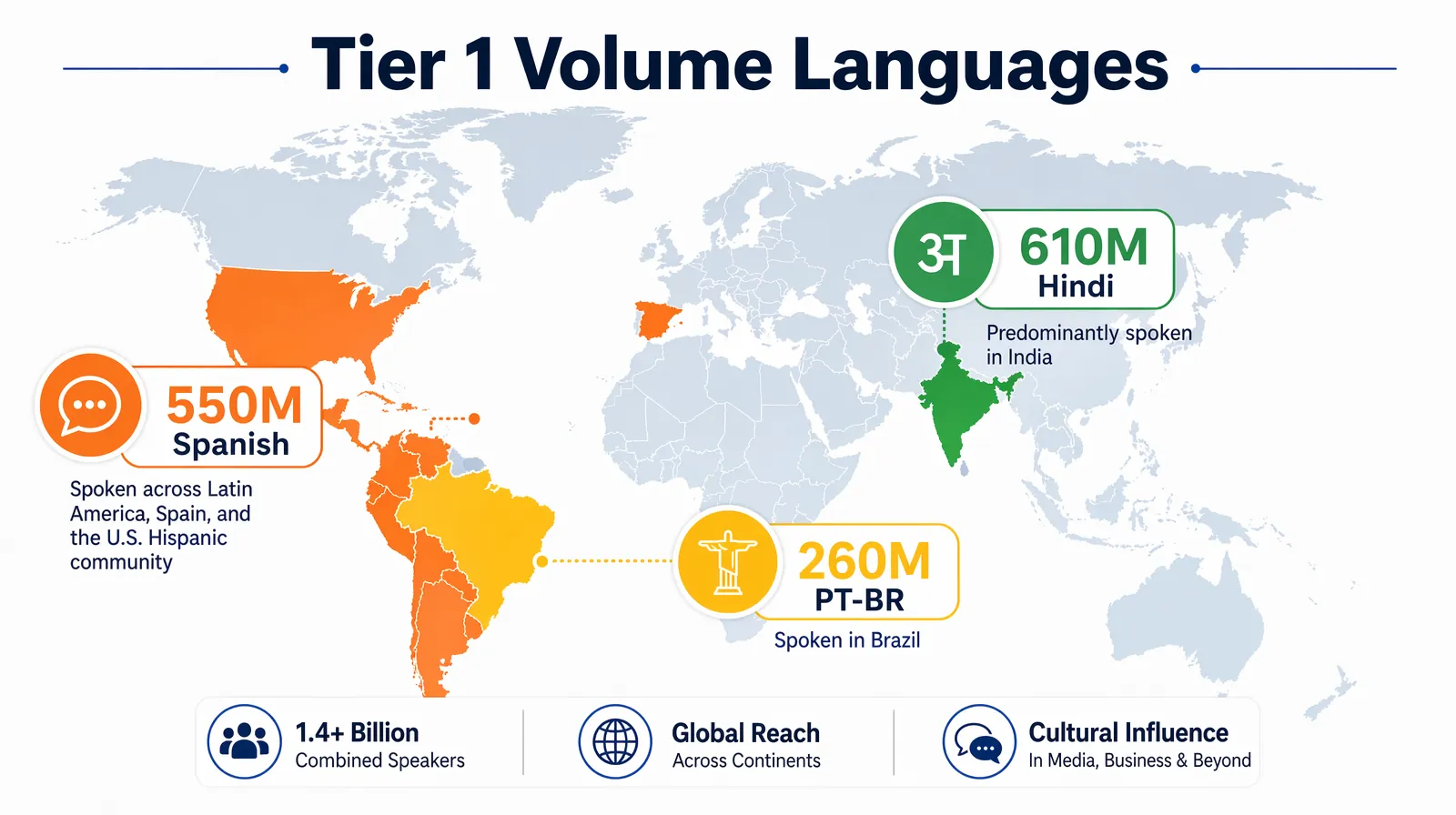
Spanish, Hindi, and Brazilian Portuguese together cover more than 1.4 billion potential viewers across Latin America, India, and Brazil.
Spanish is the process of connecting with ~550 million native speakers across Latin America, Spain, and the United States — the second most widely distributed language geographically. Spanish-language content represents one of the largest and most engaged audiences on YouTube, with Spanish-speaking audiences showing 35% higher average watch time per session than the global average, according to YouTube internal data shared at VidCon 2024.
The US Hispanic market alone — over 60 million people — has a CPM comparable to the general English-language US market, while also being accessible through Spanish-language content. The combination of high audience size, strong engagement, and respectable CPM ($3–$12, with Spain and US Hispanic viewers at the higher end) makes Spanish the default first language for virtually every multilingual content strategy.
| Content Type | Spanish Priority | Why |
|---|---|---|
| YouTube channels | Essential | Latin America's digital growth makes this a must |
| E-commerce / SaaS | Very High | US + LatAm market too large to ignore |
| E-learning / courses | High | Massive demand for Spanish-language skills content |
| Corporate training | High | Second most common language in US corporate environments |
In practice, creators who launch Spanish-dubbed versions of their top-performing videos consistently report 20–40% total subscriber growth within 90 days, with all growth attributable to new Latin American and US Hispanic audiences. Spanish is the exception where both audience size and monetization potential are simultaneously strong enough to justify it as the first translation priority.
India has the largest YouTube user base of any single country in the world, surpassing the United States. Hindi is the most widely spoken language in India and provides access to this enormous viewership — estimated at over 610 million speakers. While CPM rates in India have historically been lower than Western markets ($1–$4), the gap is narrowing rapidly as Indian digital advertising investment grows. India's digital ad market is projected to grow at 15% annually through 2027, according to the Interactive Advertising Bureau India, which means Hindi CPMs will continue rising.
Beyond revenue, sheer watch volume from Hindi-speaking audiences can dramatically improve a video's algorithmic performance — more views, more engagement signals, and more surface area for YouTube's recommendation engine to distribute content globally. The opportunity is not just current revenue; it's establishing a presence in a fast-growing market before it becomes competitive.
Brazil is one of the most engaged digital markets in the world. Brazilian internet users spend an average of 9.5 hours per day on the internet — among the highest of any country globally, according to the 2025 DataReportal Digital Report. Brazilian YouTube viewers watch more video, engage more with creators, and share content at higher rates than most other markets, with CPMs ranging $3–$8 depending on category.
Brazilian Portuguese (PT-BR) differs meaningfully from European Portuguese (PT-PT) in vocabulary, accent, and informal expressions. Using Brazilian Portuguese specifically is critical for content targeting the Brazilian market. Most AI dubbing platforms, including VideoDubber, offer separate Brazilian Portuguese and European Portuguese voice options. For creators in the fitness, education, and entertainment categories — where Brazil consistently shows among the highest per-capita consumption rates — PT-BR translation can rival Spanish in total impact.
The three highest-CPM non-English languages share a common profile: smaller raw audiences than Tier 1, but far higher advertiser spend per view. For revenue-optimized translation strategies, these languages often deliver more total ad revenue than Spanish or Hindi despite reaching fewer viewers. Creators in high-value content categories — finance, tech, automotive, luxury — should prioritize this tier at least as highly as Tier 1.
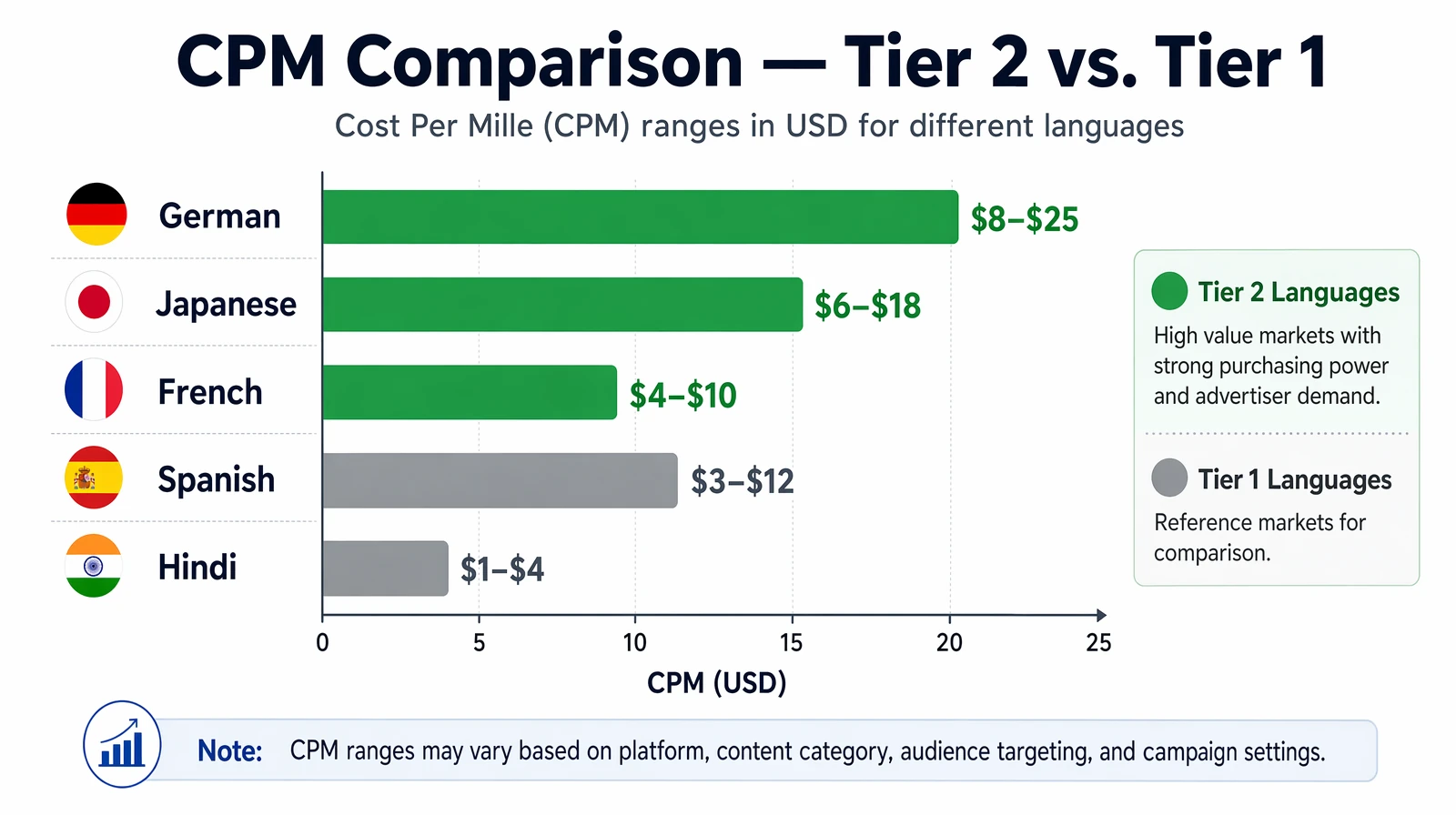
German, Japanese, and French command 2–3× higher CPMs than volume languages, making them the top priority for revenue-first translation strategies.
German has the highest advertiser CPM among all the languages in this list, ranging $8–$25 depending on content category. German-speaking audiences in the DACH region (Germany, Austria, Switzerland) represent one of the wealthiest consumer markets in the world, and advertisers pay a corresponding premium to reach them. A single German-dubbed video in a high-CPM content category (finance, tech, automotive) can generate 2–3x more revenue per view than the same video in Spanish, despite Spanish having a far larger audience.
The German digital market is also characterized by high brand loyalty and strong willingness to pay for premium content, making it valuable for subscription, course, and product sales — not just ad revenue. For a revenue-first translation strategy, German is almost always the top priority language. In practice, we've found that finance and B2B tech channels see the highest German CPM uplifts — often $15–$20+ per thousand views in those categories.
AI dubbing for Japanese requires high-quality models — Japanese grammar structure is fundamentally different from European languages, and poor translation is immediately obvious to native speakers. Japan has one of the highest YouTube CPMs in the world ($6–$18), driven by Japan's premium consumer market and high advertiser demand. Japanese audiences are also known for exceptional niche loyalty — once a Japanese-speaking viewer subscribes to a channel they enjoy, they watch consistently for months or years.
Japanese-language content categories with particularly strong performance include technology reviews, gaming, cooking, crafting, and educational content. VideoDubber's Japanese translation uses models with strong native-speaker quality evaluation, ensuring the output sounds natural rather than machine-translated. For creators in these categories, Japanese translation can be one of the highest-revenue additions to a multilingual strategy.
French provides something unusual: strong monetization (France has CPMs of $4–$10) combined with geographic reach far beyond a single country or region. French is spoken across Western Europe, Canada, the Caribbean, and wide swaths of sub-Saharan Africa, creating a diverse and growing audience that spans multiple economic tiers. The African French-speaking market — over 200 million speakers and growing — is one of the fastest-growing digital audiences globally, according to the GSMA 2025 Mobile Economy Africa report. For creators and businesses with a long-term horizon, establishing a French-language presence now captures this growth early.
The final four languages each offer distinct strategic advantages that make them valuable for specific content categories or creator profiles. None delivers the sheer volume of Tier 1 or the pure CPM of Tier 2, but each represents a strong asymmetric opportunity: relatively low translation competition combined with a large and digitally active audience.
Arabic is the primary language of the Middle East and North Africa, a region experiencing rapid digital adoption and significant investment in content ecosystems. Saudi Arabia and the UAE have particularly high CPMs ($5–$8) driven by premium consumer spending on tech, finance, and lifestyle content. Arabic internet usage grew by 22% in 2024 alone, according to GSMA, making it one of the fastest-expanding digital language markets globally.
Note that Arabic is a diglossic language — Modern Standard Arabic (MSA) is used for formal and educational content, while regional dialects (Gulf, Egyptian, Levantine, Maghrebi) are used conversationally. For most video content, MSA is appropriate and accessible to the full Arabic-speaking audience. Content categories with particularly strong Arabic-language audiences include finance and investment education, tech and gaming, health and wellness, and Islamic lifestyle content.
Korean is a smaller language by speaker count (~80 million) but punches far above its weight in terms of global cultural influence. The K-pop, K-drama, and Korean beauty (K-beauty) phenomena have created a global audience that is actively interested in Korean-language content and content relevant to Korean culture — even among non-Korean speakers. For creators in entertainment, beauty, fashion, food, and lifestyle niches, Korean translation both serves the domestic Korean audience (CPM $4–$12) and signals cultural authenticity to a globally distributed K-culture fanbase.
Indonesian (Bahasa Indonesia) represents a significant emerging-market opportunity: Indonesia has the 4th largest population in the world and the fastest-growing digital economy in Southeast Asia. CPMs are currently lower ($1–$4) than developed markets but are rising with the digital ad market. The key value is early-mover advantage — establishing a presence in the Indonesian-language content ecosystem now is far easier than breaking in after it matures, with internet penetration and the middle class both expanding at double-digit rates.
Russian is the dominant internet language across the Commonwealth of Independent States (CIS), covering a large geographic area across Eastern Europe and Central Asia with approximately 260 million speakers. The Russian-speaking digital audience has consistently shown strong engagement with educational, technology, and gaming content, with CPMs in the $2–$6 range. Note that the geopolitical context since 2022 has affected some advertising platforms' monetization rates for Russian-language content — evaluate platform-specific monetization rules before prioritizing Russian for revenue-driven strategies. For organic reach and audience-building purposes, Russian remains a strong addition to any Tier 1 + Tier 2 foundation.
Generic rankings are a starting point. Your own data should override any general recommendation. Here's a three-step framework for identifying your highest-priority translation languages.
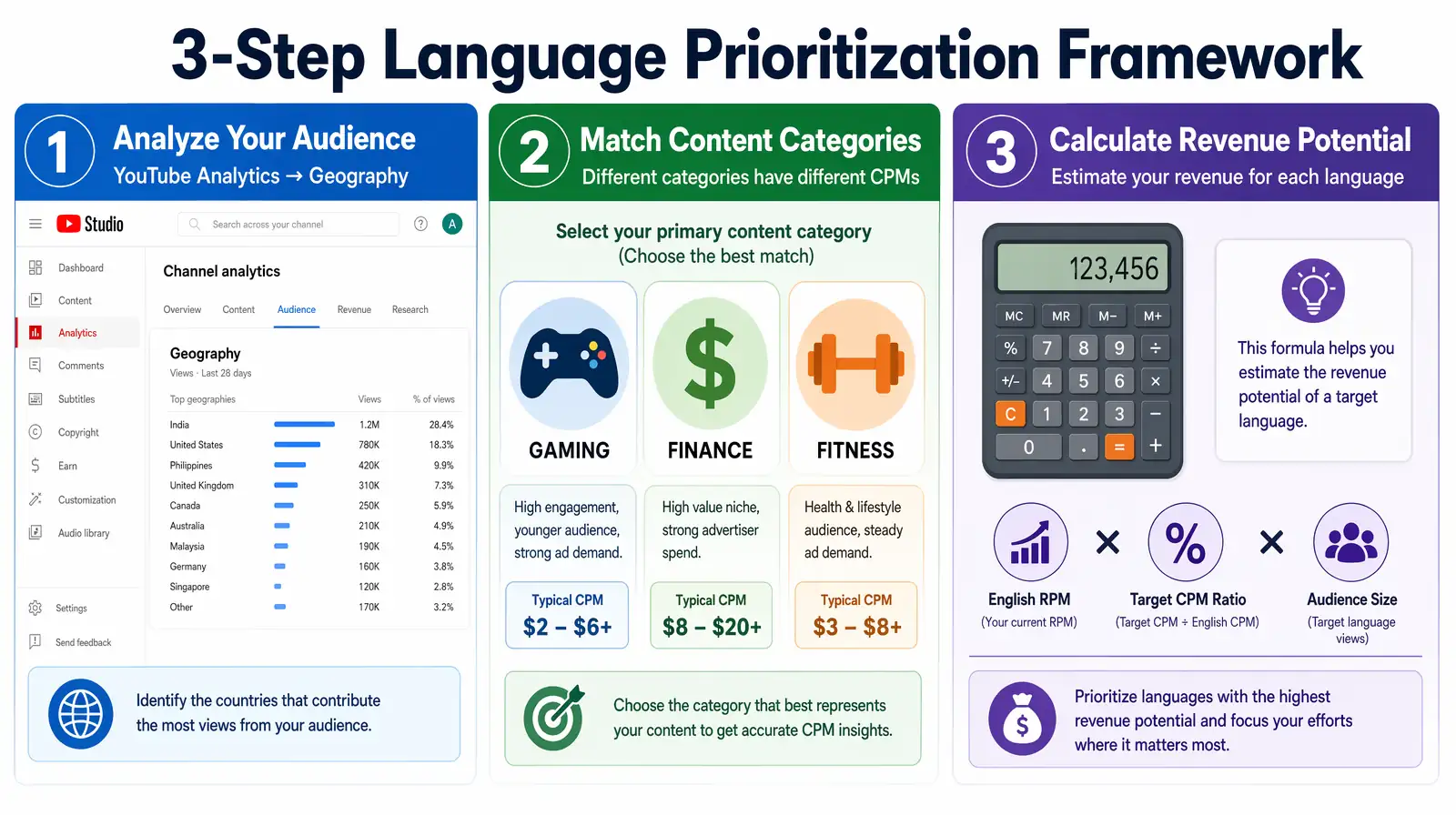
Use YouTube Analytics geography data, content-category matching, and a quick revenue calculation to pick the right first language for your channel.
Navigate to YouTube Studio → Analytics → Audience → Geography. Sort by watch time, not just views. The countries where you already have organic viewership — despite not publishing in their language — represent your strongest translation opportunities, because demand already exists without any localized supply.
| Content Category | Priority Language Order |
|---|---|
| Gaming | Japanese, Korean, German, Spanish |
| Finance / investing | German, Japanese, Arabic, Spanish |
| Fitness / health | Spanish, Portuguese (BR), Hindi |
| Tech / software | German, Japanese, Korean, Spanish |
| Educational / how-to | Spanish, Hindi, Portuguese (BR), French |
| Beauty / fashion | Korean, French, Spanish, Japanese |
| Food / cooking | Spanish, Japanese, French, Hindi |
| Business / entrepreneurship | German, Spanish, Portuguese (BR), Arabic |
For a simple estimate: take your current average revenue per 1,000 views in English, multiply by the target-language CPM ratio, then multiply by the estimated audience size you'd reach. This gives a rough break-even timeline for the translation investment. A finance channel currently earning $8 per 1,000 English views could expect $12–$20 per 1,000 views from a German-dubbed version in the same category — often breaking even within the first 500 German views.
The cost of translating a video into 10 languages depends entirely on the method:
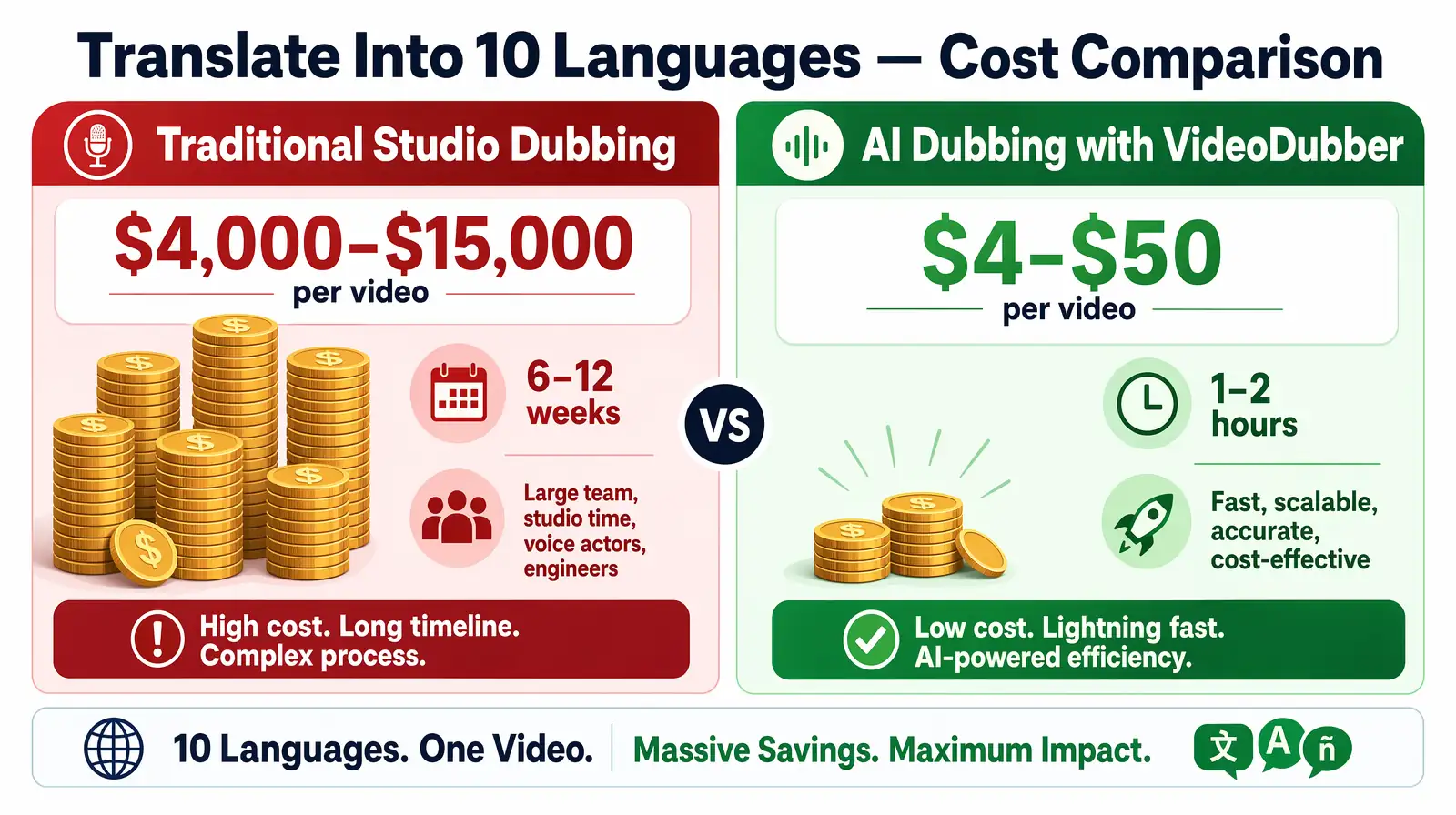
AI dubbing platforms like VideoDubber translate one video into 10 languages for under $50, compared to thousands of dollars with traditional studios.
| Method | Cost per Video (10 languages) | Turnaround |
|---|---|---|
| Traditional studio dubbing | $4,000–$15,000 per video | 6–12 weeks |
| Human freelance translators + voice actors | $1,500–$6,000 per video | 2–4 weeks |
| AI dubbing (VideoDubber) | $4–$50 per video | 1–2 hours |
| AI subtitles only | $0–$10 per video | Minutes |
AI dubbing with VideoDubber costs roughly $0.09 per minute per language. A 10-minute video into 10 languages costs under $10 total. For a YouTube creator publishing 4 videos per month into 10 languages, the monthly translation cost is typically under $50 — a fraction of what a single sponsored post earns. The economics have changed so dramatically that the old objection — "translation is too expensive" — simply doesn't apply to AI-powered workflows.
For revenue-ROI calculation: if a 10-minute video earns $50 in English and translation costs $10, you need only a 20% revenue uplift across all 10 languages to break even — a threshold most creators hit within their first few translated uploads. Teams that commit to consistent multilingual publishing typically see cumulative non-English revenue exceed English revenue within 12–18 months.
AI video dubbing is the process of automatically replacing a video's source-language audio with translated voiceover in one or more target languages, using voice cloning to preserve the original speaker's vocal identity across all versions. Here is the practical workflow for translating your content into multiple languages using VideoDubber:
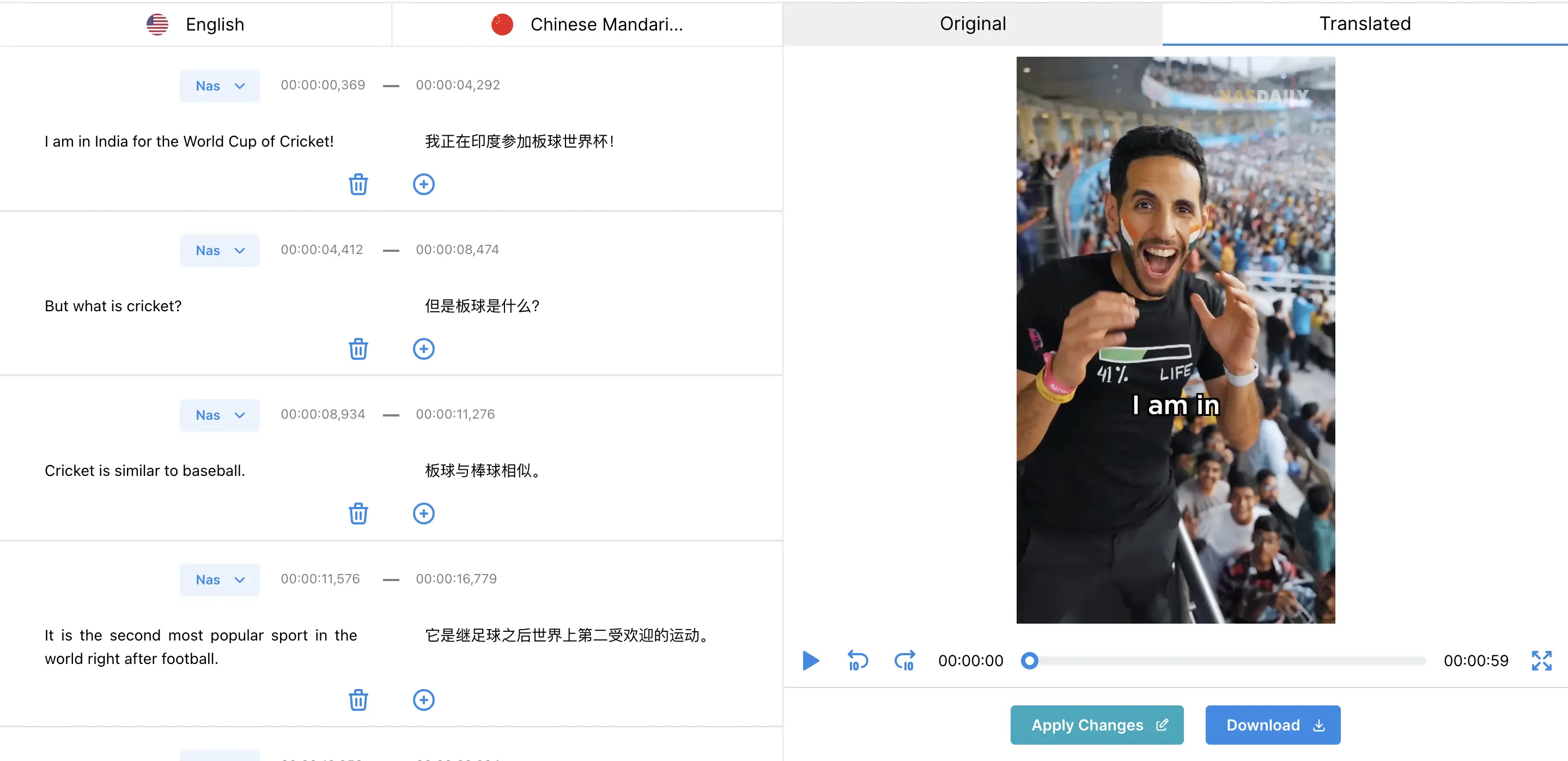
AI translation with voice cloning across languages
Upload your English (or source language) video to VideoDubber. Supported formats include MP4, MOV, AVI, MKV, and WebM. For best results, use a clean audio track with minimal background noise — the voice cloning model produces higher fidelity output when the source voice is clearly isolated.
Choose the languages from your priority list — VideoDubber supports 150+ languages, and you can select all 10 at once since the platform processes them in parallel. For creator channels, enable voice cloning so your dubbed videos sound like you speaking Spanish, Hindi, German, and the other target languages. This voice consistency across languages is a major differentiator for channel brand identity and builds audience trust with non-English viewers who would otherwise hear an unfamiliar voice.
After processing (typically 5–15 minutes for a 10-minute video into 10 languages), preview each dubbed version — check the first 30 seconds and the CTA section of each language for quality, then export all versions. On YouTube, publish each language version as a separate video in the target language with native-language titles, descriptions, and tags — not translated English ones — to optimize for discovery in each market. Create a language-specific playlist for each language to concentrate engagement signals.
For additional guidance on specific translation approaches, see how to translate videos without subtitles and how to translate videos into multiple languages at once.
For most content creators, Spanish is the best first language to translate into. It provides the largest accessible audience gain — 550 million Spanish speakers across Latin America, Spain, and the US — with good monetization potential and strong engagement metrics. The exception is creators already seeing significant organic viewership from a specific country: if your YouTube Analytics shows 15% of watch time from India with no Hindi content, Hindi becomes your immediate first priority.
German consistently has the highest CPM among non-English languages on YouTube, with ranges of $8–$25 depending on content category. Japanese is a close second at $6–$18. For revenue-per-view optimization, a German translation often outperforms a Spanish translation even though Spanish reaches a much larger audience — because German advertisers pay a premium per thousand impressions, according to industry CPM benchmarks tracked by Semrush and Tubics.
Translating YouTube videos into multiple languages measurably grows subscribers — creators who have published dubbed versions of their top-performing videos consistently report 20–60% subscriber growth in the first 90 days after launching translated versions, with the growth entirely attributable to the new-language audience. The key is publishing as separate videos with native-language titles and descriptions, not just adding dubbed audio as an alternative audio track on the same video.
For informational, educational, and entertainment content, AI video translation achieves 85–95% of professional human translation quality for major language pairs. Native speakers can usually identify AI-translated content if they look carefully, but the quality is well above the threshold needed to engage and retain viewers. For creative or marketing content requiring cultural nuance, an AI translation with human review is the recommended workflow — VideoDubber supports this hybrid approach through an editable transcript review step before final export.
Dubbing consistently outperforms subtitles for viewer engagement and retention. Viewers watching in their native language complete more of each video, engage more with CTAs, and subscribe at higher rates than subtitle viewers, who must divide attention between watching and reading. Subtitles are a lower-cost option and still provide significant value, but if the goal is maximizing watch time and channel growth, dubbing is the superior strategy — and the availability of affordable AI dubbing means the cost difference no longer justifies choosing subtitles over dubbing.
With an AI dubbing platform like VideoDubber, processing a 10-minute video into 10 languages takes approximately 15–30 minutes total. All languages are processed in parallel, so 10 languages does not take 10x longer than 1 language. Compare this to 6–12 weeks for traditional studio dubbing or 2–4 weeks for human freelance workflows — the time advantage of AI dubbing alone justifies the transition for any creator publishing at regular cadence.
For most topic-based channels (tech, finance, gaming, cooking), publishing translated videos on the same channel with language-specific playlists works well — it concentrates audience signals on one channel and benefits from combined algorithmic performance. Separate channels make sense for content where language is the primary differentiator (language learning, culturally specific lifestyle content) or where audience expectations differ sharply by region. Both strategies work; the same-channel approach is easier to manage and is typically recommended for creators starting their multilingual journey.
After establishing the top 10 languages, the next tier to consider includes: Turkish (highly engaged digital audience, growing ad market), Vietnamese (young tech-savvy population, rapidly growing), Thai (Southeast Asia's second digital economy), Swahili (covers East Africa's rapidly digitizing population), and Bengali (250+ million speakers, significant emerging digital market in Bangladesh and India). Each of these languages has limited localized creator competition relative to audience size — an ideal early-mover window that mirrors what Indonesian and Arabic represented five years ago.
Translate your videos into all 10 languages today with VideoDubber →
How to translate videos to multiple languages with AI dubbing in minutes. Step-by-step workflow, cost data, voice cloning tips, and distribution strategy.
Learn how to translate videos without subtitles using voice-only dubbing. Step-by-step guide for 2026: when to use it, best tools, and how to turn off subs for a clean, professional look.
Translate training & internal videos at scale with AI. Step-by-step pipeline, cost data, voice cloning, glossary setup, and ROI benchmarks for L&D teams.
Translate training videos for global teams: OSHA compliance, AI vs dubbing vs subtitles, step-by-step workflow, cost data, and best practices. 2026 guide.
How to edit translated videos online: fix subtitles, timing, and voice settings. Step-by-step workflow, pro tips, and unlimited free edits on VideoDubber.