The most expensive support ticket is the one that could have been avoided.
Customers prefer self-help. They would rather watch a 2-minute video on "How to Reset Your Password" than wait 24 hours for an email reply. But if that video is not in their language, they will open that ticket. Multilingual dubbing for customer support videos is one of the highest-ROI investments in your support stack—and with AI-powered platforms, it is now achievable without a studio budget. This guide explains why, and how to do it at scale.
Multilingual dubbing is the process of replacing a video's original spoken audio with a translated voiceover in another language, often using AI voice cloning to preserve the speaker's tone and style. For customer support, this means a single master video can serve your Spanish, French, Japanese, and German-speaking customers just as effectively as your English-speaking ones.
Effective self-service content, including localized video, can deflect 30–50% of incoming support tickets, according to industry benchmarks from Gartner and Forrester. At scale, that deflection translates to hundreds of thousands—or millions—of dollars in annual savings.
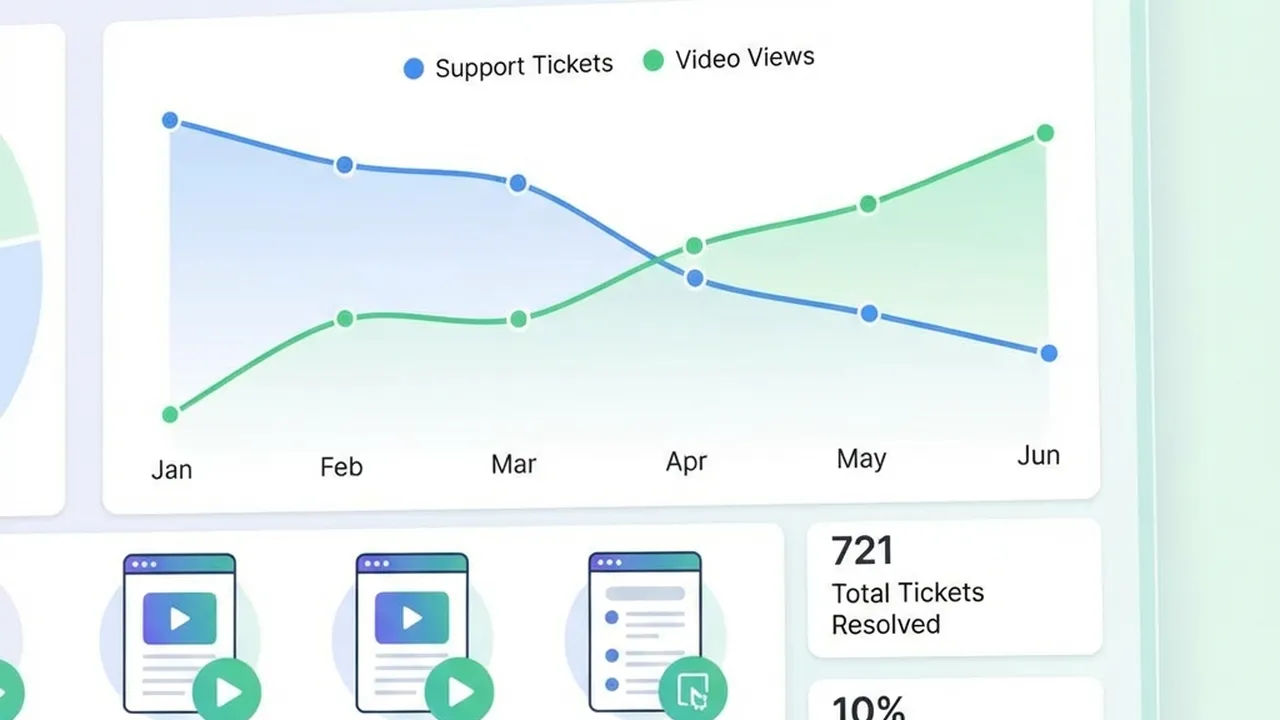
Multilingual dubbing for customer support videos: one master recording, many languages, measurable ticket deflection.
What This Guide Covers
Whether you're a support lead, a head of CX, or a founder scaling globally, these are the questions this guide answers:
| Question | Section |
|---|---|
| Does multilingual support video really reduce tickets? | The ROI of Localized Support Video |
| How much does a support ticket cost vs. self-service? | Cost of Support: By the Numbers |
| Why video instead of translated text articles? | Why Text Articles Are Not Enough |
| Dubbing vs. subtitles—which should I use? | Dubbing vs. Subtitles: Why Dubbing Wins for Support |
| How does multilingual dubbing actually reduce ticket volume? | The Ticket Reduction Mechanism Explained |
| How do I scale support videos to many languages affordably? | How to Scale Video Support Without Burning Budget |
| What's the step-by-step workflow for implementation? | Step-by-Step: Implementing Multilingual Support Videos |
| Which languages should I prioritize? | Which Languages Should You Prioritize? |
| What tools or software do I need? | Tools for Multilingual Support Video |
| What are best practices and common pitfalls? | Best Practices for Support Video Localization |
| Frequently asked questions | Frequently Asked Questions |
The ROI of Localized Support Video
Localizing your support videos into your customers' languages delivers measurable returns in three main areas: ticket deflection, customer satisfaction, and churn reduction. Together, these create a compounding ROI that grows with your user base.
1. Ticket Deflection: Direct Cost Savings
Ticket deflection is a customer support metric that measures the percentage of potential support tickets resolved through self-service channels—such as videos, FAQs, or knowledge bases—before a customer contacts a live agent.
Every time a user watches a localized support video and solves their issue independently, you avoid the cost of an agent-handled ticket. The cost difference between self-service and assisted support is dramatic:
| Channel | Typical cost per resolved issue |
|---|---|
| Self-service (video + KB) | $0.50–$2.37 per resolved issue |
| Email / chat support | $5–$25 per ticket |
| Phone support | $15–$60+ per ticket |
| B2B enterprise support | $30–$60 per ticket |
Source: Gartner benchmark data; Forrester Research on customer service cost per contact.
Studies consistently show that 30–50% of incoming support tickets can be deflected with effective self-service documentation. For companies with 10,000 tickets per month, a 40% deflection rate at an average ticket cost of $15 yields $720,000 in annual savings. Multilingual dubbing ensures that deflection works for all your key markets, not just English speakers.
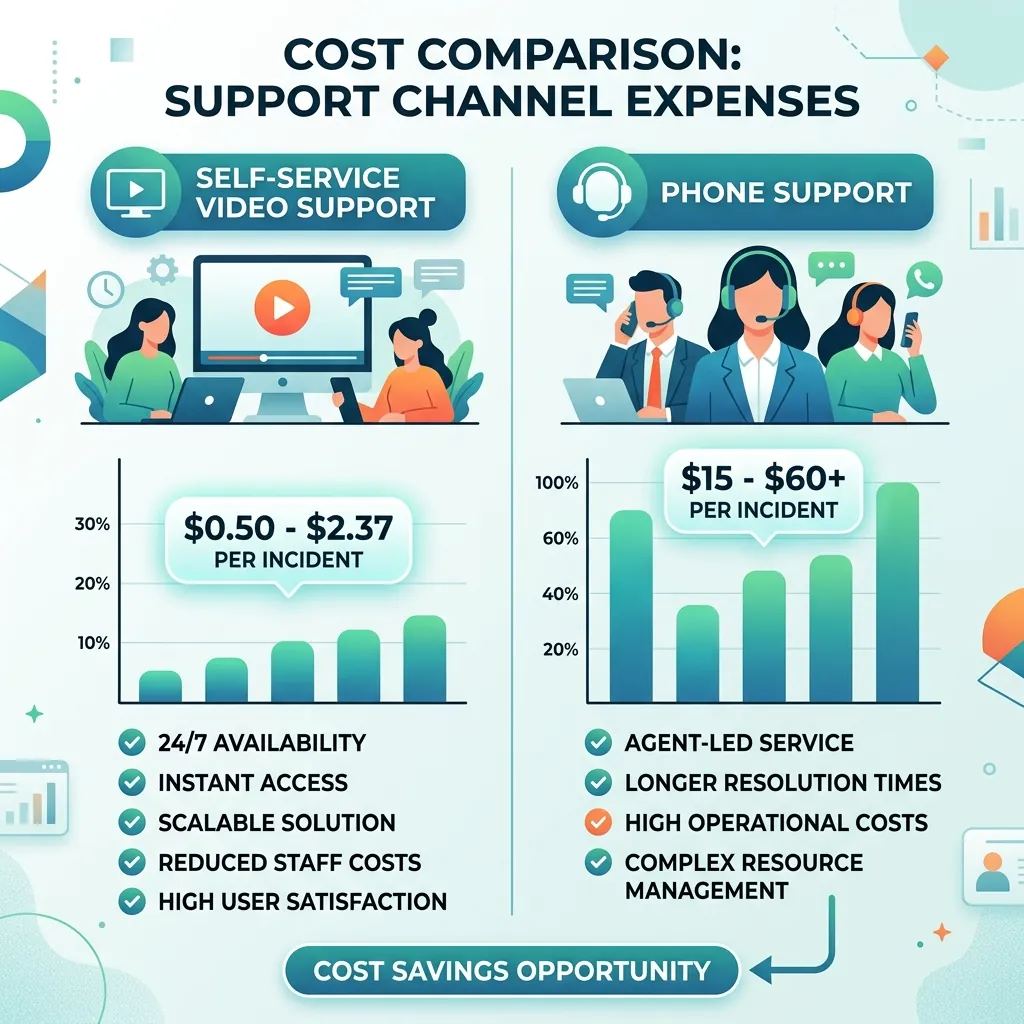
Comparing the cost of self-service video support vs. traditional phone and agent-led channels.
2. Customer Satisfaction (CSAT)
Customers feel valued when help is available in their language. Localized video-based support is consistently linked to higher customer satisfaction scores, and the data supports this:
- First-contact resolution rates improving from roughly 65% to 85% in organizations that deploy localized video support, according to Zendesk's 2025 Customer Experience Trends Report.
- CSAT scores rising from ~75% to ~92% in companies that implement video-first localized help centers.
- Average handle time dropping by 30–40% when agents are still needed, because customers arrive with more context from having watched a video first.
Satisfied customers are more likely to renew, expand their account, and recommend your product. Localized video support directly supports all three outcomes.
3. Churn Reduction
Frustration drives churn. When customers cannot find answers in a language they are comfortable with, they open tickets, wait longer, feel underserved, and often leave. Quick, accessible, localized answers keep customers in the product and reduce involuntary churn. For SaaS and subscription businesses, a 5% reduction in churn can increase profitability by 25–95% over the customer lifetime, according to research by Bain & Company.
Cost of Support: By the Numbers
Understanding the true cost per ticket makes the ROI of deflection obvious. The average cost of an agent-handled support ticket is $13.50, compared to just $1.84 for self-service resolution, according to Gartner—a 7× difference that compounds at scale.
Cost per Ticket by Industry (Assisted Support)
| Industry | Typical cost per ticket (assisted) |
|---|---|
| Retail e-commerce | $2.70–$5.60 |
| SaaS support | $18–$35 |
| High-tech product support | $28–$35 |
| B2B enterprise support | $30–$60 |
| Telecom and utilities | $20–$30 |
Sources: Gartner (median ~$13.50 per contact for assisted channels; ~$1.84 for self-service), Zendesk industry benchmarks.
The Hidden Multiplier: Repeat Contacts
The real cost is often higher than a single ticket. With an average of about 2.3 contacts per issue (Forrester Research), the cost per resolved issue is 2.3× the cost per contact. First-contact resolution rate is therefore a critical lever—and localized video self-service improves it by giving customers the complete information they need on the first interaction, in their language.
Self-Service vs. Assisted: The Gap
| Resolution type | Typical cost per resolved issue |
|---|---|
| Self-service (video + knowledge base) | $0.50–$2.37 |
| Agent-handled (email, chat, phone) | $5–$60+ (by industry) |
Shifting a meaningful share of volume to self-service—say, 30–50%—can yield $240K–$1.7M+ in annual savings depending on volume and channel mix. Multilingual dubbing ensures that self-service capability extends to all your key markets.
Why Text Articles Are Not Enough
You may already have a knowledge base in multiple languages. That is valuable—but video is superior for many of the issues that generate the most tickets and the most frustration.
When Video Beats Text
| Use case | Why video wins |
|---|---|
| Software walkthroughs | Users see exactly where to click and in what order; no ambiguity about which button or menu item to use. |
| Physical product assembly | Steps are shown visually; fewer wrong assemblies, returns, and follow-up contacts. |
| Troubleshooting hardware | "Do it exactly like this" is clearer than three paragraphs and a screenshot grid. |
| Complex or multi-step flows | Comprehension and retention are significantly higher with video than with text for procedural content. |
| Account or billing issues | A 90-second screen recording eliminates confusion that text alone cannot resolve. |
What the Data Says
- 68% of consumers prefer watching a video to reading a text article when troubleshooting a product issue, per a Wyzowl survey on customer support preferences.
- People retain approximately 65% of visual information versus roughly 10% of text-only content, according to research published in Educational Technology & Society.
- 80% of consumers say they would rather watch a product video than read a text description to resolve a problem, per HubSpot's State of Video Marketing report.
So even with translated articles, adding localized support videos—and especially dubbed ones—addresses preference, comprehension, and deflection in a way that text alone cannot match.

Visual walkthroughs provide clearer instructions than long-form text articles for complex support topics.
Dubbing vs. Subtitles: Why Dubbing Wins for Support
You have two main options for making support videos understandable in other languages: subtitles (translated text on screen) or dubbing (replacing the spoken track with the target language). For support content, the choice matters more than most teams realize.
Quick Comparison
| Factor | Subtitles | Dubbing |
|---|---|---|
| Eyes on screen | Viewer reads text, may miss UI elements or steps | Viewer watches the screen and listens in their language |
| Literacy / accessibility | Requires reading fluency and reading speed | Better for low literacy, audio learners, multitasking |
| Tone and clarity | Original tone in foreign voice; translation in text | Full control of tone and pacing in local language |
| Follow-along support | User may pause to read and lose their place in the steps | User follows steps in real time without breaking focus |
| Cultural feel | Foreign speaker + local text = "this wasn't made for me" | Native-language audio = "this was made for me" |
| Market preference | Some Northern European and CJK markets | Standard preference in Latin America, MENA, South Asia |
For support and how-to content, the goal is "follow along and do it." Dubbing lets users listen in their language while watching the screen. That is especially important for:
- Step-by-step tutorials and product demos where eyes must stay on UI elements.
- Users who prefer or need audio (accessibility, multitasking, mobile users).
- Markets where dubbed localization is the norm (many European, Latin American, and Asian locales).
Best practice: Where possible, offer both dubbed audio and optional subtitles/captions for accessibility and preference. Tools like VideoDubber generate both simultaneously, so there is no extra cost or workflow complexity to offer both formats to every user.
The Ticket Reduction Mechanism Explained
The mechanism connecting multilingual dubbing to ticket reduction is direct and measurable:
-
More users can access self-service. English-only (or subtitle-only) content leaves non-English speakers with no effective self-service option. They open a ticket instead.
-
Higher completion and resolution success. When the narration is in the viewer's language, they are more likely to watch to the end and successfully complete the task. Fewer "I tried the article but it didn't work" tickets.
-
Fewer repeat contacts. Better comprehension means fewer repeat contacts for the same issue, cutting the 2.3× multiplier effect on cost per resolved issue.
-
Consistent quality at scale. AI-powered dubbing with voice cloning and lip-sync lets you turn one master video into many languages without re-shooting or hiring a studio per language—so you can afford to cover all priority locales, not just the top one or two.
-
Agents handle fewer escalations. When customers self-resolve with video, the tickets that reach agents are higher-complexity issues that genuinely need human judgment, improving agent utilization and reducing average handle time.
How to Scale Video Support Without Burning Budget
You cannot film a new support agent or hire a studio for every language. The scalable approach is simpler than most teams expect:
Step 1: Record once. Create a single, high-quality screencast or talking-head video per support topic in your primary language (typically English). Focus on clear audio and clean UI capture.
Step 2: Translate and dub with AI. Upload to a platform like VideoDubber that handles transcription, translation, voiceover with voice cloning, and lip-sync. The result: a dubbed video that sounds like the same support agent speaking the target language.
Step 3: Publish everywhere. Embed or link these dubbed videos in your Help Center, in-app help widgets, chatbot responses, and community articles—per language. Link them from relevant knowledge base articles so users find the video version naturally.
That is a one-time production cost per topic, then marginal cost per language using AI dubbing. No native presenters in front of a camera for each locale. No studio bookings per language. No per-update re-recordings across language versions.
VideoDubber enables support teams to convert a single master support video into dubbed versions in 150+ languages, using voice cloning and lip-sync, with each language version generated in minutes and ready to embed directly in Zendesk, Intercom, Freshdesk, or any Help Center platform.
Step-by-Step: Implementing Multilingual Support Videos
A practical, repeatable workflow for support teams of any size:
| Step | Action | Notes |
|---|---|---|
| 1. Audit | List top 20–50 support topics by ticket volume or help center search queries. Identify which are best solved by video: flows, UI, assembly, troubleshooting. | Use Zendesk, Intercom, or Freshdesk analytics to identify highest-volume topics. |
| 2. Script and record | Write a short script, record one clear screencast or talking-head per topic. Keep pacing moderate; avoid jargon. 1–3 minutes per video is optimal. | Good audio quality is the single biggest factor in dubbed output quality. |
| 3. Choose languages | Start with 3–5 languages that match your user base and revenue split (see Which Languages Should You Prioritize?). | Use support ticket data by locale to prioritize; highest ticket volume = highest ROI first. |
| 4. Dub at scale | Upload the master video to VideoDubber; select target languages; enable voice cloning and lip-sync. Get back dubbed versions in hours, not weeks. | Enable Technical Mode for product-specific terminology. |
| 5. Publish and link | Upload each version to your help platform; embed or link from relevant KB articles and in-app help widgets. | Link from the English KB article so users with language preferences are routed to their version. |
| 6. Measure | Track deflection (tickets per topic before/after), video completion rates, and CSAT by locale. Double down on high-impact topics and languages. | Set up a 30-day and 90-day review cadence to quantify ROI. |
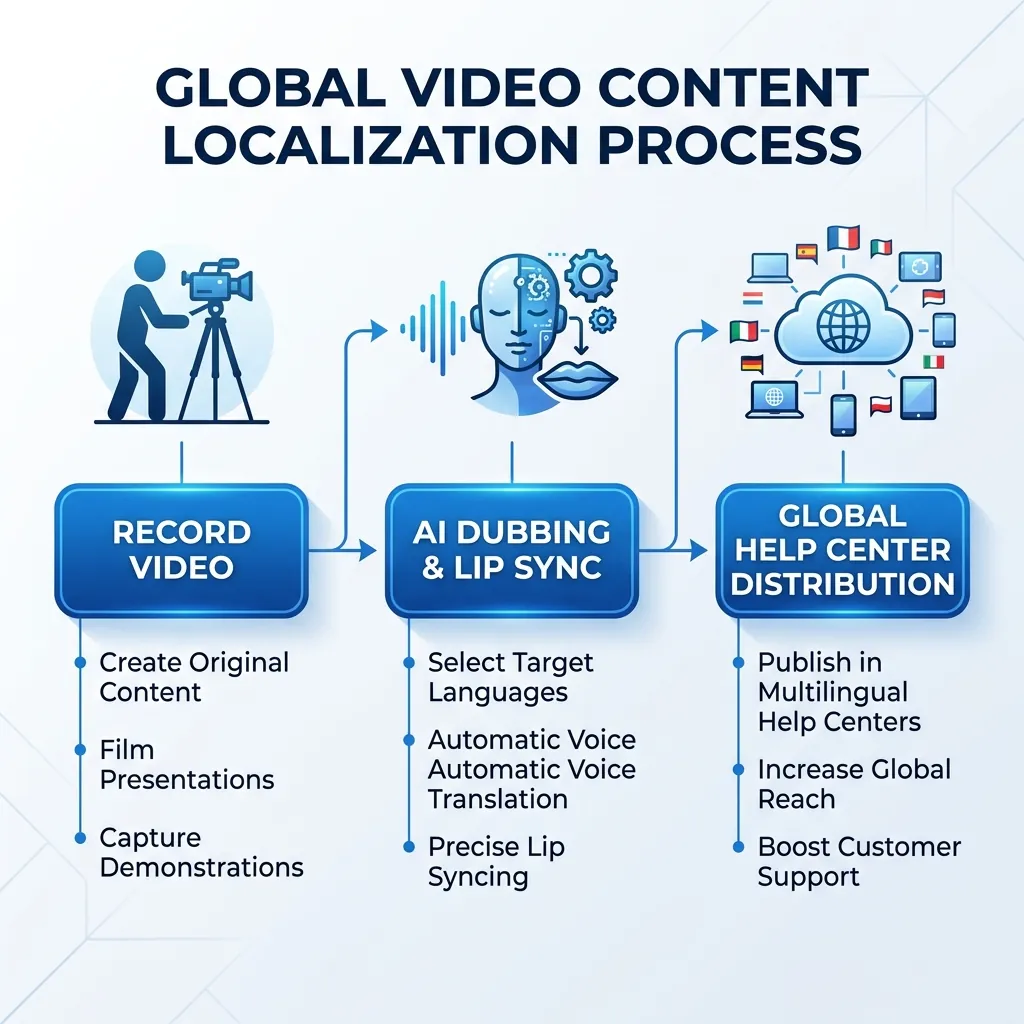
The end-to-level workflow for creating and distributing dubbed support videos globally.
Which Languages Should You Prioritize?
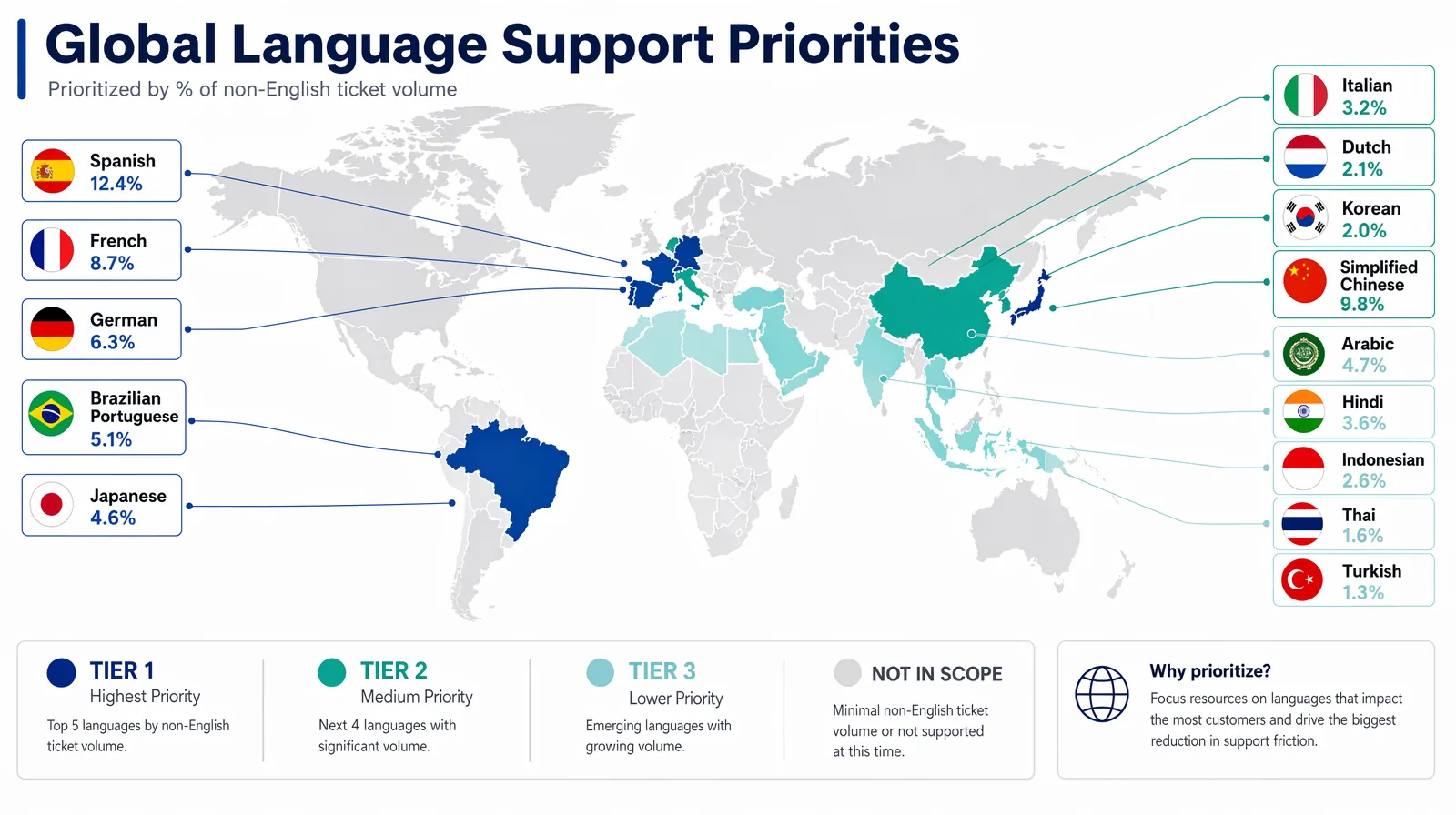
A three-tier language prioritization framework — Tier 1 covers the five languages driving 40–60% of non-English support volume for most global SaaS products.
There is no universal list; it depends on your user base, revenue split, and support volume by locale. A common starting framework for global B2B/consumer products:
| Priority | Languages | Rationale |
|---|---|---|
| Tier 1 | Spanish, French, German, Portuguese (BR), Japanese | Large markets with high support volume; often represent 40–60% of non-English ticket volume. |
| Tier 2 | Italian, Dutch, Korean, Simplified Chinese | Growth or enterprise-heavy regions; high willingness to pay; strong preference for localized content. |
| Tier 3 | Arabic, Hindi, Indonesian, Thai, Turkish | Expand once Tier 1–2 are live and measured; large upside for platforms with mobile-first APAC/MENA audiences. |
Use your support ticket data: which locales or languages generate the most tickets? Which regions have high CSAT variance compared to your English-speaking users? Those are your best candidates for localized video first. A useful signal: if a region represents 10% of your user base but 25% of your ticket volume, a language barrier is almost certainly the cause.
Tools for Multilingual Support Video
| Approach | Pros | Cons | Best for |
|---|---|---|---|
| Manual dubbing (studio) | Highest quality, full creative control | Very expensive ($50–$150+/min); slow (weeks); doesn't scale to many languages or frequent updates | One-off flagship content |
| Subtitles only | Cheaper and faster | Viewers must read while watching; less effective for follow-along support | Budget-first or quick turnaround |
| AI dubbing (e.g. VideoDubber) | One master → many languages; voice cloning + lip-sync; scalable; fast | Quality varies with source audio; best with clear recording | Scaling support library across 3+ languages |
| AI avatar + script | No filming required; generate from text | Less "real" feel; may not match your existing brand presenter | New topic creation, not localization of existing video |
| Hybrid (AI + human review) | High quality + scalability | More expensive and slower than pure AI | Compliance or regulated support content |
For scaling support videos across many languages while maintaining a human, on-brand feel, AI dubbing with voice cloning and lip-sync (e.g. VideoDubber) is the most practical: record once, dub into Spanish, Portuguese, French, Japanese, and 150+ other languages, and embed in your Zendesk Help Center, Intercom Messenger, or Freshdesk knowledge base. For more on building global support video libraries, see how to translate training videos for related workflows that apply to support content.
Best Practices for Support Video Localization
- Keep the master clean. Good lighting, clear audio (USB microphone or equivalent), and moderate pace improve both original and dubbed quality. This is the highest-leverage investment before localization.
- Use consistent terminology. Align with your existing knowledge base, product UI strings, and support macros so translations stay consistent across videos and text articles.
- Short and focused. 1–3 minutes per topic; one clear outcome per video. Split longer flows into numbered parts (e.g. "Account Setup Part 1: Connecting Your Domain").
- Pair with text. Keep a short summary or bullet list in the KB article alongside the video. Video + text improves findability, SEO, and serves users who prefer one or the other.
- Test in-market. Have a native speaker or a support agent in that locale spot-check a sample for tone, accuracy, and cultural fit before publishing to customers.
- Offer subtitles as well. Where the tool allows, provide optional captions in the same language for accessibility and for users in noise-sensitive environments.
- Link videos from relevant contexts. Embed support videos in chatbot flows, onboarding sequences, and proactive nudges—not just in the Help Center. The closer the video is to the moment of need, the higher the deflection rate.
Frequently Asked Questions
Does multilingual support video really reduce tickets?
Multilingual support video consistently reduces ticket volume when deployed correctly. Effective self-service content, including localized video, deflects 30–50% of incoming tickets, according to Gartner and Forrester benchmarks. When that content is dubbed in the customer's language—not just subtitled—more users complete the self-service flow and resolve their issue without contacting an agent, which directly reduces ticket volume and self-service abandonment rates.
How much does it cost to dub a support video into multiple languages?
Manual studio dubbing costs $50–$150+ per minute per language, meaning a 3-minute support video in five languages could cost $750–$2,250+ per batch. AI dubbing with a platform like VideoDubber costs a fraction of that—often a few dollars per minute per language—and scales to many languages from one master. Total cost per language drops sharply as you process more content, making it economically viable to localize your entire top-50 support topic library.
Dubbing vs. subtitles for support videos: which should I use?
For support and how-to content, dubbing is almost always the better choice: users can watch the screen and follow steps while listening in their language, without reading. Subtitles require split attention—reading and watching simultaneously—which increases cognitive load and causes users to miss UI steps. Use subtitles as a complement for accessibility and for users who prefer them. Where possible, offer both dubbed audio and subtitles in the same video for maximum reach.
How do I scale to 10+ languages without hiring more people?
Record one master video per topic, then use AI dubbing (e.g. VideoDubber) to generate translated, dubbed versions with voice cloning and lip-sync. Publish each version in your Help Center and in-app help. No native presenters in front of the camera per language, no studio bookings per locale. One upload, one click per language selection, and your content team's output multiplies by however many languages you need.
Which support topics should I turn into video first?
Start with topics that drive the most tickets and are visual or procedural by nature: password reset, checkout flow, account settings changes, software installation, product assembly, billing management, or returns. Use your ticket analytics and help center search data to identify the top 20–50 topics. These are the highest-ROI candidates because they combine high volume with content that video communicates better than text.
Will AI-dubbed support videos sound robotic or unnatural?
Modern AI dubbing with voice cloning keeps the original speaker's tone and style, so the result sounds like the same support team member speaking the target language rather than a generic synthetic voice. Quality is best with clear, clean source audio and supported language pairs. Always spot-check a sample with a native speaker before rolling out to customers—most teams report that voice-cloned dubbing is indistinguishable from a re-recorded session for most language pairs.
How do I measure the ROI of multilingual support videos?
Track these metrics before and after publishing localized videos: ticket volume per topic (per locale), help center article views alongside video completion rates, CSAT scores by language/locale, average handle time, and first-contact resolution rate. Run the analysis at 30 and 90 days. Most platforms see measurable ticket deflection within the first 30 days for high-volume topics, with full ROI breakeven typically occurring within 3–6 months of deployment.
Is AI dubbing compliant with data privacy requirements for customer data in support videos?
Support screen recordings often contain user data (names, account details, UI elements). When using an AI dubbing platform for support video localization, ensure the vendor encrypts data in transit and at rest, does not use your video content for model training, and complies with your data residency requirements (GDPR, CCPA, etc.). VideoDubber processes support videos with data privacy in mind, making it suitable for organizations with strict data handling policies.
Summary: Make Support Videos Multilingual to Cut Tickets and Cost
- The most expensive ticket is the one that could have been avoided. Customers prefer self-help, but only if it is available in their language.
- Localized support videos—especially dubbed—deflect 30–50% of tickets in many setups, with self-service costing $1.84 vs. $13.50 for agent-handled contacts, according to Gartner.
- Video beats text for software walkthroughs, assembly, and troubleshooting; dubbing beats subtitles for follow-along support in most markets.
- Scale by recording once and using AI dubbing (e.g. VideoDubber) to produce many languages with voice cloning and lip-sync, then embedding in Zendesk, Intercom, Freshdesk, or any Help Center.
- Measure deflection and CSAT by locale; start with your highest-volume topics and top 3–5 languages, then expand based on data.
Start with your highest-volume topics and top 3–5 languages, measure deflection and CSAT, then expand. One-time production plus scalable dubbing pays off in reduced support volume and happier customers—in every language you serve.
Further Reading
How to Add Multilingual Audio Tracks to a Video: YouTube & Beyond [2026]
How to add multilingual audio tracks to YouTube videos: AI dubbing workflow, step-by-step upload guide, and platform strategy for global reach.
Top 10 Languages to Translate Your Videos for Maximum Reach [2026 Guide]
Top languages to translate videos into in 2026: CPM data, audience sizes, prioritization framework by content type, and full AI dubbing cost breakdown.
How to Translate Videos to Multiple Languages: The Complete 2026 Guide
How to translate videos to multiple languages with AI dubbing in minutes. Step-by-step workflow, cost data, voice cloning tips, and distribution strategy.
Video Localization vs. Translation vs. Dubbing: Complete Guide [2026]
Video localization vs. translation vs. dubbing: full 2026 guide with cost tables, use-case matrix, AI dubbing workflow, and expert verdict on which to choose.
How to Translate Videos Without Subtitles: Complete Voice-Only Guide [2026]
Learn how to translate videos without subtitles using voice-only dubbing. Step-by-step guide for 2026: when to use it, best tools, and how to turn off subs for a clean, professional look.