

Video Localization for EdTech: Reaching Global Students Faster
March 15, 2026 14 mins read
The mission of EdTech is to democratize education. But if your content is locked behind a language barrier, you are only reaching a fraction of potential learners. Video localization—translating and adapting your course videos into multiple languages, often with dubbing or subtitles—is the key to unlocking global classrooms. This guide explains why it matters, how to do it at scale, and which approaches deliver the best outcomes for students and for your platform.
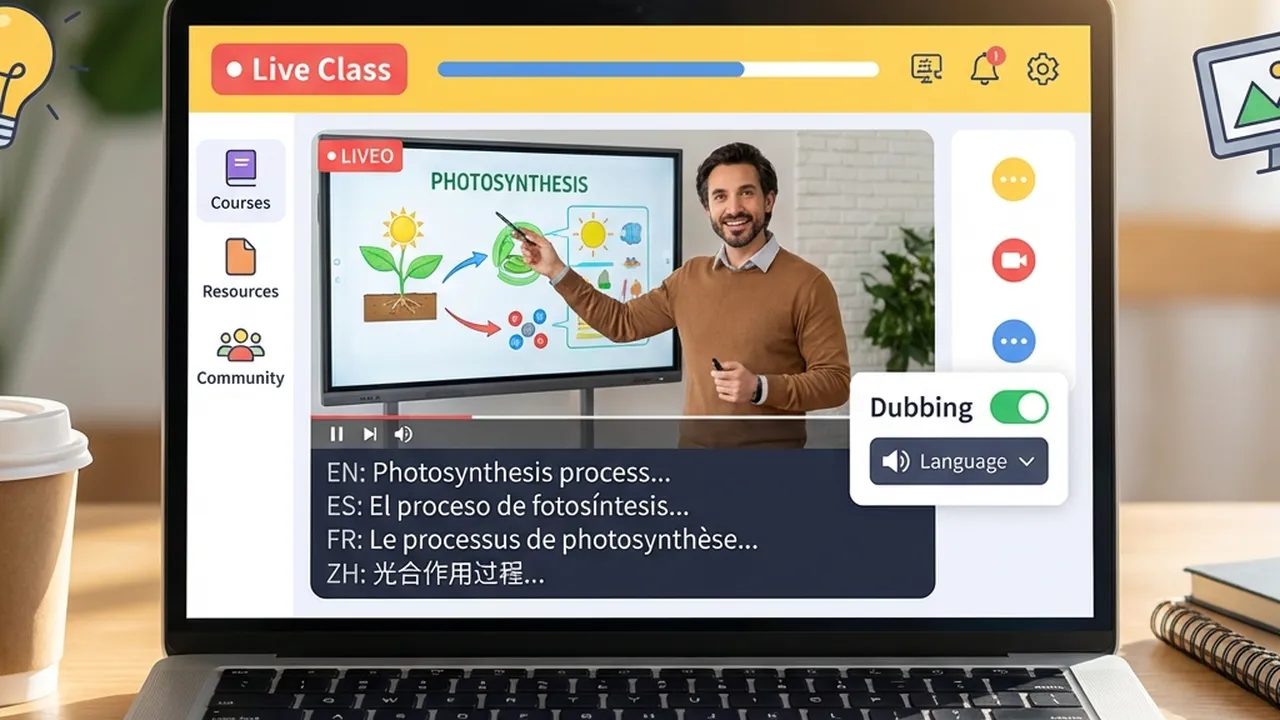
EdTech Global Students
Whether you're an EdTech product lead, a content director, or a founder expanding into new markets, you likely have one or more of these questions:
| Question | Where to find it |
|---|---|
| Why does EdTech need video localization? | The Barriers to Global Education |
| Dubbing vs. subtitles for education—which is better? | Dubbing vs. Subtitles for Learning |
| How much does it cost, and how can I scale? | Cost and Scale: Traditional vs. AI Localization |
| What's the step-by-step workflow? | Step-by-Step: Implementing Video Localization for EdTech |
| Which languages should I prioritize? | Which Languages to Prioritize for EdTech |
| What tools or solutions should I use? | Tools for EdTech Video Localization |
| How do I preserve the instructor's voice and tone? | Preserving the Instructor's Tone |
| Any best practices or pitfalls? | Best Practices for Educational Video Localization |
| What results can I expect? | Case Study: Coding Bootcamps |
Three main barriers keep EdTech from reaching global students at scale: comprehension, cost, and time.
Students learn best in their native language. Studies consistently show that comprehension and retention improve significantly when instructional content is delivered in the learner's first language rather than via subtitles or second-language instruction alone.
| Factor | Subtitles only | Dubbed / localized audio |
|---|---|---|
| Cognitive load | Split attention between reading and watching | Full attention on visuals and concepts |
| Retention | Lower when learners must read and watch | Higher when listening in native language |
| Accessibility | Requires reading fluency and speed | Works for varied literacy levels and learning styles |
| Emotional connection | Often weaker | Instructor's tone and emphasis preserved |
Subtitles help, but audio dubbing increases retention rates significantly because learners can focus on the material instead of decoding text. For complex or technical subjects—coding, math, science—this difference can determine whether a student completes a course or drops out.
Dubbing thousands of hours of course material with traditional studios is prohibitively expensive for most EdTech companies. Studio dubbing typically runs $50–$150+ per minute per language (voice talent, direction, mixing). A 10-hour course in five languages can easily reach six figures—before updates and new courses.
| Approach | Typical cost per minute (per language) | Scale to 10+ languages? |
|---|---|---|
| Traditional studio dubbing | $50–$150+ | Rarely; cost multiplies linearly |
| Freelance voiceover (no lip-sync) | $20–$80 | Possible but slow and inconsistent |
| AI dubbing (e.g. VideoDubber) | A fraction of studio cost | Yes; one master → many languages |
Without a scalable solution, global expansion stays out of reach for all but the best-funded platforms.
The academic year and enrollment cycles are fixed. Delays in translation mean missed semesters, late product launches in new regions, and lost revenue. Manual localization can take weeks or months per language; by the time content is ready, the window may have closed. Speed to market is a competitive advantage—and often a requirement—for EdTech going global.
You have two main options for making educational videos understandable in other languages: subtitles (translated text on screen) or dubbing (replacing the spoken track with the target language).
| Factor | Subtitles | Dubbing |
|---|---|---|
| Eyes on content | Viewer reads text; may miss diagrams or code | Viewer watches and listens; full focus on material |
| Cognitive load | High (read + watch + process) | Lower (listen in native language) |
| Technical subjects | Code, equations, or diagrams compete with text | Narration explains while learner watches the screen |
| Instructor presence | Voice in original language; translation in text | Same “instructor” speaking learner’s language (with voice cloning) |
| Accessibility | Depends on reading fluency | Better for varied literacy and preference |
For education, the goal is comprehension and retention. Dubbing lets students listen in their language while watching demos, code, or slides—reducing cognitive load and improving outcomes. Best practice: Offer both dubbed audio and accurate subtitles (e.g. SRT) so students can choose and so content is accessible to deaf or hard-of-hearing learners.
Understanding cost and scale helps you choose a sustainable strategy.
| Method | Cost per minute (per language) | Turnaround | Best for |
|---|---|---|---|
| Studio dubbing | $50–$150+ | Weeks | Small volume, premium brand |
| Freelance VO | $20–$80 | Days–weeks | Moderate volume, limited languages |
| AI dubbing | Few dollars per minute | Hours | Large libraries, many languages |
| Subtitles only | $1–$15 | Fast | Budget-first; lower retention impact |
Actual costs vary by language pair, length, and provider.
With AI-powered dubbing, you upload a single master (e.g. an English lecture). The system translates, generates natural-sounding speech (often with voice cloning so the professor still “sounds like themselves”), and syncs to video. Result: one production → many languages in hours, not months. That makes it feasible to localize entire course catalogs and keep them updated as curricula change.
A practical workflow:
| Step | Action |
|---|---|
| 1. Audit content | List core courses or playlists by enrollment and revenue. Start with top 10–20 courses or “gateway” modules that unlock further learning. |
| 2. Prepare masters | Ensure source video has clear audio, minimal background noise, and consistent pacing. Export in a format your dubbing tool accepts. |
| 3. Choose languages | Prioritize 3–5 languages based on your user base, growth markets, and enrollment goals (see Which Languages to Prioritize for EdTech). |
| 4. Dub at scale | Upload playlists or batches to your localization platform (e.g. VideoDubber). Select target languages; use voice cloning if you want to preserve the instructor’s voice. |
| 5. Generate subtitles | Export SRT or equivalent caption files for each language for accessibility and optional use. |
| 6. Publish and track | Publish localized versions in your LMS or player. Track completion rates, engagement, and enrollment by language to refine priorities. |
There’s no single “right” list; it depends on your current users, target markets, and growth strategy. A common starting set for global EdTech:
| Priority | Often included | Rationale |
|---|---|---|
| Tier 1 | Spanish, Portuguese (BR), Hindi, Mandarin Chinese | Huge learner bases; high demand for upskilling and K–12. |
| Tier 2 | French, Arabic, Indonesian, Vietnamese | Fast-growing markets; government and institutional adoption. |
| Tier 3 | German, Japanese, Korean, Thai, etc. | Expand once Tier 1–2 are live and you have engagement data. |
Use your analytics: where do sign-ups and demand come from? Which regions have the highest drop-off on English-only content? Those are strong candidates for localization first.
| Approach | Pros | Cons |
|---|---|---|
| Manual dubbing (studio) | Highest quality, full creative control | Very expensive and slow; doesn’t scale to large catalogs or many languages. |
| Subtitles only | Cheaper and faster than dubbing | Higher cognitive load; lower retention than dubbing for many learners. |
| AI dubbing (e.g. VideoDubber) | One master → many languages; voice clone; scalable; fast | Quality depends on source audio and language pair; best with clear speech. |
| AI avatar + script | No need to film; generate from text | Less “human” connection; may not match your existing instructors. |
For scaling educational video across many languages while keeping the instructor’s presence and tone, AI dubbing with voice cloning (e.g. VideoDubber) is the most practical: upload entire course playlists, get back dubbed versions in Spanish, Hindi, Mandarin, and 150+ other languages, plus SRT files for subtitles.
VideoDubber provides a scalable solution for educational platforms.
You can upload entire course playlists. The AI processes them in parallel, turning a semester's worth of English lectures into Spanish, Hindi, or Mandarin content in hours instead of months. That means you can localize at the pace of curriculum updates and enrollment cycles.
Teachers build a rapport with students through their voice. Using Advanced Voice Cloning, you can keep the professor's original enthusiasm and tone, even when they are speaking a language they don't actually know. Students still experience “their” instructor—just in their own language—which supports connection and retention.
For the best learning experience, offer both. VideoDubber generates accurate SRT files alongside the dubbed audio, giving students multiple ways to engage with the material and ensuring accessibility for those who prefer or need captions.
We have seen coding platforms expand into Southeast Asia by simply dubbing their existing Python courses. The result? A 300% increase in student engagement within the first quarter. Students who had previously struggled with English-only lectures completed more modules and reported higher satisfaction when the same instructor’s voice was available in their language via AI dubbing. The platform could iterate on one English curriculum and deploy it in multiple languages without re-recording or hiring local instructors—making global expansion feasible and measurable.
Subtitles are better than nothing, but dubbing improves comprehension and retention because learners can focus on the content instead of reading. For technical or long-form content, the cognitive load of subtitles often leads to lower completion. Offering both (dubbed audio + optional subtitles) serves the widest range of learners.
With traditional dubbing, a 10-hour course in one language can cost $30K–$90K+ (at $50–$150 per minute). With AI dubbing, the same course in five languages can be a fraction of that—often in the low thousands total—with turnaround in days. Cost scales with minutes and number of languages, not with studio capacity.
Modern AI dubbing with voice cloning keeps the original instructor’s tone, pacing, and style, so the result sounds like the same person speaking the target language. Quality is best with clear source audio; it’s always worth spot-checking a sample before rolling out to students.
Prioritize by enrollment potential and strategic markets: gateway courses, highest-enrollment subjects, and content for regions where you’re already seeing demand or partnership interest. Use analytics to find where English-only content is a barrier (e.g. high drop-off, support requests about language).
With AI dubbing, you re-upload the updated master and regenerate only the changed segments or full videos in each language. There’s no need to re-book studios or voice talent; you maintain one source of truth (the English course) and keep all language versions in sync.
Make your education platform truly global with VideoDubber—scale your courses to 150+ languages without re-recording and keep the instructor’s voice in every market.
Understand the key differences between video localization, translation, and dubbing. Learn which strategy is best for your global content goals.
How businesses use video localization to increase conversions, cut support cost, and scale training. Use cases, ROI data, tools, and step-by-step guide.
Scale your e-learning business by translating courses into multiple languages. A complete guide for course creators.
Learn how AI voice cloning works for video dubbing. This comprehensive guide covers neural networks, voice encoding, TTS synthesis, leading platforms, best practices, and the technology behind creating natural-sounding dubbed content.
Learn how to clone celebrity voices using VideoDubber.ai. Step-by-step guide to voice cloning technology for video dubbing and content creation.