YouTube announced that creators testing multi-language audio see over 15% of their total watch time come from non-primary-language views — and that figure grows every month. For most creators, this represents millions of potential viewers they are currently invisible to simply because their audio is in the wrong language.
If you are publishing videos in English only, you are competing in the most overcrowded content market on the planet while ignoring more than 80% of the world's population. Video dubbing for content creators is the practice of adding AI-generated, voice-cloned audio tracks in target languages so that viewers in Brazil hear Portuguese, viewers in India hear Hindi, and viewers in Mexico hear Spanish — all from the same video, in the same upload.
This guide shows exactly how to implement a video dubbing strategy that grows views, retention, and revenue — with the data, platform mechanics, and step-by-step workflow to execute it starting today.
Dashboard Overview
What This Guide Covers
| Question | Section |
|---|---|
| Why does video dubbing grow views so effectively? | Why Video Dubbing Works: The Platform Mechanics |
| What is the MrBeast case study and what can you learn from it? | The MrBeast Effect: A Case Study in Multilingual Growth |
| How much do dubbed channels earn vs. English-only channels? | Revenue Impact: What Dubbing Does to Creator Income |
| Which languages should I target first with dubbing? | How to Choose Your First Target Languages |
| What is voice cloning and why does it matter for creators? | Voice Cloning: The Feature That Makes Dubbing Work for Creators |
| Subtitles vs. dubbing: which grows views more? | Subtitles vs. Dubbing: What the Data Says |
| Step-by-step dubbing workflow for any creator | Step-by-Step: How to Dub Your Videos with AI |
| Platform strategy: YouTube, TikTok, Instagram | Platform Strategy: YouTube, TikTok, and Instagram |
| Common mistakes creators make when dubbing | Common Mistakes Creators Make When Dubbing |
| Frequently asked questions about video dubbing | Frequently Asked Questions |
Why Video Dubbing Works: The Platform Mechanics
Video dubbing is the process of replacing or adding a spoken audio track in a different language to an existing video, using AI voice synthesis to match timing while preserving the creator's vocal characteristics through voice cloning.
The reason dubbing grows views comes down to how platform algorithms work. YouTube, TikTok, and Instagram Reels all optimize for watch time. When a Spanish-speaking viewer encounters a video with Spanish audio, they watch longer than with subtitles — cognitive load drops, comprehension increases, and the viewer stays engaged. That additional watch time triggers more recommendations.
This creates a compounding growth loop:
- Dubbed audio increases watch time for non-English viewers.
- Higher watch time triggers algorithm recommendation in that language market.
- More recommendations drive more views from new audiences.
- More views produce more watch time data, strengthening the signal.
- The loop repeats, accelerates, and builds a durable multilingual audience.
Creators who add multi-language audio to their top 10 videos report an average 20–35% increase in total channel watch time within 90 days, according to YouTube's multi-language audio beta program data.
How does the YouTube algorithm treat multilingual audio tracks?
YouTube treats views from multi-language audio tracks the same as views on the original — they accumulate on the same video, contributing to the same watch time score and engagement signals. Every dubbed view strengthens the video's overall algorithmic position rather than splitting authority across multiple uploads.
The MrBeast Effect: A Case Study in Multilingual Growth
MrBeast (Jimmy Donaldson) has executed a multilingual content strategy at greater scale than any other creator. His approach evolved through three stages:
- Separate dubbed channels (e.g., MrBeast en Español) — with fully localized videos, adapted thumbnails, and translated titles.
- YouTube multi-language audio — consolidating views into the primary channel while adding dubbed tracks for Spanish, Portuguese, French, Hindi, and others.
- Native production partnerships — working with native-speaking creators to produce culturally adapted versions.
Documented results from MrBeast's multilingual strategy
| Metric | Outcome |
|---|---|
| Spanish channel subscribers | 20M+ (standalone Spanish channel) |
| Watch time from non-primary languages | 15%+ of total (per YouTube data) |
| Revenue from non-English markets | Significant contributor to total sponsorship value |
| Subscriber growth acceleration | Multilingual channels grow faster than comparable English-only channels |
The core insight: the content quality ceiling is the same across all languages once dubbing is high-quality — investment in one master video pays off in 5–10x the reach when dubbed into 5–10 languages. You do not need MrBeast's budget — AI dubbing tools like VideoDubber make the same strategy available to any creator at any scale.
Revenue Impact: What Dubbing Does to Creator Income
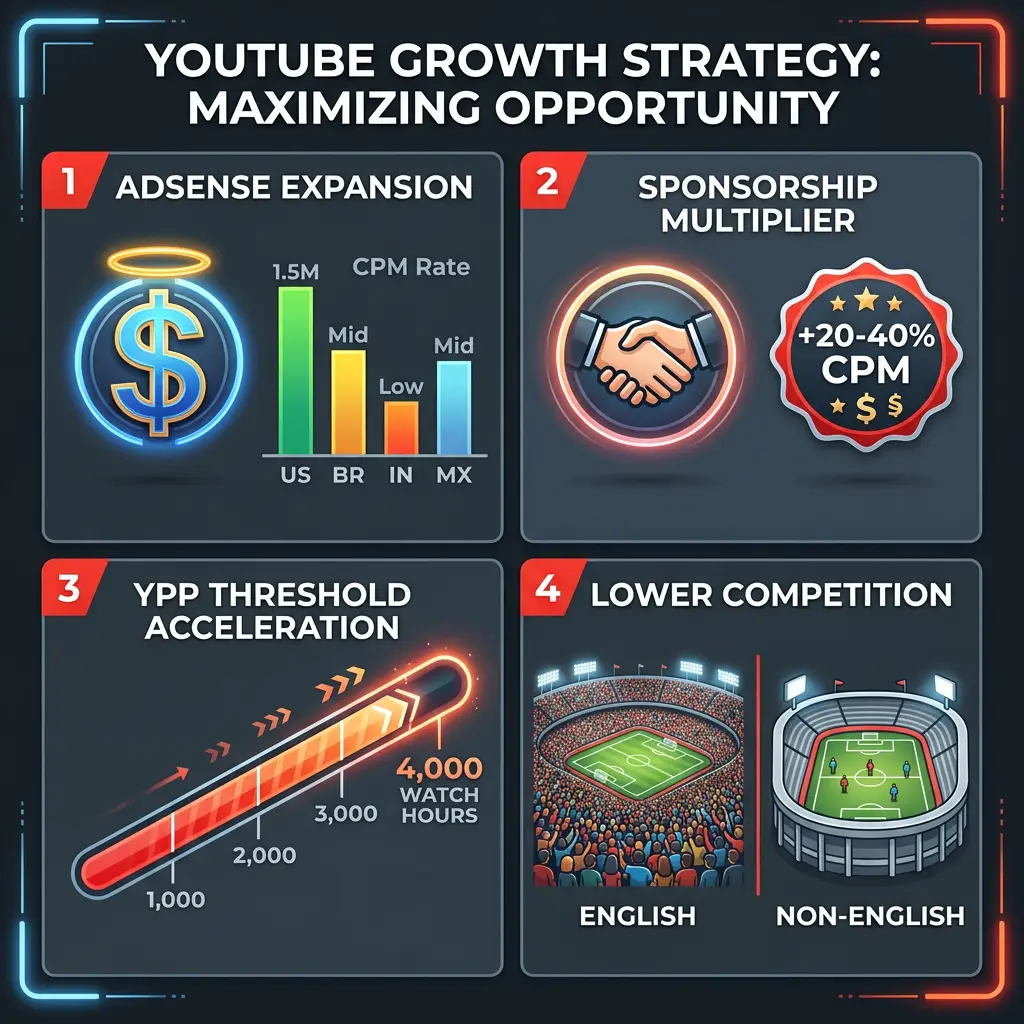
The four revenue mechanisms that compound for dubbed creator channels — AdSense expansion, sponsorship premium, YPP acceleration, and low-competition markets.
Dubbing increases creator income through four distinct revenue mechanisms:
1. AdSense revenue from new markets
| Market | Typical YouTube CPM range |
|---|---|
| USA / UK (English) | $3–$12 |
| Germany | $3–$8 |
| Brazil (Portuguese) | $1.50–$4 |
| India (Hindi) | $0.80–$2.50 |
| Mexico (Spanish) | $1–$3 |
A creator with 1 million monthly views in English generating $5,000/month in AdSense can realistically add $800–$2,500/month from incremental Hindi and Portuguese views alone by dubbing their top 20 videos.
2. Sponsorship value multiplier
A channel with verified viewership in Brazil, Mexico, India, and Spain commands higher sponsorship rates than a same-size English-only channel. Creators with documented multilingual viewership typically negotiate 20–40% higher CPM rates on international brand deals.
3. YouTube Partner Program threshold acceleration
For smaller creators working toward the 4,000-hour watch time threshold, dubbing is the fastest sustainable growth lever. Adding dubbed audio to top 10 existing videos contributes real watch time from non-English viewers who genuinely enjoy the content.
4. Lower competition in non-English markets
The English content market is saturated in virtually every niche. The Hindi, Portuguese, or Indonesian market for your specific niche may have a fraction of the supply relative to audience size. New dubbed content often ranks faster and holds positions longer in non-English markets because the competitive bar is lower.
How to Choose Your First Target Languages
Data-driven language selection process
- Open YouTube Studio → Analytics → Audience → Geography.
- Find your top 5 countries outside English-speaking markets by total watch time over the last 90 days.
- Note any country with a lower-than-expected subscriber conversion rate relative to its view count — this gap signals language friction.
- Cross-reference with the CPM table above to estimate revenue potential.
- Those countries' primary languages are your highest-ROI first targets.
Common first-language choices by niche
| Creator niche | Typical top first language | Rationale |
|---|---|---|
| Technology and coding | Hindi or Portuguese (BR) | India and Brazil have large, engaged tech audiences with underserved content supply |
| Gaming | Spanish or Portuguese | LATAM is the world's second-largest gaming market by active players |
| Finance and investing | Spanish or German | Strong demand for financial content in LATAM and DACH regions |
| Fitness and wellness | Spanish or Hindi | Massive audiences in LATAM and India; relatively low competition |
| Food and cooking | Spanish, Hindi, or Japanese | Cultural interest in cross-cultural food content is high globally |
Common top-performing target languages overall
- Spanish: 500M+ native speakers, 21 countries, among the most active YouTube audiences globally.
- Hindi: 600M+ speakers, world's fastest-growing smartphone user base.
- Portuguese (BR): Brazil has one of the world's highest per-capita YouTube usage rates.
- Arabic: 300M+ speakers; deeply underserved in most content niches.
- Indonesian: 270M+ population with booming digital content consumption.
Voice Cloning: The Feature That Makes Dubbing Work for Creators
Voice cloning is an AI technique that extracts the acoustic characteristics of a speaker — pitch, pace, timbre, and emotional register — and synthesizes speech in another language that sounds like the same person speaking naturally. It separates effective creator dubbing from generic text-to-speech.
Without voice cloning, dubbed content sounds robotic and synthetic. With voice cloning, the dubbed video sounds like you speaking Spanish, Hindi, or French — preserving the energy and rhythm your audience associates with your brand.
Why voice cloning matters for creator growth
Your audience connects with you — your personality and voice. If translation replaces your voice with a robotic synthesizer, the connection breaks. Voice cloning bridges this gap: a viewer in Brazil who discovers your Portuguese-dubbed video experiences your authentic style and is far more likely to subscribe. Creators using voice-cloned dubbing report 2–3x higher subscriber conversion rates from dubbed views compared to subtitled equivalents.
Tools like VideoDubber use voice cloning that requires as little as 30 seconds of original audio to build a production-quality voice model, then applies it consistently across all dubbed content.
Voice Clone Interface
Subtitles vs. Dubbing: What the Data Says
Head-to-head comparison: subtitles vs. dubbing
| Factor | Subtitles | Dubbing |
|---|---|---|
| Average watch time (non-English viewer) | Lower — viewer reads text, misses visuals | Higher — viewer watches while listening in native language |
| Cognitive load | High — simultaneous reading and watching | Low — passive audio processing feels effortless |
| Algorithm signal strength | Weaker — shorter sessions reduce ranking | Stronger — longer sessions signal quality |
| Accessibility | Limited to literacy-capable viewers | Accessible to all, including multitasking viewers |
| Subscriber conversion rate | Lower — weaker creator connection | Higher — voice personality transfers via clone |
| Production time | Fast — automated by YouTube | Fast with AI (15–30 min per video) |
YouTube's own data confirms: videos with dubbed audio tracks outperform subtitled equivalents by 2–4x on viewer retention among non-native speakers. The verdict: for creator growth, dubbing is more effective than subtitles in virtually every metric that matters algorithmically.
Step-by-Step: How to Dub Your Videos with AI
Step 1: Identify your top 10 videos
Using YouTube Analytics, find your top 10 all-time performing videos by total watch time (last 12 months). These are your proven winners — the content most likely to succeed in new language markets. Do not start by dubbing low-performing content. Dubbing amplifies what already works.
Step 2: Check for language-sensitive content
Flag any moments requiring adaptation rather than direct translation:
- Idioms or slang that do not translate directly
- Country-specific references (US holidays, local celebrities, regional humor)
- On-screen text or graphics in English that audio dubbing will not replace
Step 3: Upload to VideoDubber
- Go to VideoDubber.ai and start a new project.
- Upload your MP4 file or paste your YouTube video URL.
- Select your target languages — start with 1–2 for your initial pilot.
- Enable Voice Clone to preserve your vocal identity.
- Click Translate Video — processing typically takes 5–15 minutes per 10-minute video.
Language Selection
Step 4: Review and edit the translation
Use the platform's synchronized transcript editor to review flagged timecodes. Replace untranslatable idioms with culturally equivalent expressions, verify product names and technical terms, and confirm calls to action are natural in the target language. Review takes 10–15 minutes per 10 minutes of content.
Step 5: Download and distribute
For YouTube multi-language audio (recommended):
- Export the dubbed audio track from VideoDubber.
- In YouTube Studio, open the video editor for your existing upload.
- Navigate to Subtitles → Add Language → Audio and upload the dubbed track.
- Save and allow YouTube to process (typically a few hours).
For separate uploads (TikTok and Instagram):
- Download the fully dubbed MP4.
- Upload with translated title, description, and hashtags.
- Link back to your main channel from the description.
For a complete guide on YouTube multi-language audio setup, see How to Add Multilingual Audio Tracks to a Video.
Step 6: Translate metadata and thumbnails
A dubbed video with English metadata generates no SEO benefit in the target language market. Always translate the video title and description into the target language using native-level translation. If your thumbnail contains text, create a localized version — this improves CTR significantly in markets with visually distinctive scripts (Arabic, Hindi, Japanese).
Step 7: Monitor analytics and scale
After 30 days, check YouTube Analytics → Geography filtered by watch time. A successful pilot shows meaningful incremental watch time from target countries. Most creators find that incremental AdSense revenue recovers dubbing cost within the first month. Validated pilots justify expanding to additional languages.
Platform Strategy: YouTube, TikTok, and Instagram
YouTube: Multi-language audio tracks
YouTube's multi-language audio feature is the most powerful distribution mechanism for dubbed content. All views accumulate on the same video, concentrating watch time and engagement signals. This is algorithmically superior to splitting views across separate channels.
When to use separate channels: Only if your content is significantly culturally adapted per language with entirely different thumbnail styles or market-specific strategies.
TikTok: Dubbed video uploads
TikTok does not support multi-language audio on a single video. Upload dubbed videos as separate posts with translated captions, translated hashtags, and location tags for the target region. The TikTok algorithm is effective at surfacing regional content geographically.
Instagram Reels: Parallel language posts
Similar to TikTok — create language-specific posts with translated captions and location-relevant hashtags. Consistent dubbing across YouTube, TikTok, and Instagram creates cross-platform presence in each target market.
Common Mistakes Creators Make When Dubbing
Mistake 1: Starting with low-performing content
Dubbing a video that never worked in English does not fix its fundamental problems. A video with low watch time in English will produce similar results in Spanish or Hindi. Always start with proven performers from your Analytics.
Mistake 2: Using generic TTS instead of voice cloning
Generic text-to-speech sounds robotic and breaks the creator-viewer relationship. Always use voice cloning for audience-facing content. Tools like VideoDubber make voice-cloned dubbing accessible at comparable cost to generic TTS.
Mistake 3: Skipping metadata translation
A Hindi-dubbed video with an English title will not rank in Hindi search results or appear in Hindi autocomplete. Metadata translation takes 15–20 minutes per video and is responsible for a significant portion of the organic discovery benefit.
Mistake 4: Dubbing without adapting cultural references
Direct translation of culturally specific jokes or references often creates confusion in target markets. A Super Bowl reference means nothing in India; an American Thanksgiving joke requires explanation in Brazil. Flag these during pre-translation review and adapt them.
Mistake 5: Treating dubbing as a one-time project
New videos should enter the dubbing workflow within 48–72 hours of publication, not as a quarterly batch project. Channels that dub consistently see compounding algorithmic benefits as their multilingual audience grows. Sporadic dubbing never builds the critical mass required for sustained algorithm recommendation.
Frequently Asked Questions
How much does it cost to dub a YouTube video into multiple languages?
Using VideoDubber, a 10-minute video dubbed into 5 languages costs approximately $10–$50 total. Traditional voice-over agencies charge $500–$2,000+ per language. Most creators recover AI dubbing costs within the first month of a successful pilot.
Will my subscribers notice that the voice is AI-generated?
Modern AI voice cloning produces results most viewers cannot identify as AI-generated during casual viewing. Your pitch, pace, energy, and emotional register are preserved, so the dubbed voice sounds like you speaking that language.
Should I dub all my videos or just the best ones?
Start with your top 10–20 performing videos to validate. After confirming watch time growth in target markets (typically within 30–60 days), implement a forward-looking workflow where every new video is dubbed within 48 hours.
Does video dubbing hurt my English-language search rankings?
No. Multi-language audio tracks are entirely additive — they open the video to additional language markets without changing English-language performance or creating any algorithmic penalty.
How many languages should I target at once when starting out?
Start with 1–2 languages based on your top non-English audience countries from YouTube Analytics. Validate over 60–90 days, then expand to 3–5 languages based on data.
Do I need to speak the target language to produce a dubbed video?
No. AI dubbing platforms handle transcription, translation, and voice synthesis automatically. Human review of technical terms and cultural references can be outsourced to a freelance native speaker for $10–$30 per video.
What type of content benefits most from dubbing?
Content with strong visual storytelling and universal appeal: challenge videos, tutorials, product reviews, educational explainers, and how-to content. These formats rely on demonstration and narration rather than wordplay, making them highly translatable.
Is video dubbing worth it for small creators with under 10,000 subscribers?
Yes. Small creators in underserved niches can achieve faster growth in non-English markets than in English. A creator with 5,000 subscribers who dubs into Portuguese may find far fewer established competitors in that market. Dubbing has helped hundreds of small creators cross the monetization threshold months faster.
Summary: Grow Your Channel with Video Dubbing
- Video dubbing for content creators is the highest-leverage growth action available on YouTube in 2026 — it opens 80%+ of the global audience to content that would otherwise be linguistically invisible to them.
- Voice cloning preserves your personality, energy, and creator-viewer relationship across languages, enabling non-English viewers to form the same connection that drives subscription and retention.
- Start with your top 10 videos and your highest-traffic non-English markets from Analytics; validate results before scaling.
- YouTube multi-language audio concentrates watch time on a single video object, generating stronger algorithmic signals than splitting views across separate uploads.
- Translate metadata alongside audio — dubbed video with English titles generates no discovery benefit in target language markets.
- Creators who build multilingual audiences now are establishing compounding advantages while competitors remain English-only.
Further Reading
How AI Voice Cloning Works for Video Dubbing: Complete Guide
How AI voice cloning works for video dubbing: neural architecture, step-by-step process, platform comparison, and best practices for natural-sounding results.
How to Clone Celebrity Voices for Video Dubbing: Complete 2026 Guide
How to clone celebrity voices for video dubbing with AI — step-by-step guide covering audio quality, legal rules, use cases, and 150+ language support.
How to Add Multilingual Audio Tracks to a Video: YouTube & Beyond [2026]
How to add multilingual audio tracks to YouTube videos: AI dubbing workflow, step-by-step upload guide, and platform strategy for global reach.
Video Localization vs. Translation vs. Dubbing: Complete Guide [2026]
Video localization vs. translation vs. dubbing: full 2026 guide with cost tables, use-case matrix, AI dubbing workflow, and expert verdict on which to choose.
How to Use GPT-5.2 for Video Translation [2026 Guide]
How to use GPT-5.2 for video translation in VideoDubber: step-by-step, model comparison, context box tips, cost guide, and best practices for European languages. 2026.