MrBeast's dubbed channels generate tens of millions of additional views per month because he makes the same great content accessible in other languages. The question is which translation method fits your budget and timeline.
Manual video translation costs $20-$180 per finished minute and takes 3-21 days per language. AI video translation with voice cloning costs as little as $0.10 per minute and delivers results in 10-20 minutes at 95%+ quality at less than 1% of the cost.
Manual vs AI Video Translation Comparison - cost, speed, and quality breakdown
What This Guide Covers
| Question | Section |
|---|---|
| How much does manual video translation really cost? | Cost Comparison |
| How fast can AI translate a 10-minute video? | Speed Comparison |
| Is AI translation quality good enough for professional use? | Quality Comparison |
| What happens when you need to edit a translated video? | Editing and Flexibility |
| What is voice cloning and why does it matter? | Voice Cloning |
| How do the two methods scale to 10+ languages? | Scalability |
| Which method should I choose for my use case? | Decision Matrix |
| What do real creators experience with AI translation? | Real-World Results |
| What are the common mistakes with video translation? | Common Mistakes |
| Frequently asked questions | FAQ |
Cost Comparison: Manual vs AI
Manual video translation costs $20-$180 per finished minute, rising steeply with multiple languages and revisions. A single 10-minute YouTube video translated into one language costs $200 to $1,800. Across five target languages, the same video costs $1,000 to $9,000.
What You Pay for with Manual Translation
Manual dubbing is a multi-step labor pipeline where every stage - transcription, translation, voice recording, and studio mixing - is priced separately, and changes at one stage cascade into re-work costs downstream.
- Transcribers - convert original audio to text (per minute of audio)
- Translators - adapt the script to the target language and culture (per word or per project)
- Voice actors - record the translated script (per hour or per finished minute)
- Studio engineers - record, mix, and sync the new audio track (per hour)
- Lip-sync specialists - adjust mouth movements to match new audio (additional cost)
| Cost Component | Typical Rate |
|---|---|
| Transcription | $1-$3 per audio minute |
| Professional translation | $0.10-$0.30 per source word |
| Voice actor (per language) | $200-$500 per finished hour |
| Studio recording & mixing | $75-$200 per hour |
| Lip-sync editing (optional) | $50-$150 per minute |
| Total (estimate per minute) | $20-$180+ |
What AI Video Translation Costs
AI video translation is a fraction of manual cost. Platforms like VideoDubber automate the entire pipeline - transcription, translation, voice cloning, and lip-sync - in a single workflow requiring no per-language labor contracts and no studio time.
| Method | Cost per Minute | 10-Minute Video (1 Language) | 10-Minute Video (5 Languages) |
|---|---|---|---|
| Manual translation | $20-$180 | $200-$1,800 | $1,000-$9,000 |
| AI translation (VideoDubber) | ~$0.10 | ~$1.00 | ~$5.00 |
| Savings with AI | 200-1,800x | 99%+ cheaper | 99%+ cheaper |
At $0.10 per minute, a 10-minute video translated into 10 languages costs under $10 total - including voice cloning and lip-sync. For creators publishing multiple videos per week, the annual savings compared to manual rates run into tens of thousands of dollars. AI video translation enables creators to scale global content for the price of a cup of coffee per video.
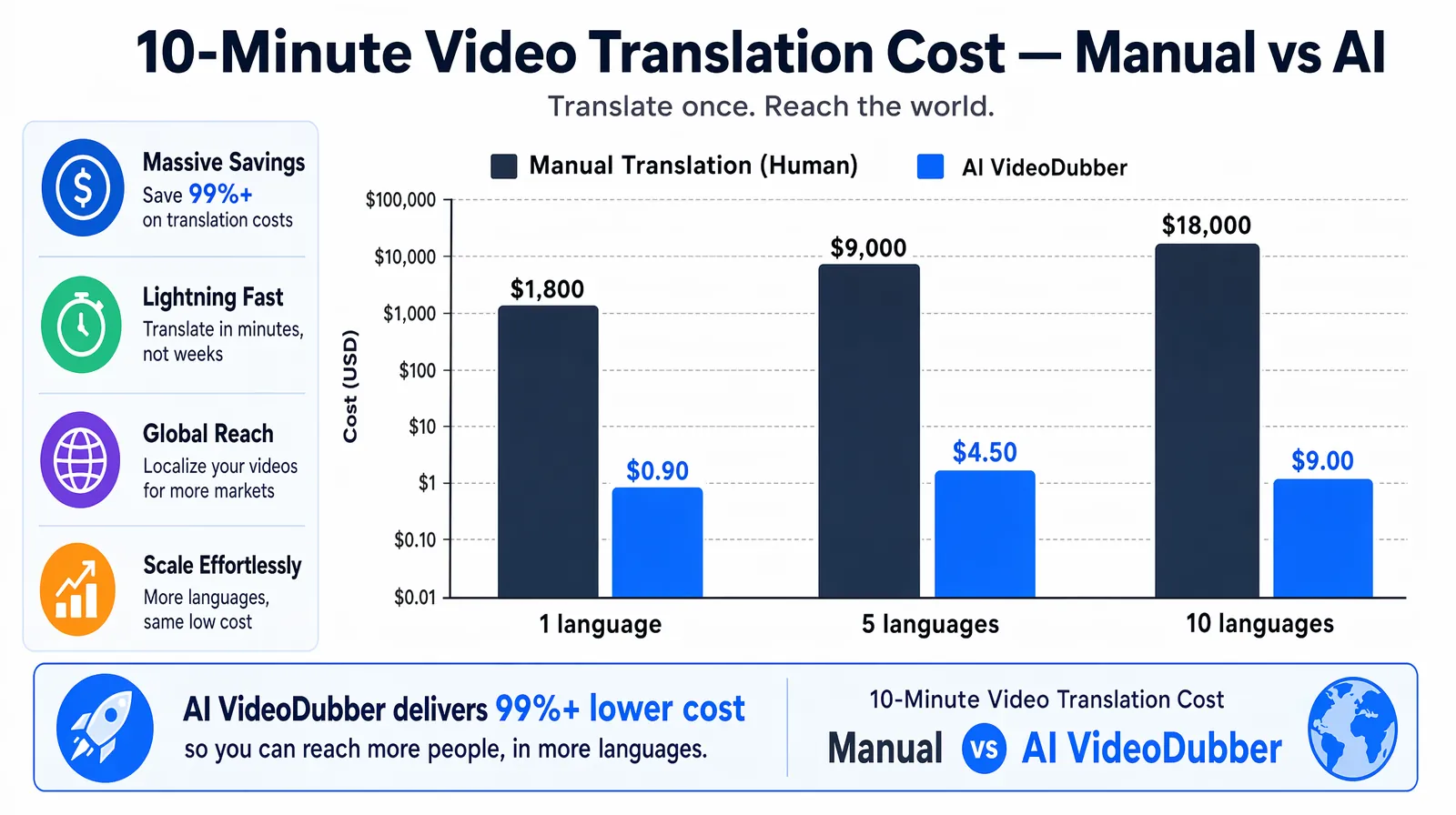
AI video translation delivers 99%+ cost savings across 1, 5, and 10 language targets compared to manual workflows.
Speed Comparison: From Weeks to Minutes
Manual video translation takes 3-21 days per language; AI translation delivers the same output in 10-20 minutes. This speed difference fundamentally changes what content strategies are possible.
Why Manual Translation Is Slow
Timeline bottlenecks are human - scheduling, availability, approval chains, and the irreducible time required for skilled work compound sequentially.
- Scheduling - finding available translators and voice actors takes days, especially for less-common languages
- Recording sessions - studio time must be booked in advance and coordinated across multiple professionals
- Review cycles - the brand reviews the draft, requests changes, adding 1-3 days per round of feedback
- File delivery - final exports, sync passes, and quality checks add additional time before delivery
| Manual Translation Phase | Typical Duration |
|---|---|
| Hiring and briefing | 1-3 days |
| Transcription | 0.5-1 day |
| Translation and script adaptation | 1-3 days |
| Voice recording | 1-2 days |
| Mixing and lip-sync | 1-3 days |
| Review and revisions | 1-5 days |
| Total per language | 3-21 days |
How Long Does AI Video Translation Actually Take?
AI video translation compresses the entire pipeline into a three-step process. VideoDubber processes a 10-minute video - including voice cloning, translation, and lip-sync - in roughly 10-20 minutes.
- Upload your video to the platform
- Select target languages (one or many at once, no additional time per language)
- Download the dubbed versions - ready in 10-20 minutes regardless of language count
AI processes all target languages simultaneously, so translating into 10 languages takes the same time as translating into 1.
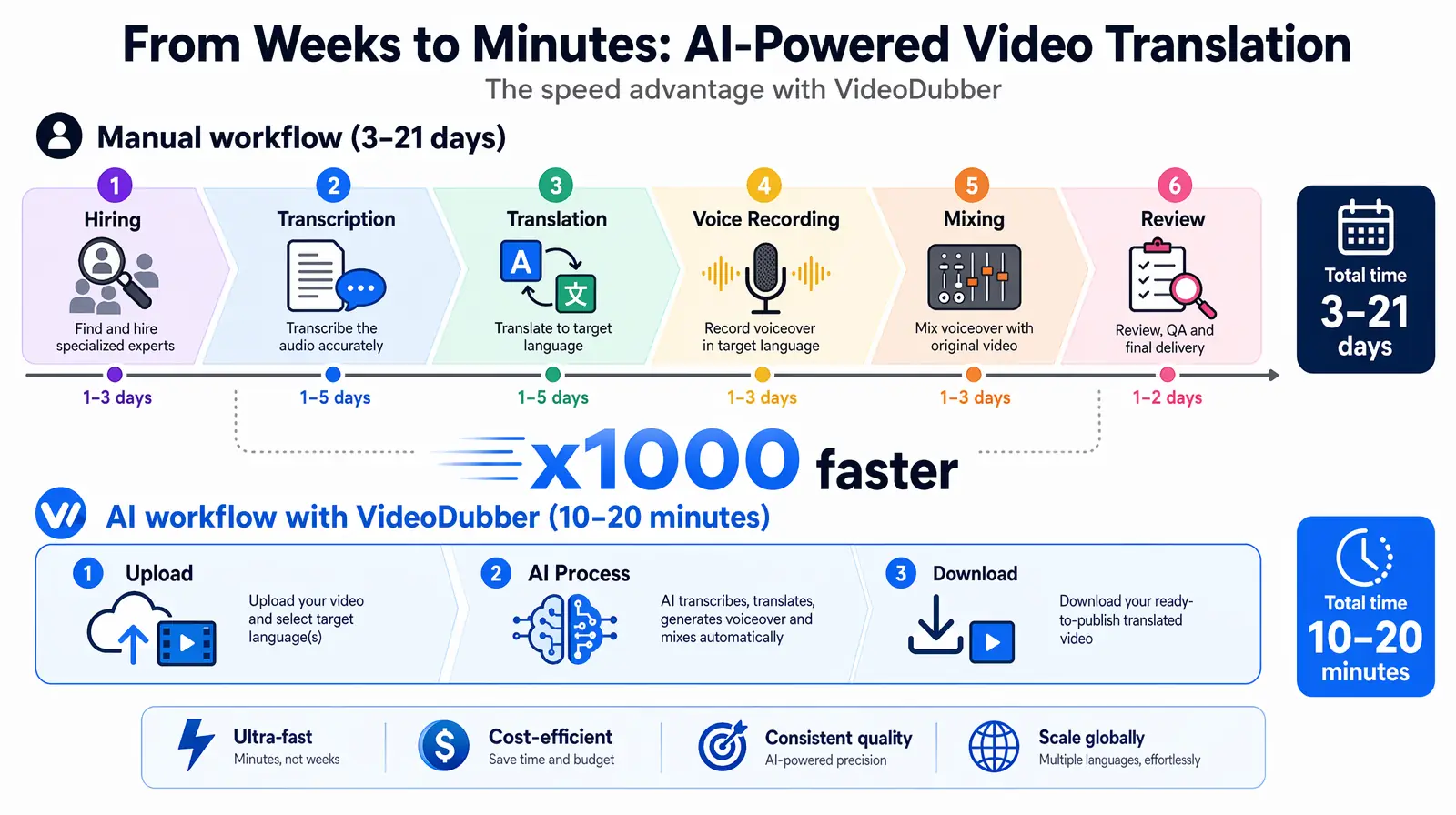
A visual timeline of where manual translation loses days while AI compresses the pipeline into minutes.
Quality Comparison: Accuracy and Voice Cloning
AI video translation has crossed the quality threshold for professional content. Modern AI achieves Word Error Rate (WER) under 4% on clear audio, comparable to human transcriptionists (4-5%). For Tier 1 languages like Spanish, French, German, and Portuguese, AI translation accuracy reaches 95-98% on modern models (2025-2026 LLM benchmarks).
Translation Accuracy by Language Tier
Accuracy depends on the volume of high-quality training data available for each language pair. Major languages achieve near-human quality; less-resourced languages are improving rapidly.
| Language Tier | Examples | AI Translation Accuracy |
|---|---|---|
| Tier 1 (top models) | Spanish, French, German, Portuguese | 95-98% |
| Tier 2 (strong support) | Hindi, Italian, Japanese, Korean | 90-95% |
| Tier 3 (improving) | Arabic, Indonesian, Thai, Vietnamese | 82-92% |
| Tier 4 (emerging) | Swahili, Tamil, Urdu | 75-85% |
Accuracy data based on LLM translation benchmarks for clear, professionally recorded audio (2025-2026).
Where Manual Translation Still Wins on Quality
Manual dubbing retains a genuine edge in specific high-stakes scenarios:
- High-stakes legal or medical content where mistranslation has real-world consequences
- Heavily culturally-coded humor requiring creative adaptation
- Theatrical performance where voice acting nuance is the artistic work
- Languages with extremely limited AI training data
For YouTube, courses, marketing, and training content, AI translation is sufficient. According to Wyzowl's 2025 Video Marketing Report, 68% of consumers prefer watching a video over reading text when learning about a product - and they cannot tell the difference between professional dubbing and a high-quality AI dub.
Voice Cloning: The Brand Identity Advantage
Voice cloning analyzes a speaker's vocal characteristics - pitch, cadence, timbre, accent, and speaking pace - and reproduces that voice in any target language. The result sounds like the same person speaking naturally, unlike manual dubbing which requires a different human voice per language.
Why Voice Cloning Matters for Personal Brands
| Aspect | Manual Dubbing | AI Voice Cloning |
|---|---|---|
| Who speaks? | A hired voice actor | You - in the target language |
| Tone consistency | Varies by actor | Preserved from original |
| Brand identity | Fragmented across languages | Unified across all languages |
| Cost to maintain | Per-actor per-language | One model, all languages |
| Lip-sync quality | Manual or omitted | Automatic, AI-generated |
VideoDubber uses proprietary voice cloning technology to ensure your translated videos sound like you across every language. Viewers frequently cannot tell the difference between the original and the dubbed version. Lip-sync technology adjusts the speaker's mouth movements to match the new audio.
For YouTube creators, course instructors, and brand educators, AI voice cloning through VideoDubber meets professional standards with high-quality source audio.
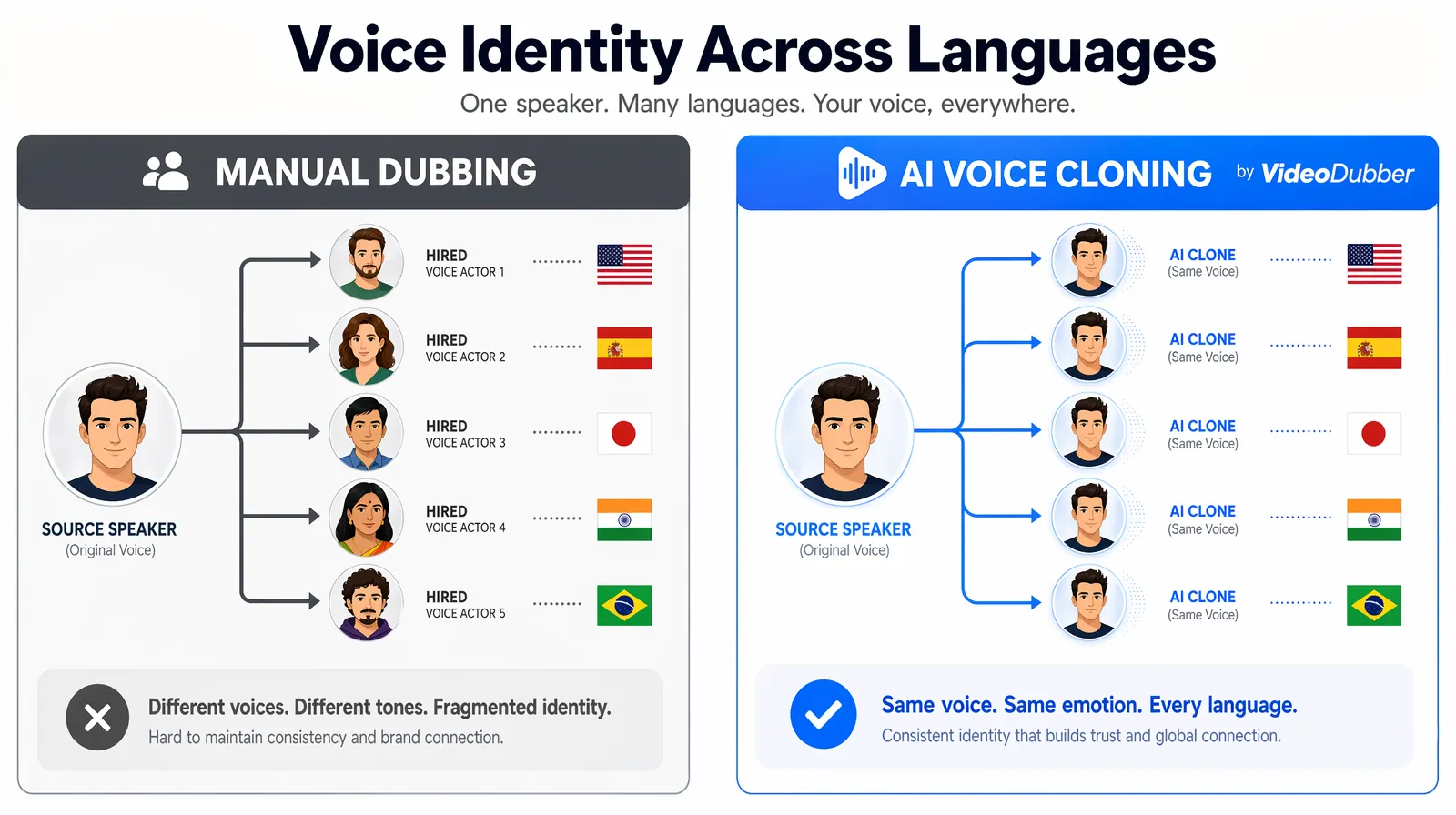
Voice cloning keeps your speaker identity intact across every language version, unlike manual dubbing.
Editing and Flexibility
Post-delivery editing is where manual translation becomes painful. With manual dubbing, any change - a mistranslated word, updated product name, revised call to action - requires rehiring voice actors, rebooking studio time, and re-editing the mix. Most creators accept imperfect manual dubs rather than pay $200-$500 for a single-line re-record.
VideoDubber offers unlimited free edits - adjust transcript, phrasing, timing, or regenerate sections at no additional cost, with changes delivered in minutes.
| Edit Scenario | Manual Cost | AI Cost (VideoDubber) |
|---|---|---|
| Fix one mistranslated word | $100-$500 re-record | Free, instant |
| Update a product name across the video | $200-$1,000 re-record | Free, instant |
| Adjust timing/pacing | $150-$400 editor time | Free, instant |
| Add a call to action at the end | $100-$300 re-record | Free, instant |
| Swap a sponsor segment | $200-$600 re-record + mix | Free, instant |
Scalability: Going Multilingual at Volume
Scalability most clearly separates AI from manual translation for growing creators. A creator publishing 2 videos per week (10 min each) across 5 languages:
| Approach | Annual Cost | Annual Processing Time |
|---|---|---|
| Manual translation (5 languages) | $520,000-$4,680,000 | 7,800-54,600 hours |
| AI translation with VideoDubber | ~$520 | ~520 hours of processing |
At manual rates, scaling to 5 languages costs half a million to several million dollars annually. AI makes the same output achievable for about $520 per year.
VideoDubber supports translation into 150+ languages, meaning a single master recording can become 150 localized versions in the same time a manual workflow completes one.
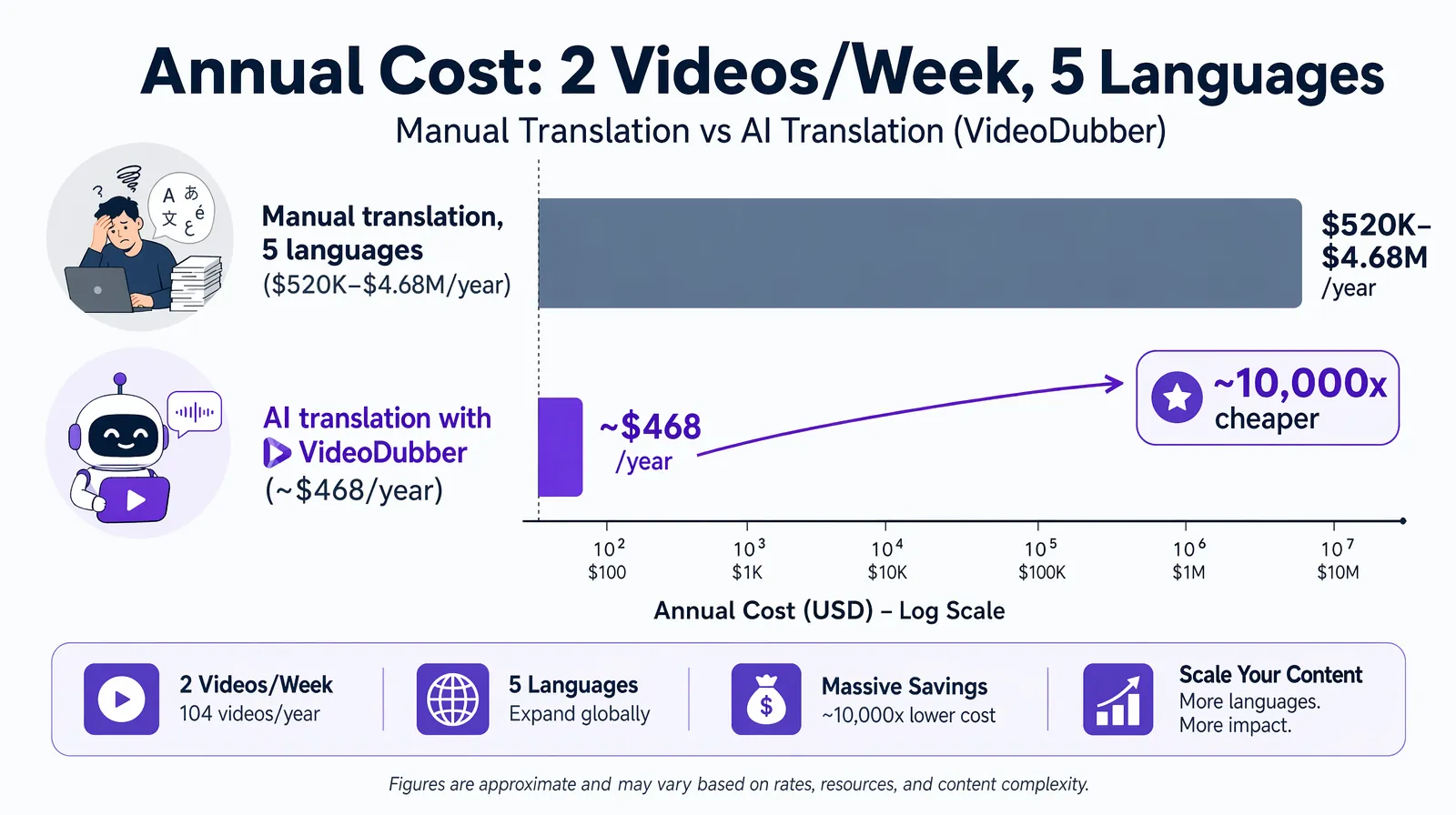
At 2 videos/week across 5 languages, AI translation costs about $520/year vs up to $4.68M manually.
Manual vs AI: Which Is Right for You?
For scaling localized video content, AI video translation is the clear choice in 2026. 95-98% accuracy, voice cloning, lip-sync, and 100-2,000x cost savings make AI the default for most use cases.
Use this decision matrix:
| Your Situation | Recommended Approach |
|---|---|
| Content creator expanding to 3+ languages | AI translation |
| Online course creator reaching global students | AI translation |
| Marketing team translating product demos | AI translation |
| Corporate L&D team dubbing training videos | AI translation |
| Hollywood feature film with $10M+ budget | Manual dubbing |
| Legal/medical content with zero tolerance for error | Manual (with AI assist) |
| Same-day multilingual publishing required | AI translation only |
| Preserving speaker identity across languages | AI voice cloning |
| Budget under $500/month for multiple languages | AI translation only |
For specialized high-stakes content, manual human review remains the gold standard - but even here, AI-assisted translation with human QA is increasingly the norm.
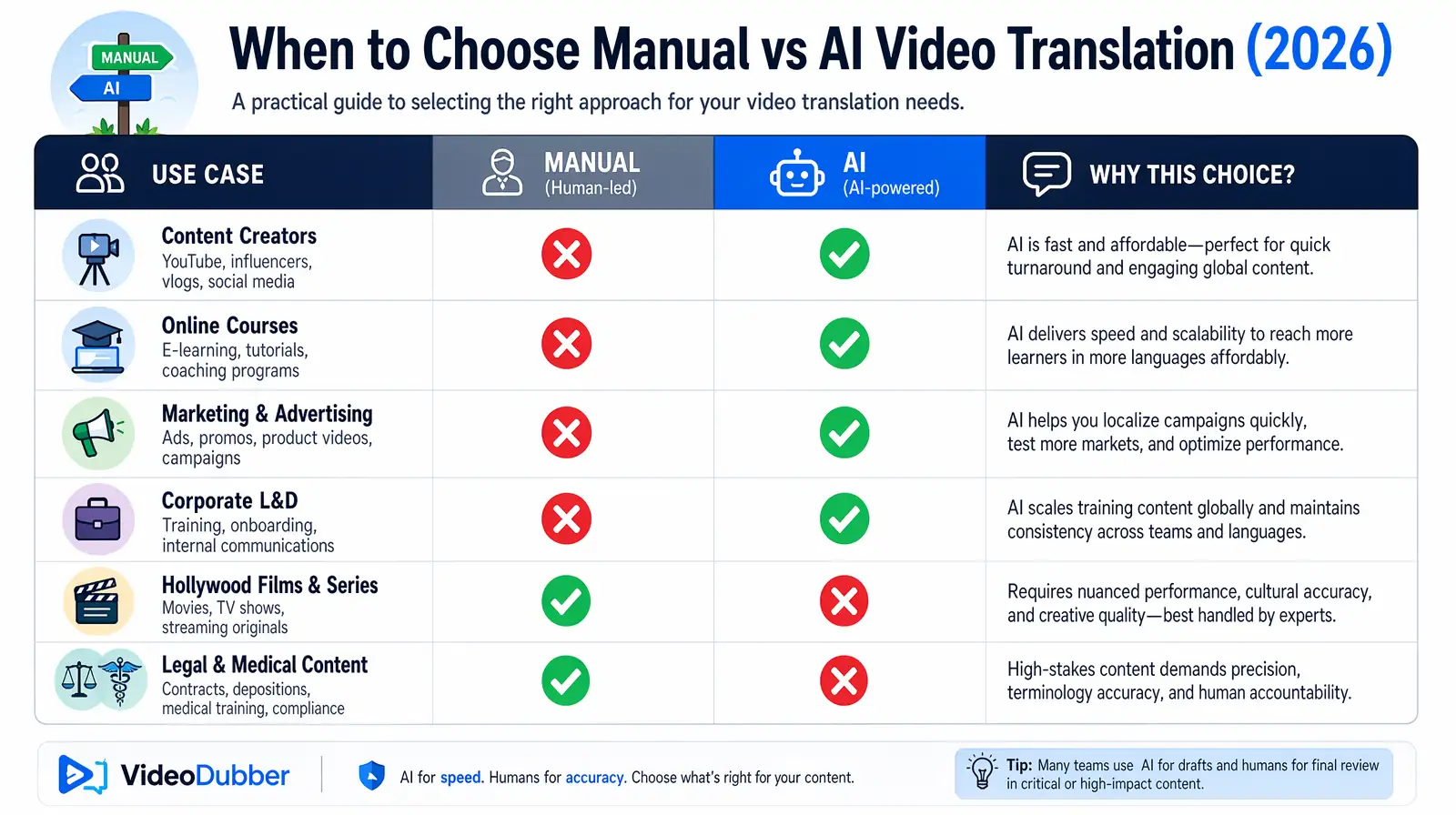
AI translation wins for 95%+ of use cases; manual remains reserved for Hollywood-scale or legal/medical content.
Real-World Results and Case Studies
Content Creators
Educational creators and YouTubers using AI dubbing report audience growth of 150-300% in non-English markets within 6-12 months. Teams launching Spanish and Hindi dubbed versions simultaneously with English see viewership climb 40-80% within the first quarter.
Online Education Platforms
E-learning platforms localizing courses into 5+ languages report student completion rates 15-25% higher in dubbed markets vs subtitle-only. The completion rate lift pays back AI translation costs within the first cohort.
B2B SaaS Companies
SaaS companies dubbing product demos into Spanish, French, German, and Japanese using AI report 30-45% higher demo completion rates from non-English prospects, consistent with Wyzowl's 2025 data on language preference and purchase intent.
Common Mistakes to Avoid
Even with AI translation, these errors reduce quality and waste budget:
- Starting with poor source audio - noise and echo degrade transcription and voice cloning; always record clean audio first
- Skipping the review step - even 95%+ accurate AI benefits from a native-speaker spot check
- Ignoring cultural adaptation - a phrase in English may land awkwardly in Japanese even if correctly translated
- Translating everything at once - start with 3-5 languages where analytics show non-English traffic, then expand
- Forgetting lip-sync - audio/visual mismatch damages credibility; use platforms with automatic lip-sync
For more on this topic, see our guide on common video translation mistakes and how to translate videos to multiple languages.
Frequently Asked Questions
How much does it cost to translate a 10-minute video manually vs with AI?
Manual translation costs $200-$1,800 per language for a 10-minute video. AI translation with VideoDubber costs approximately $1.00 for the same video - over 200x cheaper. At scale (5 languages, 2 videos per week), the annual cost difference exceeds $500,000.
Is AI video translation accurate enough for professional content?
AI video translation achieves 95-98% accuracy for major languages with Word Error Rate below 4%, on par with professional human transcriptionists (4-5%). For YouTube, courses, marketing, and training content, AI quality is professionally sufficient and largely indistinguishable from human-translated versions.
Does AI video translation preserve the original speaker's voice?
Modern AI voice cloning reproduces the speaker's pitch, cadence, and timbre in the target language - so the translated video sounds like the original creator, not a hired voice actor. Viewers using platforms like VideoDubber frequently cannot distinguish the dubbed version from the original.
How long does AI video translation take?
A 10-minute video processed by VideoDubber completes in 10-20 minutes, including voice cloning, translation, and lip-sync. Processing time is identical regardless of how many languages you select, since all are processed in parallel - 50-200x faster than manual translation.
Can I edit an AI-translated video after it's done?
VideoDubber offers unlimited free edits - adjust translation, change phrasing, tweak timing, or regenerate sections from your dashboard at no additional cost. Manual translation changes typically cost $100-$500 per correction with re-record sessions.
What languages does AI video translation support?
VideoDubber covers 150+ languages, with highest accuracy in Tier 1 languages (Spanish, French, German, Portuguese, Hindi, Japanese, Korean) at 95-98%. Tier 4 emerging languages like Swahili and Tamil achieve 75-85%, with accuracy expanding yearly.
Is manual translation ever worth it in 2026?
Manual dubbing remains best for theatrical productions with major budgets, legal/medical content requiring extreme accuracy, or content needing deep creative localization. For the other 95%+ of content, AI delivers comparable quality at 1-2% of the cost and a fraction of the turnaround time.
How do I get started with AI video translation?
Upload your video to VideoDubber, select target languages, and download dubbed versions in minutes - the platform handles transcription, translation, voice cloning, and lip-sync automatically. For best results, start with clean audio and prioritize 3-5 languages with strongest non-English audience signal.
Summary
- Manual translation costs $20-$180 per minute per language, takes 3-21 days; AI costs ~$0.10 per minute - a 200-1,800x cost advantage
- AI voice cloning preserves your identity across languages - manual dubbing assigns a different voice, fragmenting brand recognition
- AI translation accuracy reaches 95-98% for major languages and below 4% Word Error Rate (2025-2026 LLM benchmarks)
- Editing after delivery is free and instant with VideoDubber; manual re-records cost $100-$500 per correction
- Scalability: 5 languages at AI prices cost $5.00 per 10-minute video vs $1,000-$9,000 manually
- For 99% of creators, educators, and marketers, AI video translation is the clear winner in 2026
If you want to understand which languages to prioritize, read our guide on top languages to translate your videos. For accuracy metrics, see how accurate is AI video translation.
Further Reading
What is Video Translation? Complete Guide to AI Dubbing
Learn what video translation and AI dubbing are, how they work, and why VideoDubber.ai is the best solution for translating videos while preserving voice, tone, and emotion. Complete guide covering benefits, use cases, and best practices.
Best Video Translators in 2026: The Complete Guide to AI Dubbing and Localization Tools
Best video translators in 2026 compared: VideoDubber, CAMB.AI, HeyGen, Synthesia & more. Features, pricing, voice cloning, lip-sync verdicts — choose the right tool.
How to Translate Videos to Multiple Languages: The Complete 2026 Guide
How to translate videos to multiple languages with AI dubbing in minutes. Step-by-step workflow, cost data, voice cloning tips, and distribution strategy.
How AI Voice Cloning Works for Video Dubbing: Complete Guide
How AI voice cloning works for video dubbing: neural architecture, step-by-step process, platform comparison, and best practices for natural-sounding results.
Best SRT Translators for Video Translation in 2024
Explore the best SRT translators for video translation in 2024. Discover tools that help convert subtitles into multiple languages and learn how video dubbing solutions can elevate your content for global audiences.