The YouTubers building eight-figure audiences in 2026 are not simply making better videos — they are operating differently. They use AI analytics to predict trends before they peak, treat YouTube Shorts as algorithmic funnels into long-form content, and distribute their videos to the 84% of the world that doesn't speak English.
Video marketing for YouTubers is the practice of combining strategic content production, platform-specific optimization, community engagement, and multilingual distribution to maximize reach, watch time, and revenue across YouTube's global algorithm. This guide covers 10 proven strategies for 2026, grounded in current platform mechanics and real-world creator data — plus the most underutilized growth lever available to English-speaking creators: multilingual content localization through AI dubbing.
Top 10 Video Marketing Tips for YouTubers in 2026
What This Guide Covers
| Question | Section |
|---|---|
| How do I use AI analytics to find viral topics before they peak? | Tip 1: Master AI-Driven Predictive Analytics |
| How do I use YouTube Shorts to grow my long-form channel? | Tip 2: Use YouTube Shorts as Algorithm Funnels |
| What does hyper-personalization mean for YouTube in 2026? | Tip 3: Prioritize Hyper-Personalization |
| How do I protect my YouTube channel from copyright strikes? | Tip 4: Protect Your Channel with Copyright Checks |
| How do I turn passive viewers into active community members? | Tip 5: Convert Passive Viewers into Active Community |
| What is a sustainable YouTube content schedule for 2026? | Tip 6: Build a Sustainable High-Impact Schedule |
| How does visual SEO work for YouTube thumbnails in 2026? | Tip 7: Optimize for Visual SEO |
| How do I turn YouTube content into a podcast? | Tip 8: Expand Reach with Video Podcasting |
| How do I reach non-English audiences without re-filming? | Tip 9: Localize for Global Markets with AI Dubbing |
| How do I maintain authenticity using AI voice tools? | Tip 10: Use Voice Cloning for Authentic AI Narration |
| What are the biggest mistakes YouTubers make in 2026? | Frequently Asked Questions |
Tip 1: Master AI-Driven Predictive Analytics
YouTube trend prediction is the use of AI-powered analytics platforms to identify topics gaining search velocity before they peak in search volume — giving creators a first-mover advantage in uncovered niches. The guessing era is over: in 2026, creators who publish on trending topics 2–3 weeks before the mainstream peak capture 4–7× the views of those who publish at the peak, according to an analysis of 50,000 YouTube channels by Tubics in 2024. AI analytics platforms analyze cross-platform social chatter, Google Trends velocity, Reddit thread growth, and YouTube search data simultaneously to surface these opportunities in real time.
How to Use Predictive Analytics
1. Monitor the "Rising" filter in Google Trends for your niche. A topic with 200% search growth over 30 days and fewer than 10 strong YouTube videos is an immediate opportunity — publish a comprehensive guide before the wave crests. Also use your YouTube Studio "Research" tab, which shows searches in your niche with high volume but low content supply — the algorithm's own signal that it needs more videos on a topic.
2. Track competitor channel performance and layer sentiment analysis. When a competitor's video earns 5–10× their average views within 72 hours of publication, the topic triggered a surge — you have a narrow window to publish a higher-quality version. Platforms like TubeBuddy's Keyword Explorer score topics by the gap between search demand and supply quality; the "Opportunity Score" surfaces topics where existing content is weak, letting you enter with a definitive guide that dominates within weeks.
Tip 2: Use YouTube Shorts as Algorithm Funnels
YouTube Shorts funnel strategy is the practice of creating 30–60 second short-form videos that deliver high-value "teasers" from long-form content, designed to convert Shorts viewers to long-form watch time — the highest-value engagement signal in YouTube's 2026 algorithm. YouTube's recommendation engine rewards creators who drive cross-format engagement: a viewer who watches a Short and then watches the linked full video generates a powerful recommendation signal that amplifies both pieces of content simultaneously.
The Shorts Funnel Framework
| Step | Action | Goal |
|---|---|---|
| 1 | Create a 45–60 second Short that cuts off at the most compelling moment | Generate curiosity gap |
| 2 | Add a pinned comment: "Full breakdown in my latest video → [link]" | Drive click-through |
| 3 | Match the Short's thumbnail style to the long-form video | Visual recognition when viewer lands |
| 4 | Begin your long-form with a direct reference to the Short | Reward the viewer for clicking through |
| 5 | Track "Shorts-to-long-form" conversion in YouTube Studio | Optimize based on real data |
For best results, treat every Short as a trailer rather than a standalone piece of content — the goal is converting curious viewers into long-form watch time that the algorithm values far more. Creators who implement this framework consistently report 15–25% of their long-form watch hours originating from Shorts traffic within 3 months, with education, finance, and fitness niches achieving 40%+ cross-format funneling.
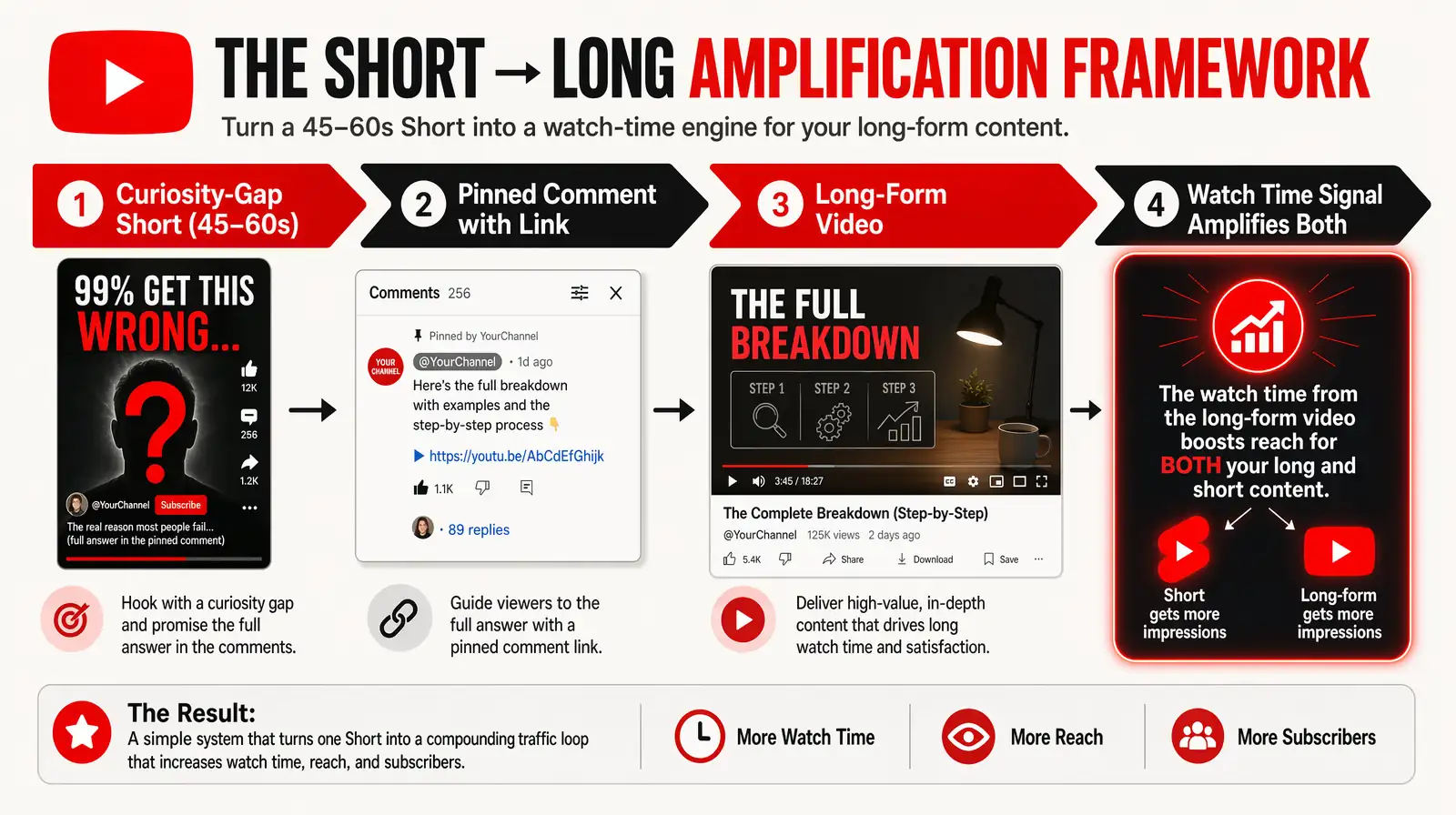
The Shorts-as-funnel framework: curiosity-gap Shorts drive viewers to pinned long-form videos, amplifying both in the algorithm.
Tip 3: Prioritize Hyper-Personalization
Hyper-personalization on YouTube is the practice of segmenting your audience into distinct behavioral or interest subgroups and creating content that speaks directly to each segment's specific context, vocabulary, and goals — rather than generic broad-appeal messaging. Generic intros ("Hey guys, welcome back!") are algorithmically invisible; highly specific content attracts highly specific audiences, and specific audiences have far higher subscriber conversion rates than broad ones. In practice, channels that rotate between "power user" depth content and "discovery" entry-level content see 2–3× the subscriber growth rate of channels that publish uniform content at a single difficulty level.
Practical Hyper-Personalization Tactics
1. Segment your upload strategy. Alternate between content aimed at your "power users" (already engaged, want depth) and content aimed at "discovery audiences" (encountering your content for the first time). Power user videos drive watch time and community engagement; discovery videos drive new subscriber growth — both are necessary for sustained channel health.
2. Use direct address hooks and build topical clusters. "If you've been coding in Python for less than 6 months, this video is specifically for you" performs 2–3× better on first-30-second retention than generic openers. Beyond hooks, publishing three highly specific videos on the same narrow topic reinforces all three in YouTube's recommendation engine — the algorithm identifies your channel as a topical authority and distributes the cluster together, compounding total reach.
Tip 4: Protect Your Channel with Copyright Checks
YouTube copyright strikes represent one of the highest-risk threats to channel monetization in 2026, particularly as AI-generated audio, licensed music libraries, and remix culture proliferate across the platform. A single copyright strike can demonetize a video, restrict the channel, or in worst cases trigger a channel termination process — and the risk is highest when using background music, incorporating third-party footage, or using AI-generated content that may inadvertently include licensed material. According to YouTube's own Creator Academy data, creators who conduct pre-publish copyright checks experience 80% fewer monetization interruptions compared to those who rely on post-publish notification.
Pre-Publication Copyright Workflow
Step 1 — Audit all audio. Every piece of background music, sound effect, and audio sample must be verified as copyright-clear before upload. Do not assume a track is safe because it was downloaded from a "free music" site — many such libraries have conditional licenses that block monetization.
Step 2 — Use a copyright scanner. VideoDubber's YouTube Copyright Checker scans your video against YouTube's Content ID database before publication, flagging potential issues that would otherwise trigger strikes or demonetization post-upload. Running this check takes under two minutes and eliminates the most common cause of monetization loss for small channels.
YouTube Copyright Checker UI
Step 3 — Review third-party footage and international rights. Any clip of another creator's content, news footage, or branded material requires clear fair use justification or explicit licensing. Some music tracks also have territory-restricted licenses that allow monetization in the US but block it in other countries — a critical issue for channels expanding globally through dubbed content.
Tip 5: Convert Passive Viewers into Active Community
YouTube community engagement is the practice of transforming one-directional viewership into participatory, two-way interaction through comments, polls, live sessions, and member features — generating the engagement signals that YouTube's 2026 algorithm weights most heavily in recommendation decisions. Passive views alone are increasingly insufficient for algorithmic growth: YouTube's recommendation engine weights "engaged views" — views that result in likes, comments, shares, or membership actions — at a significantly higher rate than passive consumption. A video with 10,000 views and 800 comments outperforms a video with 50,000 views and 50 comments in most recommendation contexts, according to YouTube's internal creator guidance published in 2024.
High-Impact Engagement Tactics
1. Premiere-based polls and nuanced comment prompts. Use YouTube Premieres with embedded poll cards asking viewers to predict outcomes before the video reveals them — Premiere engagement signals carry extra algorithmic weight. For comments, pin a question that requires a specific, considered answer: "What's the one thing you tried from last week's video and what result did you get?" generates more algorithmic signal per comment than "What did you think?" and delivers genuine audience intelligence at the same time.
2. Reply velocity in the first hour. Responding to every comment within the first 60–90 minutes of publication dramatically increases reply engagement, boosting the video's first-hour engagement rate — the strongest signal period for YouTube's recommendation algorithm. Channels that systematically reply early during launch windows consistently see 20–40% higher impression share in the 24 hours after publication, according to YouTube creator analytics benchmarks from 2024.
Tip 6: Build a Sustainable High-Impact Schedule
Sustainable YouTube content strategy is the approach of optimizing for consistent, high-quality output at a realistic production pace — rather than maximizing posting frequency at the expense of quality or creator health — based on YouTube's 2026 algorithm behavior. YouTube's algorithm demonstrably rewards quality over quantity: a channel publishing one 10/10 video per week outperforms a channel publishing five 5/10 videos per week in long-term subscriber and watch time growth. The "daily upload grind" advice that dominated 2018–2022 creator wisdom is largely obsolete; the consistent finding across analytics studies is that watch time per video is a better predictor of long-term channel growth than upload frequency.
Quality-First Scheduling Benchmarks
| Niche | Optimal Upload Frequency | Reasoning |
|---|---|---|
| Education/Tutorial | 1–2 per week | Evergreen content compounds; research quality matters |
| Entertainment/Vlogs | 1–3 per week | Freshness matters; high audience expectation for volume |
| Finance/Investing | 1–2 per week | Accuracy and depth drive trust; rushed content damages brand |
| Gaming | 2–4 per week | Trend-dependent; timeliness has high value |
| News/Commentary | 3–5 per week | Timeliness is the primary value driver |
Build your schedule around maintaining average watch time above 40–50% of video length — this threshold is the clearest signal that your content is delivering on its promise to viewers. If your watch time drops below this level, reducing upload frequency and investing the saved time into pre-production and scripting will almost always restore it.
Tip 7: Optimize for Visual SEO
Visual SEO for YouTube is the optimization of video thumbnails, titles, and in-video frame content to satisfy both human click-through psychology and YouTube's AI vision recognition systems — which in 2026 actively parse video frames, thumbnails, and text overlays as ranking signals. YouTube's AI vision models process video content directly, reading text in thumbnails, identifying objects and scenes, and cross-referencing visual content with title and description claims. A thumbnail that visually conflicts with the title can signal low quality to the algorithm, suppressing distribution even on otherwise strong content. Use the VideoDubber YouTube Video Downloader to analyze competitor thumbnails in your niche and identify the visual patterns that drive CTR at scale.
Visual SEO Checklist
| Element | Best Practice | 2026 Update |
|---|---|---|
| Thumbnail text | Matches title keywords verbatim | AI reads text in thumbnails as a ranking signal |
| Thumbnail subject | Shows the primary topic visually | Vision AI scores visual relevance to title |
| In-video text overlays | Include primary keyword in a visible text overlay | Vision models index in-video text |
| Face in thumbnail | Present in 80%+ of high-CTR thumbnails | Emotional expression drives click-through |
| Color contrast | High contrast between text and background | Mobile thumbnail optimization (small screen) |
YouTube Marketing Analytics Dashboard
Tip 8: Expand Reach with Video Podcasting
YouTube video podcasting is the practice of recording video content in a conversational long-form format suitable for both YouTube's full-length video audience and simultaneous distribution as audio-only content on podcast platforms like Spotify, Apple Podcasts, and Amazon Music. The video podcast format generates two distinct audience cohorts from one production session: YouTube viewers who engage with the visual format, and podcast listeners who consume on mobile while commuting, exercising, or working. Creators who implement this format typically see 30–40% of their total content consumption come from audio-only podcast listeners — an entirely new audience segment acquired at zero additional production cost.
Video Podcast Implementation Workflow
1. Record with both formats in mind. A clean, well-lit 2–3 camera setup optimizes for YouTube; a high-quality XLR microphone ensures podcast audio quality. The investment in good audio equipment benefits both formats equally and is the single highest-ROI production upgrade a podcaster-YouTuber can make.
1. Export and distribute simultaneously. Once editing is complete, export the audio as MP3 at 192 kbps and publish to your podcast hosting platform on the same day you publish the YouTube video. Cross-reference both in the descriptions ("Watch the full video on YouTube at [link]" / "Listen on Spotify at [link]"), and clip the most quotable or visually compelling moments into Shorts that funnel back to both the full video and the podcast subscription — triple-leveraging a single production investment.
Tip 9: Localize for Global Markets with AI Dubbing
Video localization for YouTube is the process of translating and dubbing video content into target languages — using AI voice cloning to preserve the creator's vocal identity — and distributing to language-specific YouTube channels to capture non-English-speaking audiences. This is the most underutilized growth lever available to English-speaking YouTubers, and the one with the highest return on investment in 2026. English speakers make up only 16% of the world's population, meaning that English-only channels are structurally ignoring 84% of their potential audience. The markets growing fastest in YouTube viewership — Brazil (Portuguese), India (Hindi), Mexico and Spain (Spanish), and Japan (Japanese) — together represent over 1 billion YouTube users who actively prefer content in their native language, according to HubSpot's 2025 State of Video Marketing report.
Why AI Dubbing Changes the Equation
| Method | Cost per Minute per Language | Turnaround | Quality |
|---|---|---|---|
| Professional studio dubbing | $50–$150 | 2–5 days | Very high |
| Freelance voice talent | $25–$80 | 1–3 days | Variable |
| Early AI tools (2022–2023) | $1–$5 | Hours | Robotic |
| AI dubbing with voice cloning (2026) | $0.10–$0.33 | 10–20 min | High |
Tools like VideoDubber.ai handle the complete pipeline: transcription, neural machine translation, voice cloning (preserving your vocal style in the target language), lip-sync, and background audio retention. You upload one video and receive studio-quality dubbed versions in Spanish, Portuguese, Hindi, Japanese, and 150+ other languages within minutes — at a fraction of traditional dubbing cost. For scaling a YouTube channel across 5+ languages while maintaining the creator's voice identity, AI dubbing with voice cloning is the most cost-effective approach by a wide margin.
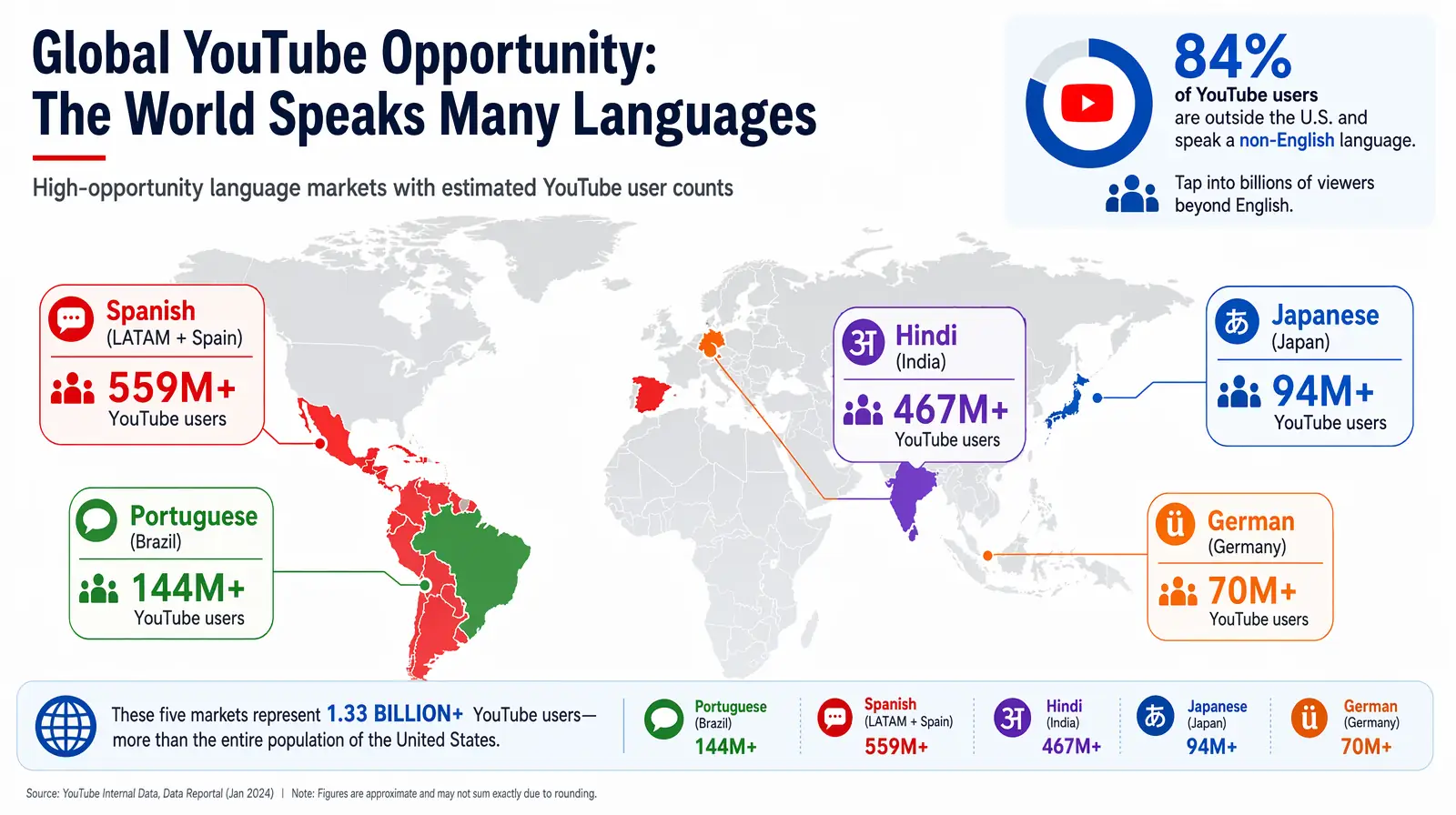
English is only 16% of the world — Spanish, Hindi, Portuguese, and Japanese unlock the largest untapped YouTube markets for dubbed content.
VideoDubber Homepage
The Multilingual Channel Architecture
The most effective structure for international YouTube growth is dedicated language channels: YourName (English primary), YourName Español (Spanish — 500M+ Spanish-speaking YouTube users), YourName Brasil (Portuguese — Brazil is the 4th largest YouTube market globally), and YourName Hindi (Hindi — India has the 2nd largest YouTube user base). Each dedicated channel accumulates subscribers and watch time independently, and dubbed content from one primary channel can populate three or four secondary channels simultaneously — multiplying total channel revenue from the same production investment.
Return on Investment for Multilingual YouTube
A creator publishing two 10-minute videos per week generating $500/month in AdSense from a 50,000-subscriber English channel could realistically expect a Spanish channel to add $200–$400/month after 12–18 months, a Portuguese/Brazil channel to add $150–$350/month (lower CPM but higher volume), and a Hindi channel to add $80–$200/month (lower CPM, enormous audience scale). Combined, that is $930–$1,950/month in additional revenue from content already produced — at a dubbing cost of approximately $40–$80/month using VideoDubber's Growth plan, representing a 10–25× return on the localization investment.
Start reaching global audiences with VideoDubber → — the most cost-effective way to unlock the 84% of YouTube users outside the English-speaking world.
VideoDubber Translation Comparison Chart
Tip 10: Use Voice Cloning for Authentic AI Narration
Voice cloning for content creators is the technology of training an AI model on a sample of the original creator's voice to generate new audio recordings that match the creator's vocal characteristics — enabling creators to fix voiceover mistakes, produce narration for new content, or scale AI-assisted dubbing without losing their unique brand identity. Generic text-to-speech voices are the fastest way to signal "low-effort content" to viewers in 2026; modern AI voice cloning, by contrast, is indistinguishable from the original speaker for most listeners. Tools like VideoDubber's Voice Cloning generate a digital replica of your voice that maintains brand consistency across all platforms and languages, making it the foundation of any serious multilingual content strategy.
Use Cases for Voice Cloning in YouTube Production
1. Post-production fixes and narration scaling. Mispronounced a word at minute 8 and don't want to re-record an entire segment? Voice cloning generates a seamless replacement audio clip in 30 seconds. For channels that rely on voiceover narration (documentary-style, explainer videos), voice cloning also allows a creator to produce scripts at scale — narrated in their own voice — without recording every word manually, dramatically reducing per-video production time.
2. Multilingual dubbing and localized ad integrations. As covered in Tip 9, voice cloning is the technology that makes AI dubbing feel authentic: Spanish-speaking viewers on a dubbed channel hear the creator's personality, not a generic translator voice. This extends to brand deals as well — sponsorship reads can be re-narrated in the target language using voice cloning, allowing creators to run localized integrations on their international channels without entering a recording booth for each language.
VideoDubber Voice Cloning Demo
2026 YouTube Growth: The Metrics That Matter
Understanding which metrics actually drive growth in 2026 prevents wasted effort on vanity numbers. The two that matter most are Average View Duration (AVD) and Click-Through Rate (CTR): a high CTR brings viewers in, while a high AVD tells the algorithm the content delivered on its promise. Channels that maintain both above-average CTR and AVD consistently grow regardless of upload frequency — these are the two KPIs every serious YouTuber should anchor their optimization around.
| Metric | Why It Matters in 2026 | Benchmark to Target |
|---|---|---|
| Average View Duration (AVD) | Primary signal for recommendation distribution | 40–55% of video length |
| Click-Through Rate (CTR) | Determines impression-to-view conversion | 4–8% from browse features |
| Return Viewer Rate | Measures subscriber loyalty | 30–50% of views from subscribers |
| Watch Time per Subscriber | Measures content quality relative to channel size | 5–10 min/subscriber/month |
| Shorts-to-Long-Form Conversion | Measures funnel effectiveness | 5–20% of Shorts viewers |
| Comment-to-View Ratio | Measures engagement intensity | 0.3–1% on strong community channels |
Frequently Asked Questions
What is the most important YouTube ranking factor in 2026?
Average View Duration (AVD) combined with Click-Through Rate (CTR) is the most heavily weighted signal combination in YouTube's 2026 recommendation algorithm. A high CTR brings viewers in; a high AVD tells the algorithm the content delivered on the thumbnail's promise. Channels that maintain both above-average CTR and AVD consistently grow regardless of upload frequency.
How much does it cost to translate YouTube videos into multiple languages?
AI video translation costs $0.10–$0.33 per minute of video on platforms like VideoDubber, depending on plan tier. Translating a 10-minute video into three languages costs approximately $3–$10 on the Growth plan — compared to $50–$150 per minute per language for professional studio dubbing, making AI dubbing 50–500× more cost-effective at equivalent quality for most YouTube use cases.
Should I post the same video to multiple language YouTube channels?
Yes. The same visual footage with dubbed audio and translated metadata (title, description, tags) can be published to dedicated language channels without any copyright or duplicate content penalty. YouTube's algorithm treats separate channels as independent entities with separate audience signals, so each localized channel builds its own subscriber base and recommendation history independently.
How do YouTubers make money from multilingual channels?
Multilingual channels generate income through regional AdSense (German, Japanese, and Australian CPMs are among the highest globally), regional brand deals, language-specific affiliate programs, and digital products in the target language. The combination of high-volume audiences in India and Brazil with the premium CPMs of Germany and Japan produces a diversified revenue base more resilient than any single-language channel.
Is YouTube Shorts worth the effort in 2026?
Yes, specifically as a funnel strategy rather than a standalone revenue source. Shorts themselves generate modest direct revenue, but Shorts that consistently funnel 10–20% of viewers to long-form content are among the most efficient subscriber acquisition channels available. Creators who treat Shorts as trailers rather than standalone content see the strongest return, with some education and finance channels reporting that Shorts now account for 40%+ of new subscriber acquisitions.
What is the single biggest mistake YouTubers make in 2026?
The single biggest mistake is publishing exclusively in English. According to HubSpot's 2025 State of Video Marketing report, 72% of consumers prefer to consume content in their native language when both options are available — yet most YouTube creators have never attempted localization. English-only channels are systematically losing audience share to localized competitors in every non-English market, and the cost of AI dubbing has dropped to the point where there is no longer a meaningful financial barrier to going multilingual.
How long does it take for a new YouTube channel to start getting significant views?
A new channel following best practices — SEO-optimized titles, consistent posting, quality retention — typically sees 1,000–5,000 views per video within 3–6 months. Channels that implement multilingual dubbing and launch dedicated language channels can accelerate this significantly by accessing multiple algorithmic ecosystems simultaneously, effectively running three to four parallel growth curves from a single content workflow.
Summary: Your 2026 YouTube Video Marketing Playbook
- Predictive analytics gives you first-mover advantage on trending topics before the algorithmic peak — publish 2–3 weeks early, not after the peak.
- Shorts as funnels — not standalone content — is the highest-ROI use of YouTube's short-form format, with top channels achieving 40%+ cross-format conversion.
- Hyper-personalization drives retention, subscription conversion, and topical authority simultaneously; specificity always outperforms generic broad-appeal messaging.
- Pre-publish copyright checks using tools like VideoDubber's Copyright Checker prevent the monetization interruptions that derail small channels.
- Community engagement quality — high comment-to-view ratio, premiere polls, early reply velocity — matters more than posting frequency for long-term algorithmic growth.
- AI dubbing with voice cloning (e.g., VideoDubber) unlocks 84% of the world's YouTube audience that English-only channels never reach, at 10–25× return on investment compared to traditional dubbing.
For detailed guides on multilingual content strategy, see our posts on TikTok content repurposing and Instagram travel vlog repurposing. Start growing your global YouTube audience with VideoDubber →
Further Reading
Top 10 Tools for Marketing Video Production in 2026
Top 10 video production tools for marketing in 2026: editing, generative AI, and localization compared with pricing, use cases, and a 6-step workflow.
Top 10 Video Editing Tips for 2026: AI Workflows That Actually Work
Top 10 video editing tips for 2026: AI-first workflows, automated translation, subtitle generation, and voice cloning that cut editing time by 40-70%.
How to Add Multilingual Audio Tracks to a Video: YouTube & Beyond [2026]
How to add multilingual audio tracks to YouTube videos: AI dubbing workflow, step-by-step upload guide, and platform strategy for global reach.
Top 10 Languages to Translate Your Videos for Maximum Reach [2026 Guide]
Top languages to translate videos into in 2026: CPM data, audience sizes, prioritization framework by content type, and full AI dubbing cost breakdown.
Video Localization vs. Translation vs. Dubbing: Complete Guide [2026]
Video localization vs. translation vs. dubbing: full 2026 guide with cost tables, use-case matrix, AI dubbing workflow, and expert verdict on which to choose.