English speakers account for roughly 17% of the global population — brands publishing only in English are structurally invisible to more than 5 billion potential customers.
Global video translation is the process of converting brand video assets — ads, product demos, training content, social media clips — into target languages through dubbing, voice cloning, and lip-sync. As of 2026, AI has compressed cost-per-language for a 2-minute brand video from thousands of dollars to under $30.
This guide covers strategy, economics, execution, and measurement of brand video translation for DTC brands entering Latin America, B2B SaaS companies expanding into Europe and Asia, or any scale in between.
Multilingual Marketing Funnel showing global brand expansion via video translation
What This Guide Covers
| Question | Section |
|---|---|
| Why is video translation the top global growth lever? | The Global Content Opportunity |
| How much does brand video translation cost? | Cost of Brand Video Translation |
| What are the highest-ROI use cases? | Strategic Use Cases for Video Localization |
| How does AI dubbing work for brand content? | How AI Video Translation Works for Brands |
| Manual agency vs. AI: which is right for my brand? | Agency Dubbing vs. AI: Choosing the Right Approach |
| How do I build a global video strategy? | How to Execute a Global Video Translation Strategy |
| Which markets and languages should I prioritize? | Which Markets Deliver the Highest Video ROI? |
| How does video translation improve brand SEO? | The "Native" Advantage: Video SEO and Discoverability |
| Common mistakes brands make | Common Mistakes in Brand Video Localization |
| Measuring success | Measuring the ROI of Global Video Translation |
| Frequently asked questions | Frequently Asked Questions |
The Global Content Opportunity
Video translation for brand expansion is the practice of localizing existing video assets into target markets' languages so advertising, product content, and support materials perform as effectively abroad as domestically.
CSA Research finds 76% of online consumers prefer buying with information in their own language, and 40% will never buy from an English-only website. Viewers watch 40% longer in their native language (YouTube/Wyzowl), and those who finish a product video are 64% more likely to purchase (Brightcove).
Three compounding advantages make video translation the highest-ROI global content investment in 2026:
- Brand awareness: Reaching untapped demographics in LATAM, Asia, Europe, and Africa invisible to English-only campaigns.
- Engagement: Native-language video outperforms subtitled content on retention, completion rate, and conversion.
- Trust: Customers addressed in their mother tongue convert at materially higher rates (Forrester's 2024 Customer Experience Index).
Cost of Brand Video Translation
The cost gap between agency localization and AI-powered video translation changes strategic decisions entirely. A brand that could previously localize 5 flagship videos per year can now localize its entire 200-video library into 10 languages in the same budget.
Cost Comparison by Method
| Method | Cost per finished minute | Turnaround per video | Scalability |
|---|---|---|---|
| Full-service localization agency | $500–$2,000+ per language | 4–12 weeks | Low |
| Freelance voice talent + post-production | $100–$500 per language per minute | 1–4 weeks | Moderate |
| AI dubbing with voice cloning | $1–$15 per language per minute | 15–90 minutes | Unlimited |
A brand with a 100-video library translating into 5 languages faces:
- Agency route: $5M–$20M+
- AI route: $50K–$150K
That 30–100× cost differential is why AI dubbing has become the default localization method at virtually every budget tier. Even large enterprises retain agency relationships only for hero content, using AI dubbing for the 80–95% of total video volume.
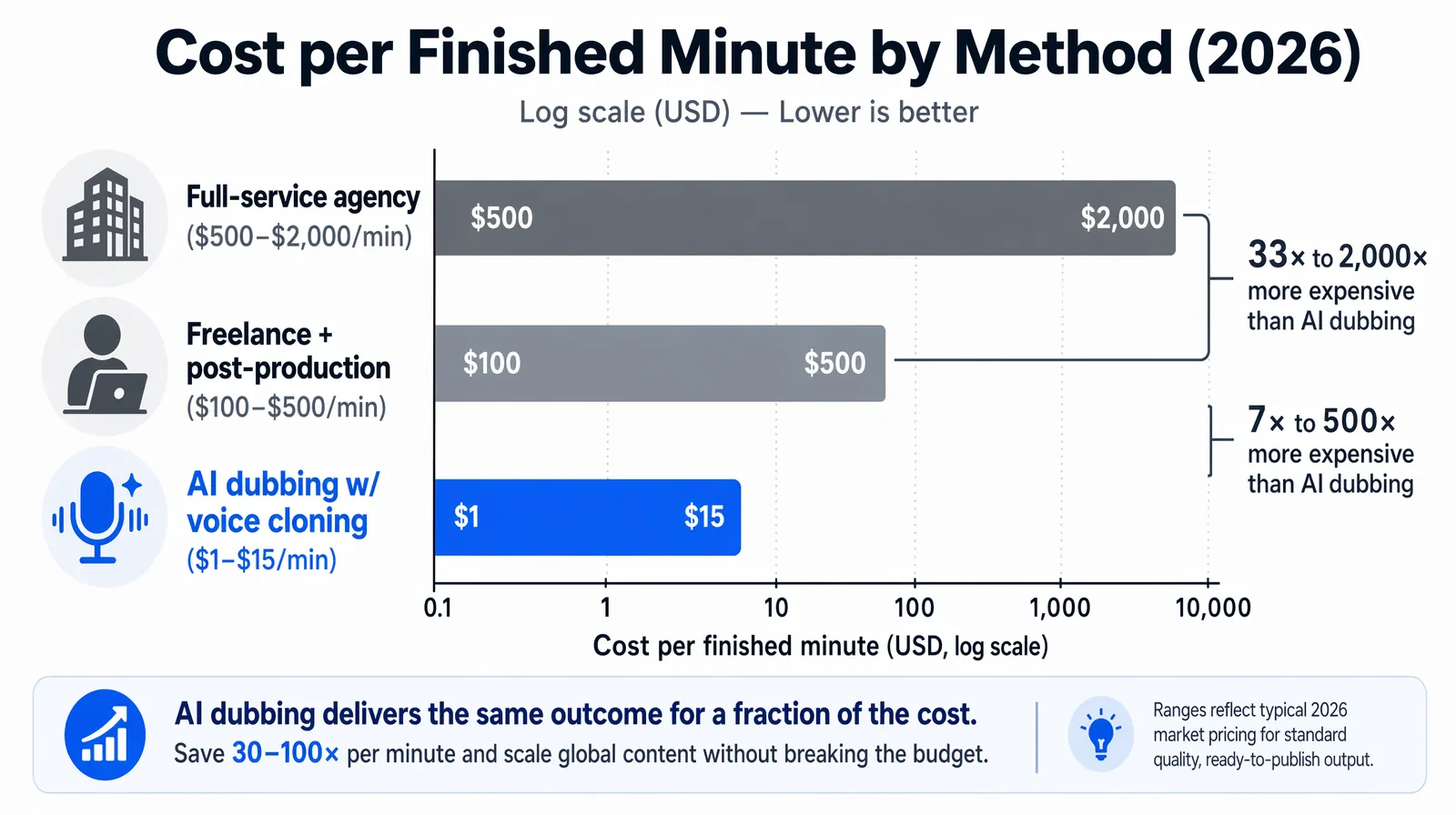
AI dubbing drops per-minute localization costs by 30–100x compared with full-service agencies.
Where to Invest Savings
- More target languages: expanding from 2 to 10+ active markets within the same annual budget.
- More frequent updates: new creative translated within 24 hours.
- Higher-quality native review: redirecting 10–20% of saved budget toward human QA on critical assets.
Strategic Use Cases for Video Localization
1. Advertising and Performance Marketing
How does native-language advertising outperform subtitled ads?
According to Meta's research, native-language video ads achieve 20–30% higher CTR and 15–25% lower CPC compared to subtitled equivalents. Brands can dub top 5 English ad creatives into Spanish, Portuguese, French, and German in a single afternoon — then A/B test across markets. VideoDubber enables this with voice cloning and lip-sync, preserving brand voice identity across every language version.
2. Product Demos and Explainer Videos
Localized product demos reduce purchase funnel drop-off. B2B SaaS companies report 15–30% demo-to-trial conversion improvements in non-English markets within 90 days. A 3-minute demo shown thousands of times monthly generates compounding returns from a single translation. See How SaaS Companies Localize Product Demos.
3. Customer Support and Educational Content
Customer support videos dubbed into non-English languages reduce incoming support ticket volume while improving customer satisfaction scores. Gartner and Zendesk benchmarks suggest localized self-service video content can deflect 25–40% of support tickets in markets where deployed. VideoDubber makes it practical to maintain a fully localized video knowledge base in 10+ languages at per-video cost below $50. See Customer Support Videos: Why Multilingual Dubbing Reduces Tickets for a full ROI breakdown.
4. Corporate Training and Internal Communications
Video training content translated into employees' native languages produces better knowledge retention and compliance scores. The ATD's 2024 report found native-language training reduces time-to-proficiency by 32%.
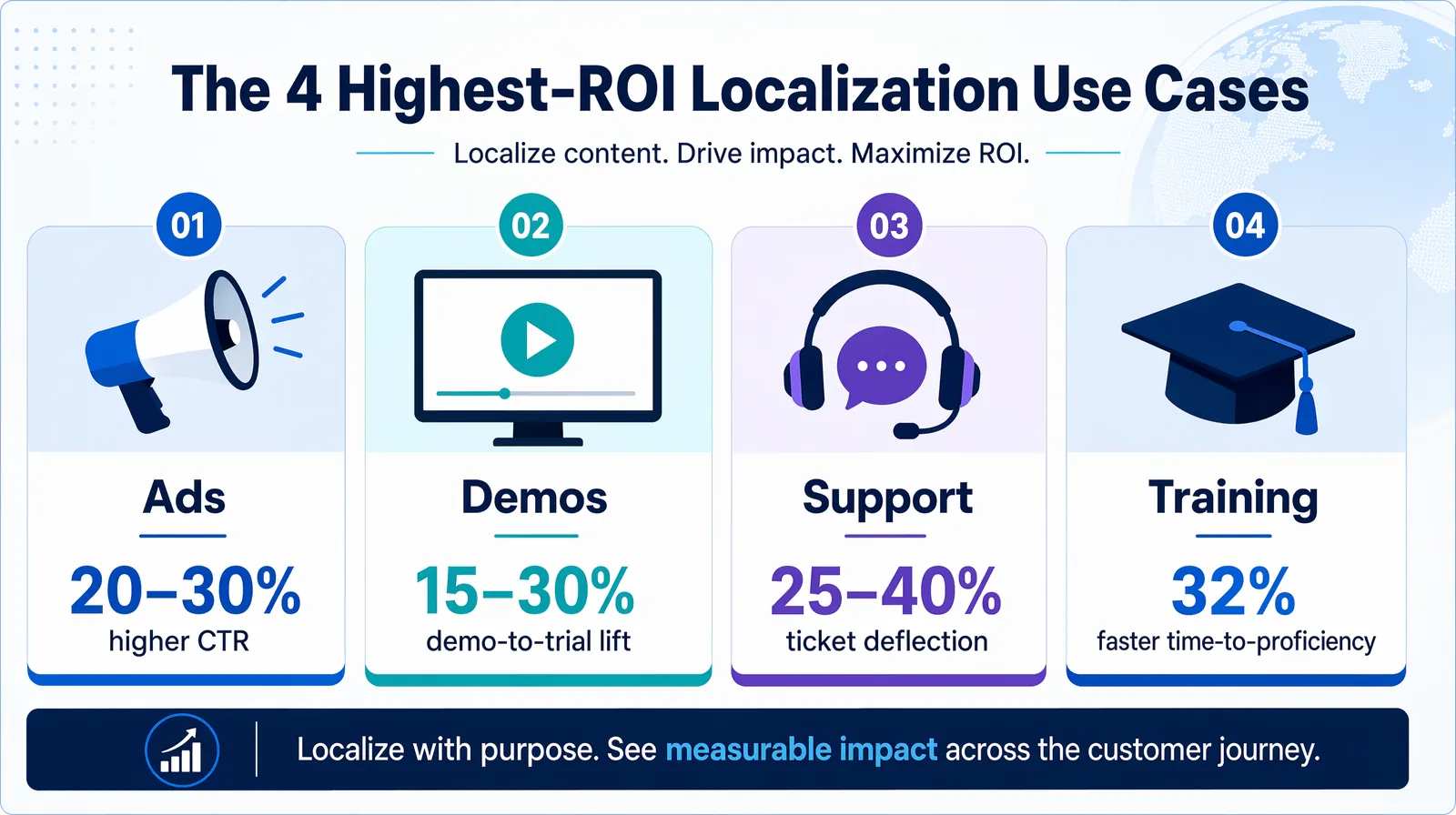
The four highest-ROI video localization use cases for brands expanding globally in 2026.
How AI Video Translation Works for Brands
AI video translation is the technology pipeline that converts a source-language brand video into a target language through automated transcription, neural machine translation, voice synthesis, and lip-sync rendering — preserving the brand's original visual and audio identity.
The Technical Pipeline
- Speech recognition: ASR transcribes original audio, achieving 95%+ accuracy for standard accent and pacing.
- Neural machine translation (NMT): Large language models translate the transcript preserving tone, formatting, and CTA structure — including brand-specific terminology via custom glossary.
- Voice cloning: The speaker's pitch, rhythm, and emotional range are extracted and used to synthesize the translated script with the same voice identity.
- Lip-sync rendering: Generative AI adjusts video frames so mouth movements match the new audio timeline, eliminating visual mismatch.
What Brand Managers Should Know About Quality
AI translation quality depends heavily on source material quality. Brands achieve the best results when source audio is broadcast quality (-14 LUFS or better), speech pace is 120–160 wpm, brand terms are in a custom glossary, and a native reviewer approves customer-facing content. Teams following these standards reduce revision cycles by 60–70%. See How Lip-Sync AI Works in Video Translation.
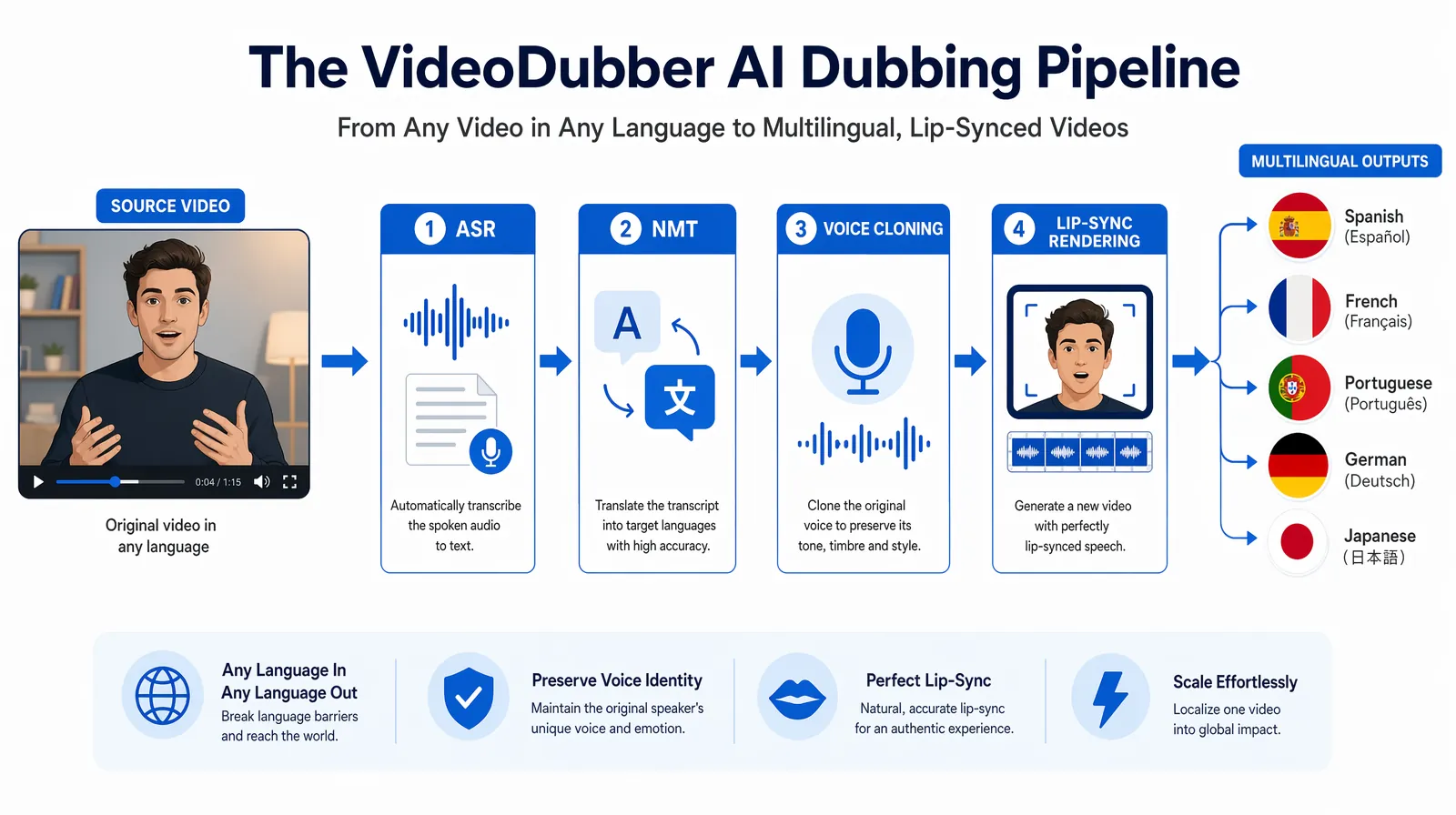
The four-stage AI dubbing pipeline that converts a brand video into dozens of localized versions.
Agency Dubbing vs. AI: Choosing the Right Approach
| Content tier | Description | Recommended approach |
|---|---|---|
| Tier 1: Hero campaigns | Major brand campaigns, TV spots, flagship launches | Full-service agency; AI for initial pass |
| Tier 2: Performance ads | Digital ads, social content, YouTube pre-rolls | AI dubbing — speed and cost matter more than perfection |
| Tier 3: Product and support | Demos, how-tos, onboarding, knowledge base | AI dubbing — high volume, frequent updates |
| Tier 4: Internal content | Training, compliance, all-hands | AI dubbing — no external audience; speed dominates |
For Tier 2–4 content (80–95% of most brands' video libraries), AI dubbing with voice cloning is the superior choice on every dimension except absolute quality ceiling. Reserve agency budgets for Tier 1 assets.
For brands scaling to 5+ languages, VideoDubber handles Tier 2–4 content in one workflow — translating, dubbing, and lip-syncing from a single master upload with per-project glossaries.
How to Execute a Global Video Translation Strategy
Brands that treat localization as a continuous operational workflow consistently outperform those that localize reactively.
Step 1: Audit Your Video Library
Catalog existing video assets across three dimensions: content type (ad, demo, support, training), performance tier (top 20% by views or conversions — proven to resonate and most likely to transfer), and language sensitivity (content with idioms, cultural references, or regulatory claims requiring market-specific adaptation).
Step 2: Choose Your Target Markets
Analyze existing traffic and sales data to identify where language friction costs revenue. The most reliable signal is a gap between non-English traffic and conversion — Brazil generating 8% of traffic but 1% of revenue indicates language friction. This typically reveals 3–5 markets where translation generates immediate revenue impact.
Step 3: Leverage AI for Scale
Upload priority videos to an AI dubbing platform. A 2-minute ad translated into 5 languages takes 15–30 minutes with VideoDubber, supporting voice cloning and lip-sync in 30+ languages with glossary-constrained translation.
Step 4: Quality Assurance
Even with AI accuracy above 90%, brand content requires human review calibrated to tier:
- Critical assets (hero campaigns, demos): full review by a native-speaking brand team member evaluating tone, cultural fit, and brand voice.
- Performance assets (digital ads, social): spot-check 2–3 segments per video for brand name pronunciation, product terms, and CTA clarity.
- Support and training content: single pass by a market-familiar employee or freelancer.
Step 5: Distribute with Localized Metadata
For every translated video, also translate: title and headline, description and long-form copy, tags and categories, and thumbnail text. This generates ongoing organic discovery that subtitled-video-with-English-metadata cannot achieve.
Step 6: Measure and Iterate
Track performance per language version against your English baseline (see Measuring the ROI of Global Video Translation). Monthly reviews identify top markets 3× faster than quarterly cycles.
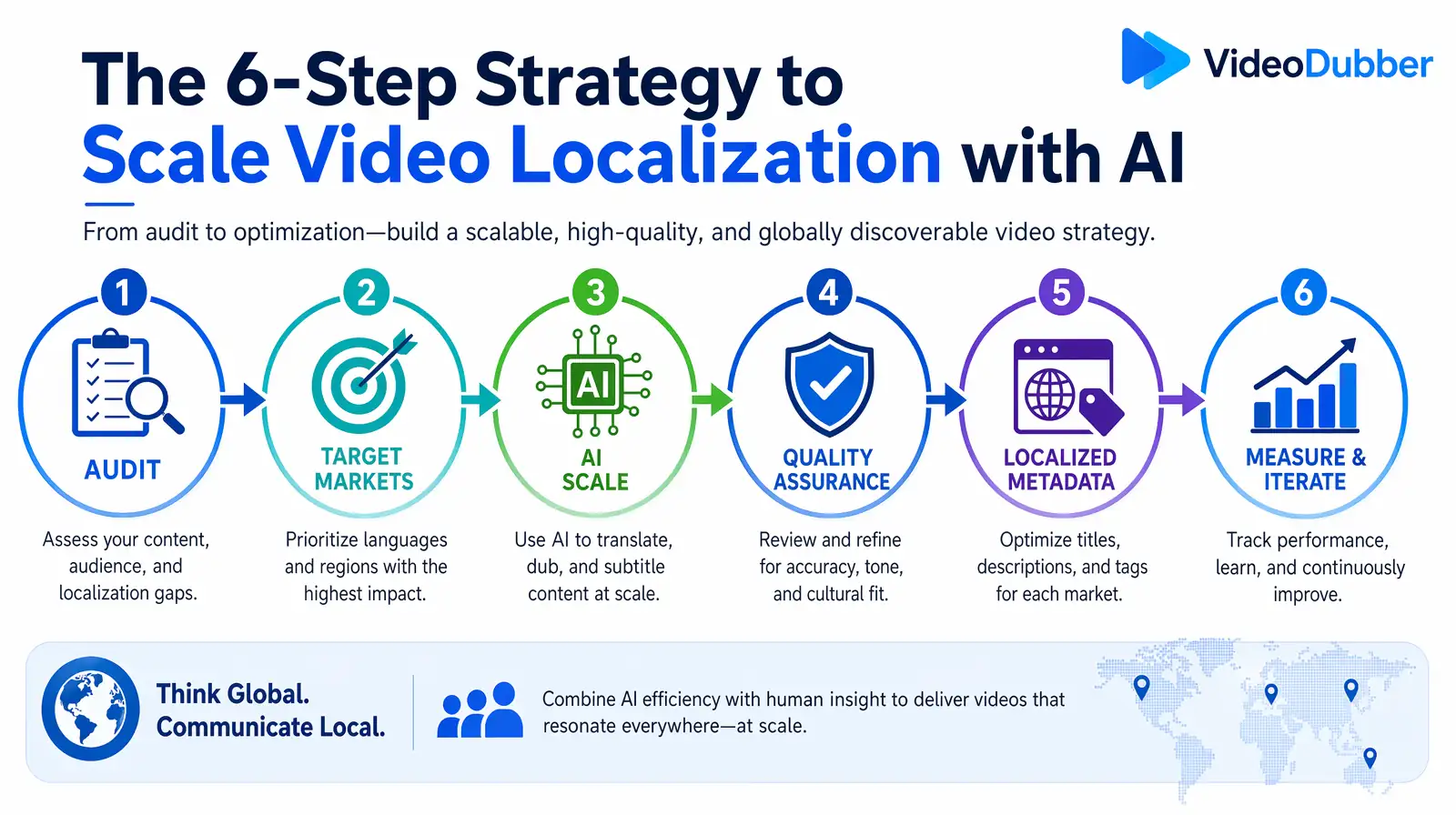
The six operational steps that separate brands with scalable localization from those that localize reactively.
Which Markets Deliver the Highest Video ROI?
The following framework applies broadly to consumer and B2B brands entering non-English geographies in 2026.
Tier 1 Markets: Immediate High-ROI Opportunities
| Market | Language | Why it's high-ROI |
|---|---|---|
| Latin America (Mexico, Colombia, Argentina) | Spanish | 500M+ speakers, rapidly growing digital commerce, strong brand loyalty to localized content |
| Brazil | Portuguese (BR) | Largest economy in South America; social media engagement 2–3× higher in native language |
| India | Hindi + regional languages | World's fastest-growing digital market; English literacy varies widely by tier and geography |
| France, Belgium, West Africa | French | High-income European market + 300M francophone global audience across 5 continents |
| DACH region | German | Highest GDP per capita in Europe; strong B2B market for SaaS and manufacturing categories |
Tier 2 Markets: High Growth, Lower Current Competition
| Market | Language | Opportunity |
|---|---|---|
| Southeast Asia | Indonesian, Thai, Vietnamese | 650M+ population, rapid mobile commerce growth, minimal localized brand content from global competitors |
| MENA | Arabic (Modern Standard + regional) | Significantly underserved in quality localized brand content; high engagement with video formats |
| East Asia | Japanese, Korean | Premium markets with high willingness to pay; strong cultural preference for native-language content |
Most brands discover their highest-ROI non-English market is already visible in existing web analytics — Brazil or Mexico generating substantial traffic with below-average conversion rates is a clear signal of language friction. Tier 2 markets represent greenfield opportunity where early localization establishes a competitive moat.
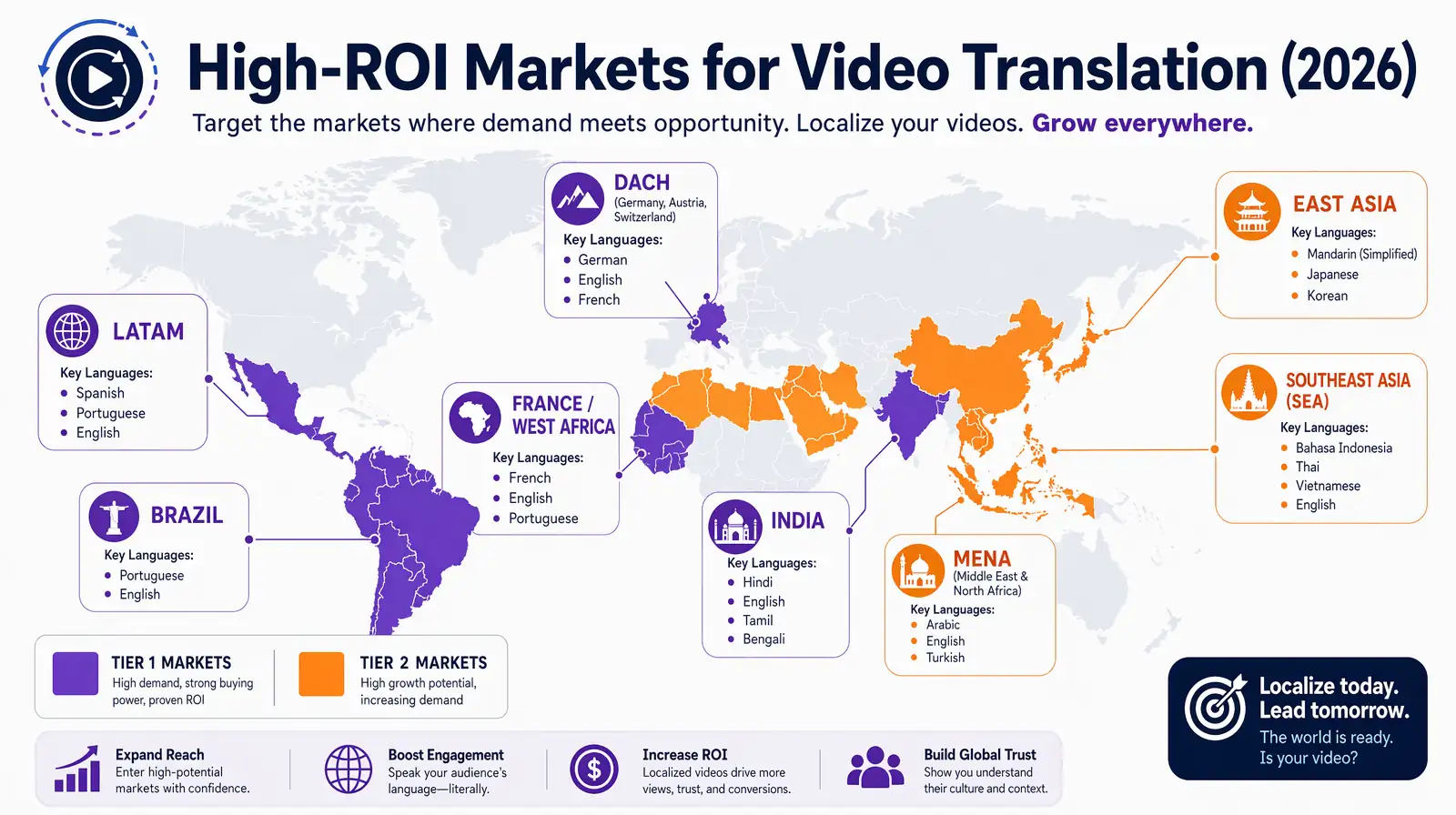
Tier 1 and Tier 2 markets ranked by video-translation ROI for consumer and B2B brands.
The "Native" Advantage: Video SEO and Discoverability
How Local-Language Video Wins in Search
Multilingual metadata (translated title, description, tags) allows your video to rank for local-language queries on YouTube, Google, Yandex, and Baidu. A video titled "Python para Iniciantes" competes in a far less crowded results page than the English equivalent. YouTube's algorithm prioritizes content in the viewer's preferred language, recommending dubbed video with localized metadata to matching speakers automatically.
YouTube-Specific Advantages
YouTube internally reports that multi-language audio videos receive algorithm boosts in matching regions. Channels adding multi-language audio tracks report 20–40% increases in subscriber growth from non-English regions within 6 months (YouTube Creator Academy data). For a step-by-step guide, see How to Add Multilingual Audio Tracks to a Video.
Common Mistakes in Brand Video Localization
| Mistake | Impact | How to avoid |
|---|---|---|
| Translating idioms literally | Confusing or offensive copy in target language | Build a cultural review step into QA; flag idioms pre-translation |
| Keeping English-language metadata | Zero SEO benefit from translated video | Always translate titles, descriptions, tags, and thumbnail text |
| Using generic TTS voice instead of voice clone | Brand voice identity lost; lower audience trust | Enable voice clone mode in your dubbing platform |
| Skipping QA on critical assets | Brand or accuracy errors in customer-facing content | Mandatory human review pass for Tier 1–2 content |
| Translating only the audio, not on-screen text | Mixed-language experience undermines market credibility | Include on-screen text localization in project scope |
| Launching all languages simultaneously before testing | Budget committed before market validation | Pilot one language per content tier; validate before full rollout |
Measuring the ROI of Global Video Translation
Core Metrics by Content Type
| Content type | Primary metric | Secondary metric |
|---|---|---|
| Advertising | Conversion rate by language version | Cost per acquisition vs. English baseline |
| Product demos | Demo-to-trial conversion rate | Time-on-page / video completion rate |
| Support content | Ticket deflection by language | CSAT score by locale |
| YouTube content | Watch time by language | Subscriber growth by geography |
| Training | Post-training assessment scores | Completion rate by language |
Industry benchmark: Brands that fully localize their top-10 video assets into 3 target languages typically see 15–40% revenue growth in those markets within 6–12 months (Common Sense Advisory).
Setting Up Attribution Correctly
Measuring video translation ROI requires isolating the localization effect — launch translated content in one market while holding a comparable market at English-only as control. UTM parameters on localized video links with language-segmented GA4 views allow full-funnel tracking from localized video view to conversion.
Frequently Asked Questions
How long does it take to translate a brand video into multiple languages?
Using AI dubbing platforms like VideoDubber, a 2-minute brand video can be translated, dubbed, and lip-synced into 5 target languages within 30–60 minutes. Add 30–60 minutes per language for human review on critical content. Traditional agencies take 4–12 weeks.
Is AI-dubbed video good enough for premium brand campaigns?
AI dubbing quality is sufficient for digital advertising, product demos, social media, and support content — 80–95% of most brands' video libraries. For hero brand campaigns, a hybrid approach works: use AI for an initial pass and agency post-production for final polish. The AI pass alone cuts agency costs by 40–60% on premium assets because the agency starts from a near-complete translation.
Does video translation affect my brand voice?
Voice cloning in AI dubbing preserves the original speaker's pitch, cadence, and emotional range in the target language — the dubbed video sounds like the same person speaking the local language natively. Without voice cloning, generic TTS voices lack personality and feel uncanny to audiences. Always enable voice cloning for external, customer-facing brand content.
Which languages should a B2B SaaS brand prioritize for video translation?
Prioritize languages aligned with highest-traffic, lowest-conversion non-English markets — that gap reflects language friction. Common first choices: German (DACH enterprise), French (France/Belgium), Spanish (LATAM mid-market), and Japanese (Japan enterprise).
How do I maintain brand consistency across 10+ language versions?
Use a custom glossary and brand style guide per target language, uploaded to your AI platform before translation. The glossary should specify: product name pronunciations, tagline translations (or "do not translate" flags), tone register per market (German/Japanese audiences expect formal; Brazilian Portuguese allows informal), and culturally sensitive terms. VideoDubber supports per-project glossaries that reduce post-translation corrections by 50–70%.
Can I update a translated video when the source content changes?
AI dubbing makes updates fast and cheap. When source video changes (UI update, new pricing, revised compliance messaging), re-upload the updated master and generate new language versions in hours. This update speed is particularly valuable for B2B SaaS with frequent product releases — often cited as the primary reason organizations switch from agency-based to AI localization workflows.
Does localizing video content improve paid advertising performance?
Native-language ads consistently outperform subtitled ads. CTR, VTR, and conversion rate are all measurably higher when ad audio matches the viewer's language. Facebook and Google reward higher engagement with lower CPMs — localized ads achieve 15–25% lower cost-per-acquisition within 30–60 days against English equivalents targeting non-English audiences.
What is the minimum viable video library for a global launch?
Localize your top 5–10 performing videos into your highest-priority language first. This typically includes: one hero brand video, two to three product demos, and one to two support/FAQ videos — covering awareness, consideration, and retention stages. VideoDubber supports batch processing to translate the full launch set simultaneously.
Summary: Building a Global Brand Through Video Translation
- Video translation for global brand expansion gives English-only brands immediate access to the 83% of the world that thinks, searches, and buys in non-English languages.
- AI dubbing reduces cost 30–100× compared to agencies while delivering quality sufficient for 80–95% of brand content use cases.
- Prioritize strategically: performance ads, product demos, and support content deliver the fastest measurable ROI.
- Voice cloning is non-negotiable for preserving brand identity — generic TTS voices undermine trust.
- Localize metadata alongside video: translated titles, descriptions, and tags generate compounding SEO and algorithmic discovery benefits.
- Measure by market: track conversion rate, watch time, and ticket deflection per language version to concentrate investment where data confirms performance.
Global expansion no longer requires local offices or massive production budgets — it requires a smart content strategy, systematic localization workflow, and AI tools to execute at scale.
Further Reading
How to Use GPT-5.2 for Video Translation [2026 Guide]
How to use GPT-5.2 for video translation in VideoDubber: step-by-step, model comparison, context box tips, cost guide, and best practices for European languages. 2026.
How to Use Gemini for Video Translation [2026 Guide]
How to use Gemini for video translation: complete 2026 guide. Step-by-step in VideoDubber, Asian-language strength (Japanese, Korean, Hindi), multimodal context, and when to pick Gemini vs GPT or DeepSeek.
How Accurate Is AI Video Translation? Benchmarks, Data & Real Examples (2026)
How accurate is AI video translation in 2026? WER benchmarks, language accuracy tiers, cost data, and real-world examples—complete guide with data.
How Lip-Sync AI Works in Video Translation: Complete Technical Guide [2026]
How lip-sync AI works in video translation: facial landmarks, phonemes, visemes, GAN neural rendering, and tool comparison — complete 2026 technical guide.
How to Change Speaker Voices in Video Translation: Complete Guide [2026]
Change speaker voices in video translation with step-by-step workflows for voice assignment, instant cloning, and Pro+ voice cloning. Full 2026 guide.